

Two months ago, a corporate training director called me in a panic. Their company had just received a formal complaint from the European Works Council about their remote certification program. The issue? Their proctoring software was recording employees' home environments, flagging "suspicious behavior" when kids walked by, and storing biometric data that violated GDPR.
The kicker - they'd already spent $180,000 on the platform, trained 40 administrators, and were midway through certifying 2,400 employees across 12 countries.
This wasn't their first rodeo with assessment security either. They'd tried honor codes (cheating went up 60%), time limits (accessibility complaints rolled in), and browser lockdowns (IT tickets exploded). Nothing worked without creating bigger problems.
What they needed wasn't more surveillance. They needed smarter operational controls.
Why invasive proctoring creates more problems than it solves
Most organizations default to proctoring because it feels comprehensive. Record everything, flag everything, review everything. But this approach breaks down fast in practice.
Take bandwidth requirements. A typical proctored exam needs 2-3 Mbps sustained upload speed. Sounds reasonable until you realize 30% of remote workers share connections with family members streaming, gaming, or working from home. Connection drops across 50 organizations running proctored assessments averaged 12% per session. That's not counting the people who never even attempt the assessment because they know their connection won't handle it.
The privacy angle gets messier. I worked with a healthcare organization that discovered their proctoring vendor was subcontracting video reviews to a third-party in the Philippines. Nothing illegal, but try explaining that to nurses whose home offices were being reviewed by strangers halfway around the world. Trust evaporated overnight.
Then there's the cost structure most vendors hide. Sure, the base platform might be $30 per test-taker. But add in:
-
Administrator training ($5,000-$15,000)
-
IT integration ($10,000-$50,000)
-
Review time (2-5 minutes per flag at $25/hour)
-
Retake coordination ($50-100 per incident)
-
Legal review for privacy compliance ($5,000-$20,000)
A 1,000-person certification program easily hits $75,000-$100,000 in total costs.
The false positive problem might be worse. Modern proctoring flags everything - looking away (checking notes), multiple faces (family member walks by), unusual sounds (doorbell, dog barking). One university I worked with had 8 reviewers spending 30 hours per week reviewing flags from 400 weekly assessments. Actual confirmed cheating incidents? Maybe 2-3 per month.
Building privacy-preserving controls that actually work
The secret isn't catching cheaters - it's making cheating operationally ineffective. This requires thinking about assessment security as a system design problem, not a surveillance problem.
Eliminate assessment bottlenecks.
Evaloly simplifies every step from test design to results analysis, making assessments faster and more reliable.
- Customizable test creation
- Automated grading and analytics
- Secure distribution and proctoring
No credit card required
Start with rotation pools. Instead of one exam everyone takes, create a pool of 150-200 questions that generates unique 50-question assessments. The math works in your favor here. With 200 questions selecting 50, you have 11.4 × 10^47 possible combinations. Even if test-takers share every question they remember, the next person gets a substantially different exam.
A rotation system looks like this operationally:
| Component | Traditional Approach | Rotation Pool Approach |
|---|---|---|
| Question Development | 50 questions total | 200 questions (4x coverage) |
| Test Variations | 1-3 versions | Essentially unlimited |
| Maintenance Schedule | Complete rewrite annually | Add 20-30 questions quarterly |
| Compromise Recovery | Invalidate entire exam | Retire specific questions |
| Development Cost | $5,000-$10,000 | $15,000-$25,000 initial |
The rotation pool costs more upfront but becomes cheaper to maintain. When questions leak (they always do), you retire those specific items without invalidating the entire assessment.
Retire leaked questions immediately rather than reissuing the full exam.
Analytics flags provide another layer without recording anything. Track patterns, not people. For a professional certification body with 15,000 annual test-takers:
-
Response time patterns (answering complex questions in under 3 seconds)
-
Navigation sequences (jumping to question 47, then back to 3, then to 31)
-
Score jumps (failing twice with 40%, then scoring 95%)
-
Answer distribution anomalies (selecting "C" for 80% of answers)
These patterns trigger human review, not automatic failure. You're flagging statistical anomalies for investigation, not accusing anyone of cheating.
The review triggers that work best:
-
Time-based
Complete assessment in less than 20% of median time
-
Pattern-based
Identical wrong answers to 5+ questions with another test-taker
-
Score-based
40+ percentile jump between attempts
-
Navigation-based
Non-sequential progression through 70%+ of questions
Document without accusation. You're building patterns of behavior, not prosecuting crimes.
The operational workflow that makes this sustainable
Most organizations fail here - they design controls without designing workflows to manage them. You need clear escalation paths, not just detection rules.
Level 1 Review (Automated): System flags assessments meeting trigger criteria. No human involvement yet. Typically catches 8-12% of assessments.
Level 2 Review (Administrative): Staff member reviews flagged assessments within 48 hours. They're not making accusations - they're categorizing:
-
Technical issue (offer retake)
-
Unclear pattern (note and proceed)
-
Potential integrity issue (escalate)
About 60% turn out to be technical issues or false positives.
Level 3 Review (Committee): Monthly review of escalated cases by a 3-person committee. They examine:
-
Pattern consistency across multiple assessments
-
Context (disability accommodations, technical issues)
-
Response if contacted
Only about 0.5-1% of total assessments reach this level.
Document without accusation. You're building patterns of behavior, not prosecuting crimes.
A simple escalation workflow looks like this:
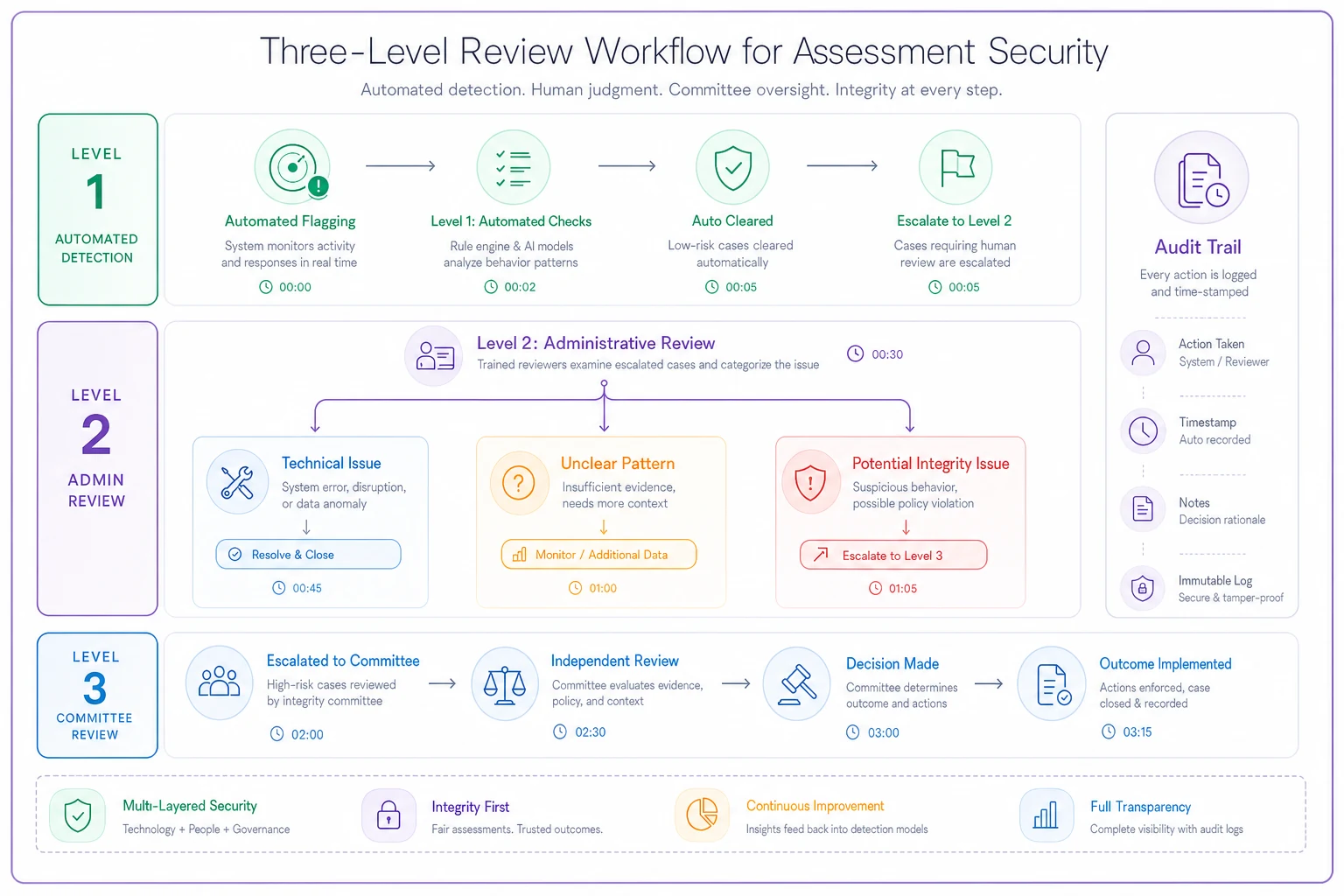
This keeps manual reviews focused.
Real implementation example: 5,000-person certification program
A financial services firm needed to certify 5,000 employees annually on compliance topics. Their previous proctored solution was failing - 30% couldn't complete assessments due to technical issues, privacy complaints were mounting, and costs exceeded $400,000 annually.
Question Pool Development Created 250 questions across 5 competency areas. Each assessment pulled 60 questions with guaranteed coverage of all competencies. Development cost: $35,000.
Analytics Implementation Built detection rules for:
-
Completion time under 8 minutes (median was 35 minutes)
-
Sequential identical answers (5+ in a row)
-
Score improvements over 50 percentile points
-
Pattern matches with other test-takers
Honor Statement Enhancement Required typed acknowledgment: "I understand this assessment is monitored for statistical anomalies and irregular patterns may trigger review of my certification status." Completion went from 500 characters of legal text to one clear sentence. Acknowledgment rate improved from 67% (people clicking through) to 94% (people actually reading).
Human Review Process
-
2 part-time reviewers (10 hours/week each)
-
Review committee meeting monthly (3 hours)
-
Clear escalation criteria documented
-
Response templates for common situations
Results After 6 Months:
-
Completion rate
94% (up from 70%)
-
Technical issues
2% (down from 30%)
-
Privacy complaints
0 (down from 15-20 monthly)
-
Total cost
$120,000 annually (down from $400,000)
-
Suspected integrity issues
8-12 per month, 2-3 confirmed
The confirmed integrity issues were actually easier to address. Instead of "the AI flagged you," conversations started with "we noticed unusual patterns in your assessment data." People were more likely to admit mistakes when confronted with patterns rather than accusations.
Sample detection rules that actually catch problems
Analyzing thousands of assessments reveals certain patterns consistently indicate problems. Here are rules that generate manageable false positive rates while catching real issues:
The Speed Demon Rule
``
IF completiontime < (mediantime * 0.25)
AND score > 70%
THEN flag for review
``
The Perfect Sequential Pattern
``
IF consecutivesameanswer >= 7
AND answer_position != "A"
THEN flag for review
``
The Dramatic Improvement Rule
``
IF (currentscore - previousscore) > 45
AND previous_attempts >= 2
THEN flag for review
``
The Synchronized Swimming Rule
``
IF matchinganswerswithpeer > 85%
AND matchingwronganswers > 5
AND completiontimeswithin10_minutes
THEN flag both for review
``
These rules need tuning based on your assessment type. A rapid-fire knowledge check has different patterns than a scenario-based evaluation.
Audit examples from real implementations
The audit trail matters more than the detection. Effective documentation looks like this:
Example 1: False Positive - Technical Issue
-
Assessment ID
CERT-2024-0847
-
Flag triggered
Completion time (6 minutes vs 35 minute median)
-
Review finding
Test-taker previously completed similar certification, familiar with format
-
Resolution
No action, note added to profile
-
Time to resolution
15 minutes review
Example 2: Confirmed Issue - Answer Sharing
-
Assessment IDs
CERT-2024-0923, CERT-2024-0924
-
Flag triggered
89% matching answers, including 8 identical wrong answers
-
Review finding
Employees in same department, completed within 20 minutes of each other
-
Resolution
Both required to retake with different question sets, department notified
-
Time to resolution
2 hours investigation, 3 days to complete retakes
Example 3: Gray Area - Accommodation Need
-
Assessment ID
CERT-2024-1102
-
Flag triggered
Non-sequential navigation through 90% of questions
-
Review finding
Employee has documented ADHD, jumping between questions is coping strategy
-
Resolution
No action, accommodation note added for future assessments
Time to resolution: 45 minutes including HR consultation
When privacy-preserving controls make sense (and when they don't)
This approach works best for:
-
Internal employee certifications
-
Professional development assessments
-
Compliance training validations
-
Skills verification programs
-
Course completion exams
Where you need high-volume, repeated assessments with moderate stakes. The goal is maintaining standards while respecting privacy and controlling costs.
It's the wrong fit for:
-
High-stakes licensure exams
-
One-time certification with significant career impact
-
Assessments with immediate financial consequences
-
Situations requiring legal-grade proof
-
Programs with known organized cheating rings
For a bar exam or medical boards, you probably need proctoring. For quarterly compliance training, you don't.
The workflow automation opportunity
Managing these controls manually quickly becomes unsustainable. You need systems that can track patterns across time, flag anomalies consistently, and maintain audit trails automatically.
AI-powered operational software changes the game here. Instead of reviewing every assessment, automated systems can monitor pattern development, identify statistical anomalies, and escalate only meaningful variations for human review. The system learns your organization's normal patterns - accounting department typically takes 25-30 minutes, sales takes 35-40 minutes - and flags real deviations.
More importantly, automated workflows handle the mundane parts. When someone triggers a speed flag, the system can automatically check their assessment history, note any previous completions of similar content, and either clear the flag or escalate appropriately. Your reviewers focus on genuine concerns rather than processing false positives.
Operational efficiency comes from centralizing all this data. Instead of spreadsheets tracking retakes, emails coordinating reviews, and separate systems for assessment delivery, everything lives in one platform. When a pattern emerges - maybe several employees from one location suddenly showing unusual response patterns - you spot it immediately rather than months later.
Building assessment security that scales
The hardest part about moving away from invasive proctoring isn't technical - it's cultural. People expect either maximum surveillance or no security at all. The middle path of intelligent controls feels unfamiliar.
Start small. Pick one assessment program, implement basic rotation and analytics, measure the results. When cheating rates stay low while completion rates improve and complaints disappear, expand gradually.
Document everything. Not just the flags and reviews, but the rationale behind your rules. Why 7 sequential answers instead of 5? Why 25% of median time instead of 30%? When someone challenges your process, you need answers based on data, not hunches.
Most importantly, communicate transparently. Tell test-takers exactly what you're monitoring. "We track statistical patterns to ensure assessment integrity" beats vague threats or hidden surveillance. People behave better when they understand the system.
The goal isn't eliminating all cheating - that's impossible without turning your assessment platform into a surveillance state. The goal is making cheating difficult enough that most people won't bother, while catching the egregious cases that undermine your program's credibility.
Privacy-preserving controls deliver that balance. They're operationally sustainable, legally compliant, and effective enough for most assessment programs. They treat test-takers as professionals rather than suspects.
That training director who called me in a panic? Six months later, their certification program runs smoothly with 95% completion rates, zero privacy complaints, and costs down 70%. They catch the problems that matter, ignore the ones that don't, and their employees actually trust the system.
That's what assessment security without proctoring looks like when it works.
Ready to revolutionize your evaluation process?
Join over 2,000 organizations using Evaloly to optimize assessments, improve learner outcomes, and make data-driven decisions.