


Corporate training departments live in this weird space where everyone agrees learning matters, but nobody agrees how to prove it. Last quarter, I watched a tech company's head of talent development scramble through 47 slides trying to justify their $2.4M training budget. She had completion rates, satisfaction scores, test results—everything except what the CFO wanted: proof that any of this moved the business needle.
This disconnect happens everywhere. Educational institutions chase graduation rates while employers complain about skill gaps. HR teams track training hours completed while operations managers wonder why performance hasn't budged. The problem isn't measurement—we're drowning in metrics. The problem is that most assessment strategies start backward, collecting data first and hoping it means something later.
After building operational platforms for training companies and analyzing hundreds of organizations dealing with this exact issue, there's a pattern: successful assessment strategy alignment doesn't start with choosing metrics. It starts with defining what success actually looks like for your specific context, then working backward through a structured decision flow.
The fundamental disconnect breaking most assessment strategies
Most organizations treat assessment like a compliance checkbox. Course completed? Check. Test passed? Check. Certificate issued? Check. Meanwhile, the actual business problems that triggered the training investment persist unchanged.
A mid-sized healthcare company spent $340,000 on customer service training last year. They measured everything—pre and post assessments, module completion times, even follow-up surveys six weeks later. Their training vendor provided beautiful dashboards showing 94% completion rates and average scores improving from 72% to 89%.
Eight months later, their customer complaint rate hadn't moved. Response times stayed flat. The board questioned whether training worked at all. The real issue? They'd never connected their assessment approach to the actual operational problem: inconsistent service delivery across three different office locations operating with different processes.
This happens because assessment strategies typically form in isolation from business operations. L&D designs what to measure. Finance wants different metrics. Operations needs something else entirely. Without a unified decision flow connecting these perspectives, you end up measuring what's easy instead of what matters.
Mapping the assessment decision flow that actually works
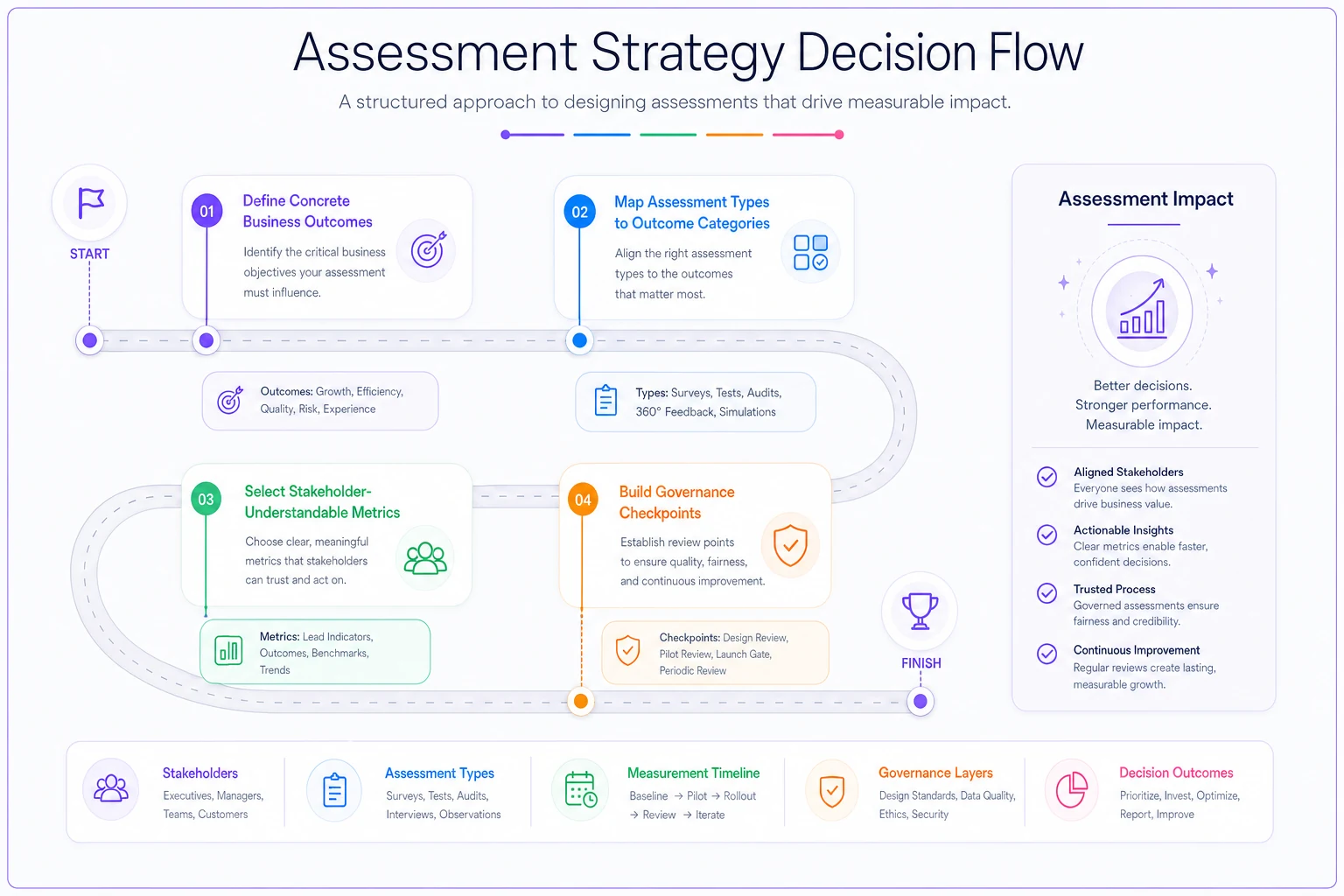
Phase 1: Define concrete outcomes first Stop starting with learning objectives. Start with business outcomes. What specific operational change needs to happen? Not "improve customer service" but "reduce average resolution time from 4.2 days to 2.8 days" or "decrease escalation rate from 18% to under 10%."
Eliminate assessment bottlenecks.
Evaloly simplifies every step from test design to results analysis, making assessments faster and more reliable.
- Customizable test creation
- Automated grading and analytics
- Secure distribution and proctoring
No credit card required
A logistics company struggling with warehouse errors illustrates this perfectly. Their initial training approach focused on "safety awareness" and "procedural knowledge." Once they shifted to outcome-first thinking, they defined success as "reduce mis-picks from 340 per month to under 100" and "eliminate overtime caused by rework." Their entire assessment approach shifted from testing knowledge to measuring actual picking accuracy in real time.
Phase 2: Map assessment types to outcome categories Different outcomes require different assessment approaches. Knowledge outcomes need different measurement than behavior change. Behavior change needs different measurement than business impact.
| Outcome Category | Assessment Type | Measurement Timing | Success Indicators |
|---|---|---|---|
| Knowledge Transfer | Tests, scenarios, case analysis | Immediate + 30 days | Accuracy, retention, application ability |
| Skill Development | Performance tasks, simulations | During + 60 days post | Task completion, quality scores, speed |
| Behavior Change | Observation, workflow tracking | 30-90 days post | Frequency of target behaviors, consistency |
| Business Impact | Operational metrics, KPI tracking | 90-180 days post | Revenue, efficiency, quality metrics |
Most organizations make the mistake of using knowledge assessments to predict business impact. A call center might test product knowledge extensively, but if the real problem is inconsistent follow-up processes, those test scores won't correlate with customer retention improvements.
Phase 3: Select metrics that stakeholders actually understand Technical accuracy means nothing if stakeholders can't connect it to value. A pharmaceutical company's training team proudly reported that their new compliance program achieved "Level 3 Kirkpatrick evaluation scores averaging 4.2/5." The board's response: blank stares and budget questions. Transform assessment metrics into business language:
-
Instead of "85% passed the assessment" → "85% can now handle complex cases without escalation"
-
Instead of "4.5/5 satisfaction score" → "Managers report 30% less time spent on corrections"
-
Instead of "70% behavior transfer rate" → "$4,200 saved per employee from reduced errors"
Phase 4: Build governance checkpoints that prevent drift Assessment strategies fail when nobody owns the connection between measurement and outcomes. Create specific review points:
30-day checkpoint: Are we collecting the right data? Early indicators tracking as expected? 60-day checkpoint: Is behavior actually changing? Any unexpected barriers? 90-day checkpoint: Are business metrics moving? Need strategy adjustment? 120-day checkpoint: ROI calculation possible? Scale or modify?
A retail chain implemented this checkpoint system for their inventory management training. At 30 days, completion looked good but error rates hadn't budged. Investigation revealed trained employees were being scheduled in departments where they couldn't apply new skills. Rapid adjustment of scheduling practices turned a potential failure into a 22% reduction in shrinkage within four months.
A visual of the decision flow helps teams follow the sequence without skipping steps.
The automation also handles the tedious checkpoint scheduling, stakeholder reporting, and metric calculation that typically gets dropped when teams get busy. When your 60-day behavior assessment checkpoint arrives, the system already has the data compiled, anomalies flagged, and recommendations prepared.
The stakeholder ROI statement template that gets buy-in
Generic ROI promises kill credibility. "This training will improve performance" means nothing. Stakeholders need specific, measurable commitments tied to their priorities.
For Operations Leaders: "This [specific training intervention] will reduce [specific operational problem] from [current baseline metric] to [target metric] within [timeframe], measurable through [specific assessment method]. Expected operational value: [calculated estimate based on current costs]." Example: "This workflow optimization training will reduce order processing errors from roughly 8% to under 3% within 90 days, measurable through our existing quality audit system. Expected operational value: $67,000 annually from reduced rework and customer credits."
For Financial Stakeholders: "Investment of [training cost] targets [specific cost reduction or revenue increase] through [mechanism of change], validated by [assessment approach]. Break-even point: [specific timeframe]. Total expected return: [conservative estimate] to [optimistic estimate] based on [comparable examples or pilots]."
For HR/Talent Leaders: "This initiative addresses [specific talent gap] affecting [number] of employees, reducing [specific HR metric] from [baseline] to [target]. Assessment through [method] provides ongoing talent development data for [future use cases]." The key: make commitments you can actually measure through your assessment strategy. Don't promise what you can't prove.
Building assessment matrices that connect everything
Most organizations track training metrics in isolation from operational data. Your LMS shows completion rates. Your operations dashboard shows performance. Your financial system shows costs. Nobody connects them systematically.
The solution requires what I call an Assessment-to-Impact Matrix—a living document that maps every assessment point to its corresponding business metric:
| Assessment Component | Data Source | Business Metric | Correlation Method | Review Frequency |
|---|---|---|---|---|
| Module completion rate | LMS | Time to competency | Cohort comparison | Weekly during rollout |
| Skills assessment score | Testing platform | Task accuracy | Regression analysis | Monthly |
| Manager observation rating | Performance system | Quality scores | Direct correlation | Quarterly |
| Behavior checklist adherence | Workflow software | Process efficiency | Pre/post analysis | Monthly |
| Knowledge retention test | LMS | Error reduction | Trend correlation | Quarterly |
A manufacturing company built this matrix for their equipment operator certification program. Within three months, they identified that simulation scores above 85% correlated with 94% first-time quality pass rates, while scores between 70-84% only achieved 71% quality pass rates. This insight let them adjust pass thresholds and add targeted remediation, saving approximately $180,000 annually in rework costs.
Start by linking each assessment component to a single priority business metric before expanding to multiple correlations.
This lets you prove impact quickly and iterate on what matters most.
Where automation transforms assessment from burden to advantage
Manual assessment tracking breaks down at scale. When you're managing training for 50 employees, spreadsheets work. At 500, you need systems. At 5,000, you need automation or assessment becomes a full-time job for multiple people.
Modern operational platforms can automatically connect learning data with business metrics, eliminating the manual correlation work that kills most assessment strategies. Instead of someone spending weeks building reports to prove training impact, AI-powered systems continuously analyze the relationships between assessment results and operational outcomes.
A distribution company integrated their training platform with their warehouse management system through an operational automation platform. The system now automatically tracks when employees complete forklift safety modules and correlates that with incident rates, productivity metrics, and equipment damage costs. What used to require quarterly manual analysis now updates in real-time, flagging when assessment scores predict operational issues before they occur.
This isn't about replacing human judgment—it's about freeing humans from data drudgery so they can focus on interpreting insights and adjusting strategy. The head of training spends time improving programs based on clear impact data rather than hunting for proof that training matters.
Common failure patterns in assessment strategy execution
Even with perfect planning, assessment strategies fail in predictable ways. Recognizing these patterns early prevents waste and frustration.
The Correlation-Causation Trap A financial services firm noticed their top performers all scored above 90% on product knowledge assessments. They mandated everyone achieve 90%+ scores. Performance didn't improve. Why? Top performers were already motivated high achievers—the test scores were an effect, not a cause, of their success. Fix: Always run controlled comparisons. If possible, pilot with a subset before rolling out broadly. Track confounding variables like experience, role, and prior performance.
The Measurement Theater Problem Organizations often measure what looks good rather than what matters. A software company tracked "hours of technical training completed" because it was easy to measure and showed impressive numbers to leadership. Meanwhile, their actual problem—slow feature adoption by customers—persisted because the training focused on features customers didn't need. Fix: Start with the business problem, not the available metrics. If you can't draw a straight line from your assessment to a business outcome, you're measuring the wrong thing.
The Timeline Mismatch Expecting immediate business impact from training sets everyone up for disappointment. Skills take time to develop. Behaviors take longer to change. Business metrics take even longer to shift. A sales organization expected revenue increases within 30 days of negotiation training. When results didn't materialize quickly, they declared training ineffective. Six months later, deal sizes had increased 18% and close rates improved 12%—but by then, nobody connected it to the training. Fix: Set realistic timelines based on outcome type. Knowledge might transfer in days, but business impact typically takes 60-120 days minimum to become measurable.
Creating decision flows for different organizational contexts
Not every organization needs the same assessment complexity. Your decision flow should match your context, resources, and maturity level.
For Small Organizations (Under 100 learners):
-
Pick ONE business metric that must improve
-
Choose ONE behavior that drives that metric
-
Assess whether the behavior is happening (not whether people know how)
-
Check the business metric monthly
-
Adjust training based on what you observe
Keep it simple. A small accounting firm wanted to reduce client documentation errors. They tracked one thing: percentage of returns filed without amendments needed. When that number improved from 82% to 94% after process training, they had their ROI story.
For Growing Organizations (100-1,000 learners):
-
Define 3-5 key business outcomes
-
Map each to 2-3 observable behaviors
-
Create simple rubrics for behavior assessment
-
Establish monthly review rhythm
-
Build basic correlation tracking
-
Report quarterly to stakeholders
For Large Organizations (1,000+ learners):
-
Segment outcomes by business unit/role
-
Create assessment taxonomies by competency
-
Implement automated data collection
-
Establish predictive indicator models
-
Create real-time dashboards
-
Run continuous correlation analysis
-
Adjust strategies based on segment performance
Not every organization needs every step. Match complexity to capacity and scale up as you prove impact.
Making the ROI conversation less painful
The dreaded ROI conversation becomes manageable when you've built your assessment strategy correctly from the start. Instead of scrambling to justify past spending, you're presenting clear connections between specific interventions and measured outcomes.
A technology company's learning team used to dread quarterly business reviews. They'd spend weeks preparing defensive presentations about completion rates and satisfaction scores. After implementing a structured assessment decision flow, their presentations transformed. They now open with: "Here's the $1.3M operations problem we targeted. Here's how we measured it. Here's what changed. Here's what we learned for next quarter."
The CFO stopped questioning their budget. Operations started requesting more training partnerships. The shift came from changing the conversation from "prove training works" to "here's how training solved this specific problem."
Stakeholders don't actually care about assessment strategy. They care about results. Your assessment approach is just the mechanism for proving you delivered what you promised. When every assessment connects directly to a business outcome through a clear decision flow, ROI conversations become progress reports rather than justification sessions.
The path forward: building your assessment decision flow
Start tomorrow with one program. Pick your highest-visibility training initiative and map it through this decision flow:
-
What specific business outcome must improve? (Get a number, not a concept)
-
What observable behaviors drive that outcome?
-
How will you measure those behaviors changing?
-
When will you check for business impact?
-
Who needs to see what data when?
-
How will you automate the tedious parts?
Don't try to transform your entire assessment approach overnight. Build one complete decision flow, prove it works, then expand. Each successful connection between training and business outcomes makes the next one easier to design and sell.
The organizations getting this right aren't necessarily spending more on training or using fancier assessment tools. They're just being systematic about connecting learning interventions to business problems through carefully designed assessment strategies. They measure what matters, not what's easy. They speak stakeholder language, not learning jargon. And increasingly, they're using operational automation to handle the complex data integration that makes true assessment strategy alignment possible at scale.
Your training programs probably create more value than you can currently prove. The right assessment decision flow doesn't just measure that value—it amplifies it by focusing effort where impact is highest. Stop measuring everything. Start measuring what moves your business forward.
Ready to revolutionize your evaluation process?
Join over 2,000 organizations using Evaloly to optimize assessments, improve learner outcomes, and make data-driven decisions.