

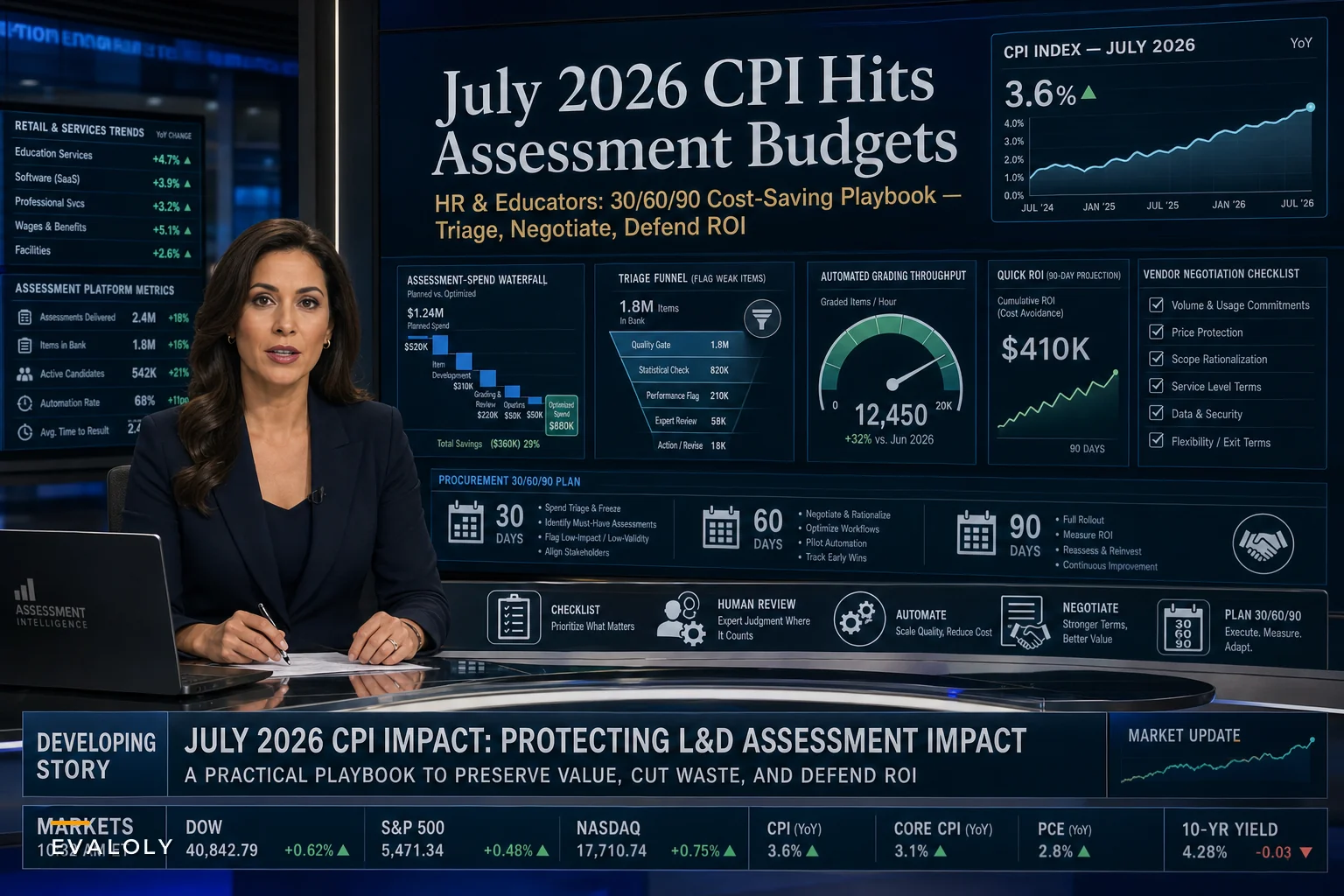

The July 2026 CPI print landed softer than most people expected. Consumer prices rose just 0.1% for the month, annual inflation eased to 3.4% from 3.5%, and core measures cooled too — the kind of number that looks reassuring in a headline. As the BLS release framed it, price growth is moderating. Reuters tied the slowdown partly to easing gasoline prices. But a cooling CPI doesn't actually make your budget conversation easier. If anything, it usually makes it harder. When inflation is screaming, finance tends to hold budgets flat and wait it out. When it moderates, they see an opening to reallocate — and L&D and assessment lines are almost always among the first places they go looking. "Inflation is under control" quietly becomes "so why did your measurement spend go up?" If you run assessment programs — certification exams, hiring screens, internal competency checks — this is the moment to get ahead of that conversation, not react to it in Q4.
Why assessment budgets get targeted first (and why the timing hurts)
L&D assessment budgets sit in an awkward spot. They're operationally critical but rarely tied to a revenue number a CFO can point at in a board deck. Training at least gets credit for "developing people." Assessment gets treated as overhead — the thing you do after the training, the cost of proving something worked.
That perception is the real problem, and a softening CPI just accelerates it. When macro pressure eases slightly, the internal narrative shifts from "protect everything" to "optimize spend." And optimization almost always starts with the lines nobody can defend in one sentence.
Worth noting: the programs that survive budget cuts aren't the ones with the best psychometrics. They're the ones where the owner can walk into a meeting and say, plainly, "this assessment prevents X bad hires per year" or "this cert reduces our compliance exposure by Y." The technically excellent program with no ROI story gets trimmed. The mediocre program with a clean impact narrative survives. That's not fair, but it's how the room works.
Start by separating "assessment cost" from "assessment waste"
Before you cut anything, figure out what's actually costing money versus what's just visible. Those are different things, and finance rarely distinguishes between them.
Eliminate assessment bottlenecks.
Evaloly simplifies every step from test design to results analysis, making assessments faster and more reliable.
- Customizable test creation
- Automated grading and analytics
- Secure distribution and proctoring
No credit card required
-
Load-bearing cost — the stuff that, if you remove it, the assessment stops being defensible (item development, review cycles, basic security)
-
Convenience cost — spend that saves staff time but isn't essential to validity (premium proctoring tiers, redundant tooling, over-scoped vendor contracts)
-
Legacy drift — money quietly leaking into things nobody remembers approving (unused seat licenses, duplicate platforms, exams that run out of habit)
The biggest savings almost never come from cutting load-bearing cost. They come from finding legacy drift. A common example: a mid-sized training org running two separate assessment platforms because two teams onboarded independently a few years back, paying somewhere in the $18k–$22k range in overlapping licenses nobody ever consolidated. That's not a psychometric decision. It's an operational cleanup that funds half your next project.
The mistake is going straight to the load-bearing stuff because it's the most visible line item. You end up weakening the thing that made the program credible while the actual waste keeps running in the background.
A quick triage for what to protect, defer, or cut
When a reallocation memo shows up, you don't have weeks to model this out. You need a fast, defensible sort.
| Category | Protect | Defer | Cut |
|---|---|---|---|
| High-stakes exams (certification, compliance) | Core item bank, review cycles, security controls | Cosmetic redesigns, new format experiments | Redundant proctoring tiers |
| Hiring assessments | Validity evidence, scoring logic | New role expansions | Nice-to-have integrations |
| Internal competency checks | Anything tied to a real decision | Assessments run "for visibility" | Duplicate tools, unused seats |
| Reporting/analytics | Stakeholder-facing impact reports | Deep-dive research projects | Vanity dashboards nobody opens |
The column that saves the most money isn't "Cut" — it's "Defer." Deferring a redesign or a new-role rollout buys you a full budget cycle without touching anything that affects defensibility. Cutting feels decisive; deferring is usually smarter.
Where automation actually earns its keep under a tight budget
"Use AI to save money" is exactly the kind of hand-wave that gets people buying tools they don't need. So it's worth being specific about where it genuinely reduces cost versus where it's just shiny.
The real cost in most assessment programs isn't the technology — it's human hours spent on repetitive, low-judgment work. Reviewing near-duplicate items. Re-tagging content for a new report. Manually pulling exam stats every quarter. Chasing item-writers for status updates. None of that requires expert judgment, but all of it eats the time of people who should be doing expert judgment.
AI-assisted operational platforms help here mostly by absorbing that repetitive layer, so limited staff hours go toward decisions that actually need a human. A few practical spots where that shows up:
-
Item triage — flagging weak or drifting questions automatically so reviewers only look at the ones that matter, instead of scanning the whole bank
-
Metadata and tagging — auto-suggesting competency tags so content stays report-ready without manual re-tagging every cycle
-
Routine reporting — assembling recurring stat pulls so your team isn't rebuilding the same spreadsheet every month
Prioritize automating item triage and tagging before investing in broad platform features—those yield the fastest staff-hour savings.
When this makes sense — and when it doesn't
Automation earns its keep when you have high volume and repetitive work — lots of items, frequent reporting, recurring maintenance. If you run two exams a year with 40 items each, a spreadsheet and a careful reviewer are probably fine, and any additional tool spend is just adding another line for finance to question.
It's a bad fit when you're using automation to paper over a validity problem. If your items are weak, faster processing just produces bad results faster. Fix the content first. Speed on top of a broken item bank is negative value, and finance will eventually notice the outcomes don't hold up.
Here's a simple workflow to visualize how automation handles repetitive tasks and frees experts for high-value review.
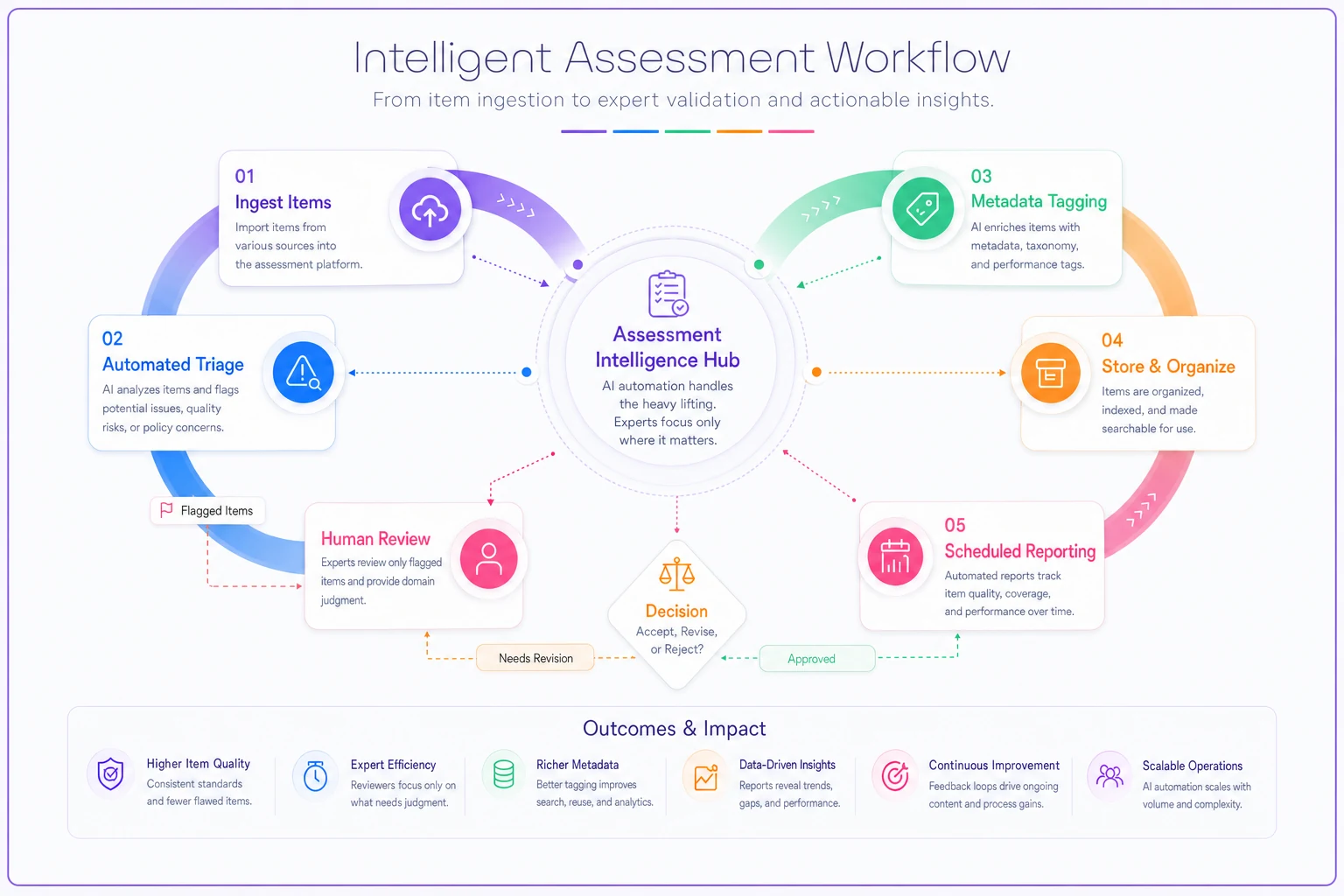
The point isn't to replace measurement expertise. It's to stop spending scarce, expensive human hours on the parts that don't need it — which is what lets a lean program survive a budget squeeze without losing credibility.
A real scenario: a certification program that had to cut 20%
A small professional certification body — four staff, two exams, a few thousand candidates a year — was told to trim their assessment line by roughly 20%, somewhere in the $60k–$70k range.
Their first instinct was to cut a reviewer role, which would have gutted the thing that made the exams defensible. Instead they ran the triage above and found three things:
-
Two overlapping platforms, one of which could be sunset — around $16k/year recovered
-
A premium proctoring tier they'd never actually needed at their scale — another ~$9k
-
Roughly a third of reviewer time spent on manual item flagging and quarterly stat pulls, which they shifted to an assisted workflow
They hit the 20% target without cutting a single person or weakening review depth. The reviewer who'd been spending chunks of each week on manual triage shifted to actually improving weak items — which, over the next cycle, is arguably worth more than the money saved.
The lesson isn't "automate everything." It's that the budget pressure became the forcing function that made them audit spend they'd been quietly ignoring for years.
Fix the ROI story before finance writes it for you
Everything above buys you time. But the deeper problem — the one that keeps assessment on the chopping block every cycle — is that most programs can't clearly connect what they measure to a decision the organization actually cares about.
If your assessment produces a score that goes into a file, it's overhead. If it produces a score that changes who gets hired, promoted, certified, or flagged for retraining, it's operational infrastructure. Same data, completely different budget conversation. The difference is entirely in whether you've mapped the assessment to a real decision and can say so plainly.
This is worth doing before the next budget cycle, not during it. Walking through how learning goals translate into measurable outcomes is exactly the exercise that turns "nice to have" into "load-bearing" in a CFO's mental model — and we laid out a full approach for that in turning learning goals into measurable ROI. If you do one strategic thing this quarter, that's it.
A short checklist to run this month
Before the reallocation conversation reaches you:
-
[ ] Inventory every assessment tool and license — flag anything overlapping or unused
-
[ ] Sort your spend into load-bearing, convenience, and legacy drift
-
[ ] Identify at least one deferrable project that buys a full budget cycle
-
[ ] Map each active assessment to a specific decision it drives
-
[ ] Write a one-sentence impact statement for each program (if you can't, that program is at risk)
-
[ ] Pull the top recurring manual tasks eating reviewer hours and ask whether they actually need a human
Before the reallocation conversation reaches you:
Bottom line
A cooling CPI is quietly more dangerous to your budget than a hot one, because it hands finance a reason to reallocate rather than protect. The programs that come through intact aren't the ones that spent the most or measured the most precisely — they're the ones that could cut waste without touching what made them credible, and could explain in one sentence why they matter.
Do the boring audit now. Find the drift, defer the cosmetic work, protect the validity, and make sure every assessment you run is tied to a decision someone actually cares about. That's a far better position than scrambling to justify yourself after the cut has already been decided.
Do the boring audit now. Find the drift, defer the cosmetic work, protect the validity, and make sure every assessment you run is tied to a decision someone actually cares about. That's a far better position than scrambling to justify yourself after the cut has already been decided.
Ready to revolutionize your evaluation process?
Join over 2,000 organizations using Evaloly to optimize assessments, improve learner outcomes, and make data-driven decisions.