
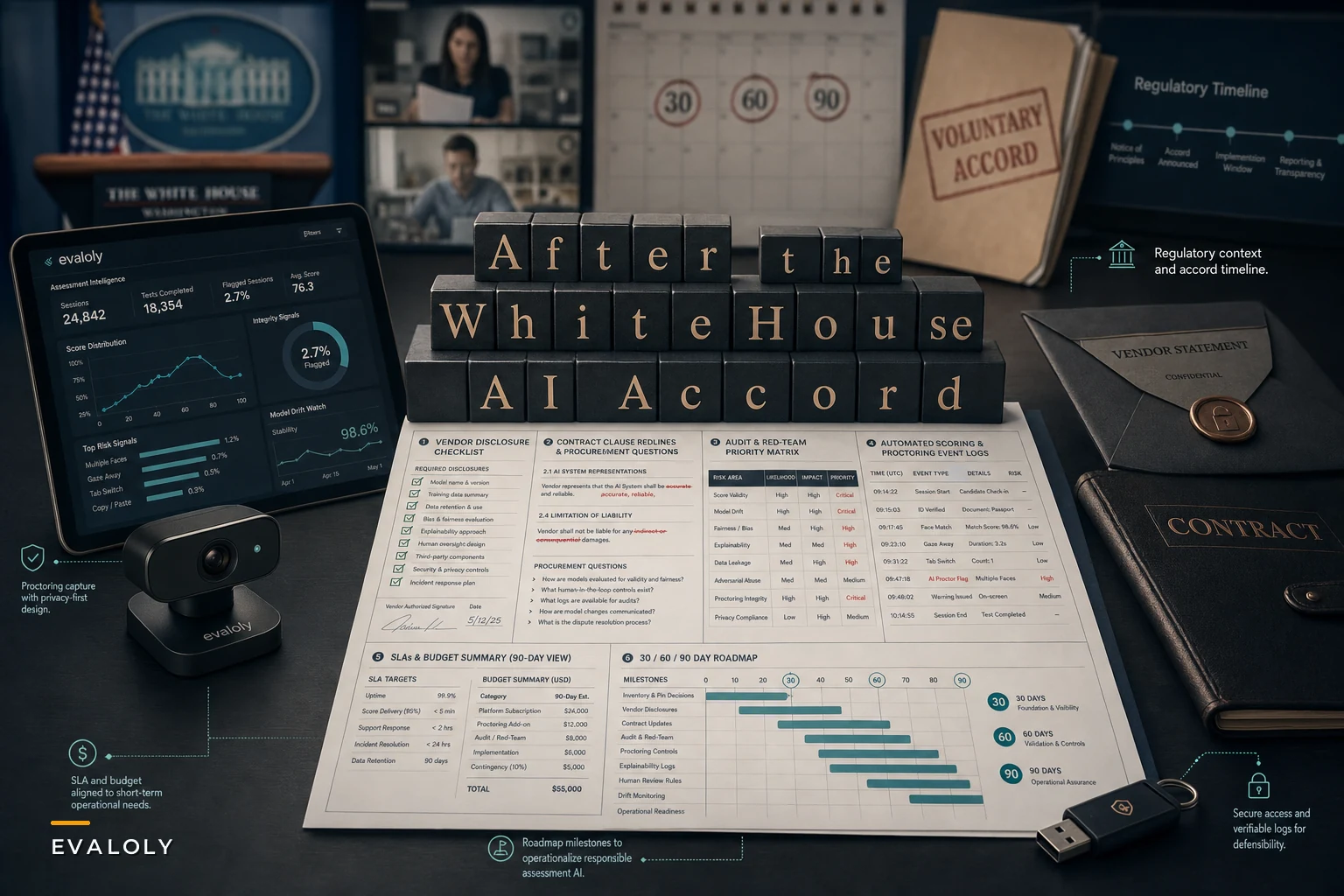

On September 29, the White House gathered a room full of AI company CEOs and walked away with a short, voluntary "AI accord" — self-policing principles the participants described as "morally binding" rather than legally enforceable. CNBC reported that it's closer to a handshake on safety and standards than any real regulation, and Reuters noted that the signatories were mostly the large model providers sitting underneath a huge chunk of the tools we all use daily.
For assessment teams, the interesting part isn't the accord itself. It's what happens downstream over the next 60–90 days. Your scoring vendor, your proctoring provider, your item-bank platform — most of them quietly run on models from the companies in that room. When those providers start issuing updated "aligned with the AI accord" statements, your procurement and vendor-risk workflows are what has to absorb the noise and figure out what's actually real.
This post is about that absorption work. Not the politics, not the headline. The practical steps for deciding which vendor claims matter, how to pressure-test automated scoring and proctoring under new scrutiny, and where to tighten contracts before renewal season arrives.
Why a "voluntary" accord still lands on your desk
Voluntary doesn't mean irrelevant. What usually follows a high-profile pledge like this is a wave of vendor marketing that's technically accurate and operationally useless. You'll get emails with subject lines like "Our Commitment to Responsible AI" that say nothing about how your candidate data moves, whether a model touches scoring decisions, or who reviews flagged exams.
The gap between a vendor's public alignment statement and their actual data-handling behavior is where assessment teams get burned. A platform can sincerely support safety principles at the corporate level while the specific feature you licensed — automated essay scoring, or behavioral proctoring flags — runs on a subprocessor that was never part of any pledge.
The real exposure isn't the accord. It's that the accord gives vendors a new vocabulary to sound compliant without changing anything you can actually audit. Assessment owners carry the validity and fairness risk regardless of what a vendor press release says. If an automated scoring model produces a biased result, "but they signed the accord" is not a defense you want to bring to a candidate appeal.
The underlying problem this exposes
Most assessment programs never built a clean separation between who makes the testing decision and what model influenced it. That worked fine when scoring was rubric-based and human-reviewed. It falls apart the moment a model sits in the pipeline and a vendor's model provider changes its terms, retrains on new data, or quietly deprecates the version you validated against.
The accord is going to accelerate model churn. Providers will update, patch, and re-align quickly to stay consistent with whatever they committed to. Every one of those updates can silently shift how an automated scorer behaves. If you don't have version pinning and change notifications written into your vendor terms, you'll discover the drift only when your pass rates move for no reason you can explain.
A fast triage for incoming vendor statements
Before you forward another "aligned with the accord" email to legal, run it through a quick filter. Most of these statements collapse into one of three buckets.
Eliminate assessment bottlenecks.
Evaloly simplifies every step from test design to results analysis, making assessments faster and more reliable.
- Customizable test creation
- Automated grading and analytics
- Secure distribution and proctoring
No credit card required
| Claim type | What it usually means | What to actually ask for |
|---|---|---|
| "We support responsible AI principles" | Marketing. No operational commitment. | Nothing. File it. Don't let it count as diligence. |
| "Our models meet new safety standards" | Possibly real at the corporate level, unclear at the feature level. | Which specific features in our contract use these models, and which subprocessors are involved? |
| "We've updated our data handling and audit logs" | Potentially meaningful. | Documentation of the change, effective date, and whether it alters your existing DPA. |
The mistake teams make is treating all three as equivalent progress. A vendor sending bucket-one language should not move your risk score at all. Only bucket-three claims, backed by actual documents, should change how you feel about renewal.
One pattern worth watching: vendors who suddenly over-communicate about principles but go quiet when you ask feature-level questions. That silence is the signal. Vendors with real governance maturity tend to answer the specific questions faster than the vague ones.
Rework your vendor-risk questions for scoring and proctoring specifically
Generic security questionnaires won't catch what's shifting right now. You need questions tuned to the two areas under the most renewed scrutiny — automated scoring and proctoring.
-
Model provenance Which underlying model powers automated scoring, and can you pin a version for the life of our contract?
-
Change notification Will we get written notice before a model update that could affect scoring behavior, with enough lead time to re-validate?
-
Human-review threshold At what confidence or flag level does a human get involved, and who is that human — your staff or a subcontractor?
-
Proctoring data retention How long are video, audio, and behavioral signals stored, where, and who can access them during an investigation?
-
False-flag handling What's the documented path when proctoring flags an innocent candidate, and what's the measured false-positive rate?
-
Explainability For any adverse scoring or integrity decision, can the vendor produce a reason that a candidate appeal board would actually accept?
-
Subprocessor disclosure Full list of subprocessors touching candidate data, updated whenever it changes.
If a vendor can't answer the human-review threshold question with a specific number or rule, that's the biggest red flag on the list. "A human reviews flagged cases" means nothing without knowing what triggers the flag and whether anyone overrides the model in practice.
When tightening vendor terms actually makes sense
Not every contract needs renegotiation right now. Push hard on terms when the vendor's model sits directly in a scoring or integrity decision — a result that affects whether someone passes, gets hired, or gets certified. That's where validity and legal exposure concentrate.
For lower-stakes uses — practice quizzes, formative checks, internal training assessments — a lighter touch is fine. Spending three weeks renegotiating the DPA for a diagnostic quiz nobody makes decisions on is misallocated effort. Match the scrutiny to the stakes.
Who should slow down
If you're a small program running one or two assessments with mostly human scoring, resist the urge to overhaul everything because of a news cycle. The accord changes the vendor landscape, not your immediate risk, if you don't have models making consequential decisions. Document where you stand, watch for real DPA changes, and don't burn limited bandwidth chasing statements that don't touch your workflow.
A short, realistic scenario
A mid-sized certification body — around 9,000 candidates a year across a few professional exams — had moved to automated essay scoring on one high-stakes exam about 18 months prior. Their contract said nothing about model versioning or change notice. Fine, until it wasn't.
After a wave of post-accord updates from their scoring vendor's model provider, the essay pass rate drifted roughly 4–5 points over two testing windows with no change in the candidate population. No alert. No notification. They only caught it because someone on the psychometrics team was watching score distributions out of habit.
The cleanup took most of a quarter: re-scoring a sample by hand, confirming the drift was model-driven, and renegotiating terms to add version pinning and 30-day change notice. The validity scare was the expensive part — not in dollars, but in the credibility hit of having to explain to a board why scores moved.
After adding change-notification clauses and a standing monthly score-distribution review, the next vendor update came with advance notice and a re-validation window built in. No drama the second time. The lesson wasn't that automated scoring is dangerous. It was that they'd outsourced a decision without keeping control of the inputs to that decision.
The workflow that keeps you ahead of vendor churn
```
```
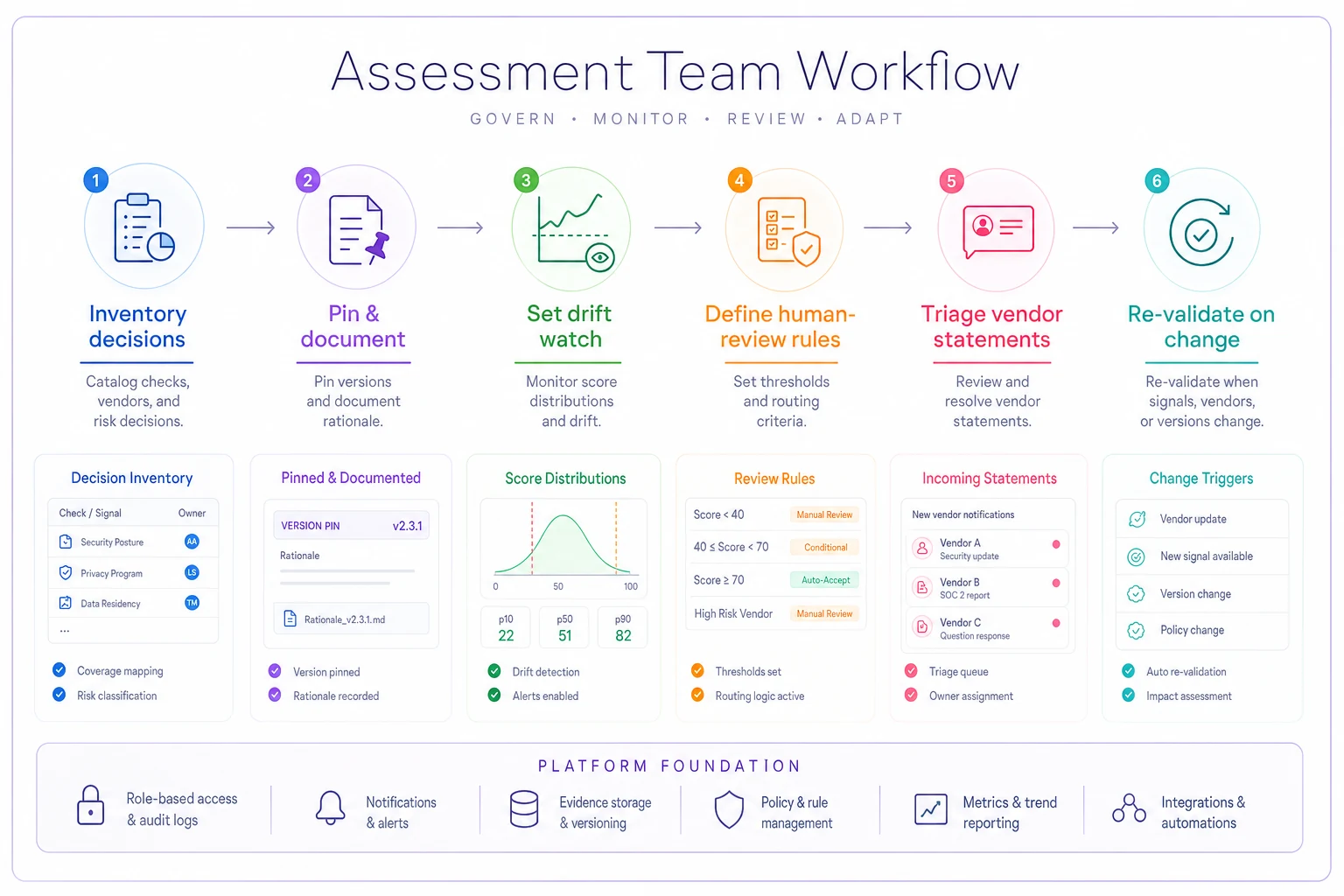
A straightforward process any assessment team can stand up without a major program:
-
Inventory where models touch decisions. List every feature — scoring, proctoring flags, item generation — and mark which ones influence a consequential outcome.
-
Pin and document. For each consequential feature, record the current model version (or vendor commitment), the effective DPA, and the subprocessor list.
-
Set a drift watch. For automated scoring, review score distributions regularly — monthly or per testing window. You're looking for unexplained shifts.
-
Define human-review rules in writing. Not "a human checks flags" but the specific trigger, the reviewer's role, and how overrides get logged.
-
Route vendor statements through the triage table. Only bucket-three, document-backed claims update your risk register.
-
Re-validate on change. When a vendor updates a model behind a scoring decision, treat it like a new form — sample, compare, confirm comparability before trusting results.
Prioritize setting up a standing drift watch (monthly or per testing window) before investing heavily in renegotiation; catching drift early saves credibility.
Step three is the one most teams skip and most need. Score drift is quiet. It doesn't throw an error; it just slowly moves your outcomes until someone notices a pattern. Catching it early is almost entirely a matter of having a standing review instead of a reactive scramble.
Where the accord actually helps you
There's a genuine upside worth using. The accord gives you leverage. When a vendor publicly commits to safety and standards, you now have a clean reason to ask for the documentation that backs it up. "You've publicly aligned with these principles — can you show us the audit logs and change-notification process that support that?" is a much stronger position than asking cold.
Smart teams will use this window to lock in terms they've wanted for a while: version pinning, explainability logs, subprocessor transparency, defined human-review thresholds. Vendors are more receptive right now because the environment makes refusing look inconsistent with their own messaging.
This is also the moment to make sure your internal governance is actually written down and enforceable, not just a shared understanding among people who happen to know each other. If you haven't formalized your guardrails, explainability logging, and red-team practices, the groundwork in our piece on responsible AI governance for assessments covers the operational controls that turn a vendor's promise into something you can audit on your side.
The real takeaway
The accord didn't change your obligations. It changed the conversation around them, and it kicked off a round of vendor activity that will flood your inbox with statements of varying honesty.
The teams that handle this well won't be the ones with the most impressive vendor pledges sitting in a folder somewhere. They'll be the ones who know exactly which models touch which decisions, who pinned their versions, who watch their score distributions, and who wrote their human-review rules down before they needed them. That work isn't glamorous and it won't make headlines — but it's the difference between explaining a score shift confidently and scrambling to explain it after the fact.
The accord didn't change your obligations. It changed the conversation around them, and it kicked off a round of vendor activity that will flood your inbox with statements of varying honesty.
The teams that handle this well won't be the ones with the most impressive vendor pledges sitting in a folder somewhere. They'll be the ones who know exactly which models touch which decisions, who pinned their versions, who watch their score distributions, and who wrote their human-review rules down before they needed them. That work isn't glamorous and it won't make headlines — but it's the difference between explaining a score shift confidently and scrambling to explain it after the fact.
Ready to revolutionize your evaluation process?
Join over 2,000 organizations using Evaloly to optimize assessments, improve learner outcomes, and make data-driven decisions.