
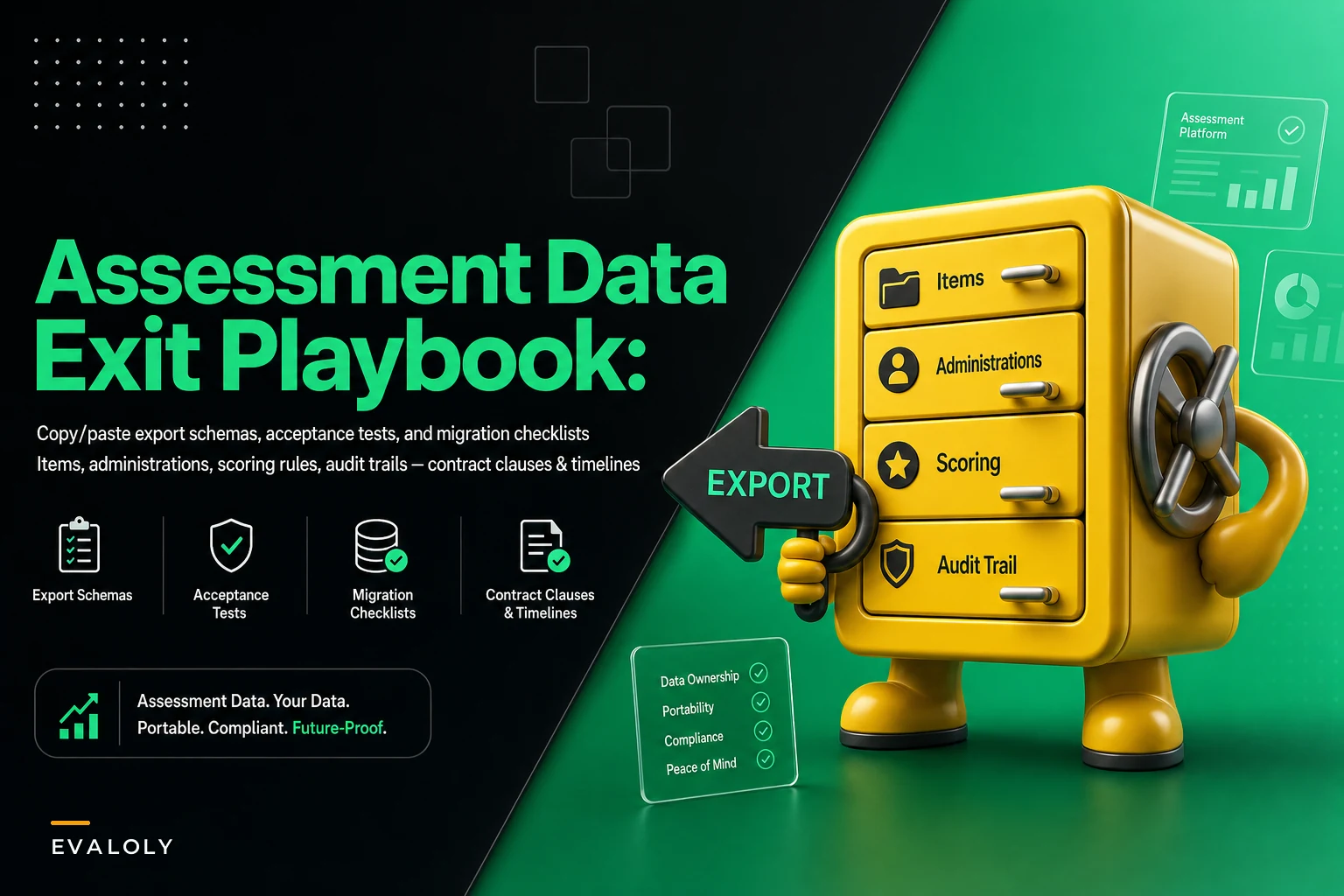

Most assessment teams only find out how badly their data is locked in when they're already trying to leave. The contract is signed, the renewal clock is ticking, and someone in L&D casually asks: "So how do we get our items and candidate records out?" That's the wrong moment to find out the vendor exports PDFs of score reports and nothing else.
Portability isn't a feature you add later. It's an artifact set you negotiate up front — a minimal export schema, acceptance tests you can actually run, a mapping checklist, honest timeline estimates, and a few contract clauses that give exports real teeth. This post is about building those artifacts specifically for assessment entities: items, administrations, scoring rules, and audit trails. Not learning content in general. Not generic "data" clauses. The four things that actually determine whether your program survives a platform switch.
Why assessment data breaks differently than other data
If you've exported a candidate list before, you might assume portability is a solved problem. Usually it isn't — because assessment data has dependencies that most export tools quietly drop.
An item isn't just a question stem and four options. It carries scoring logic, option-level weights, media references, accessibility tags, exposure history, and version lineage. An administration isn't just "who took what." It's the form assembled at that moment, the specific item versions served, timing data, routing decisions for adaptive tests, and the scoring rule set active on that date. A score isn't a number — it's the output of a rule that may have changed three times since the test was administered.
The common failure pattern looks like this: a vendor hands you a clean CSV of items and a clean CSV of results, and both look fine. Nobody notices until months later that the exported scores can't be reproduced because the scoring rules weren't exported with version timestamps. Or that adaptive routing logic vanished entirely, so historical administrations can't be reconstructed. The data is there. The relationships between the data are gone. And relationships are what make assessment records defensible.
This is why a vendor saying "yes, we support export" means almost nothing. Export of what, at what fidelity, with which dependencies intact — that's the actual question worth asking.
The minimal export schema (what "complete" actually means)
Don't ask for everything. Ask for the minimum set that lets you reconstruct, re-score, and defend historical administrations somewhere else. Anything beyond that is nice-to-have; anything less is a trap.
Eliminate assessment bottlenecks.
Evaloly simplifies every step from test design to results analysis, making assessments faster and more reliable.
- Customizable test creation
- Automated grading and analytics
- Secure distribution and proctoring
No credit card required
| Entity | Must export | Commonly dropped (watch for these) |
|---|---|---|
| Items | Stem, options, correct-answer keys, scoring weights, item ID, version ID, media files (not just links), accessibility metadata, content tags | Version lineage, retired-item history, option-level partial-credit rules |
| Administrations | Candidate ID, form/version served, exact item versions delivered, timestamps, timing per item, routing path (adaptive), accommodations applied | Which scoring rule set was active, seed/randomization order, proctoring flags |
| Scoring rules | Full rule definitions, cut scores, scaling/equating parameters, effective date ranges, version history | Prior rule versions, who approved changes, rationale notes |
| Audit trails | Who changed what, when, before/after values, approvals, access logs tied to records | Deleted-record events, exports previously run, failed-login context |
The single most overlooked column in that whole table is effective date ranges on scoring rules. Without them, you can export a decade of candidate responses and still be unable to answer the one question an auditor or legal challenge will ask: "What score did this person receive on this date, and can you prove the rule that produced it?"
A practical rule of thumb: if your export can't let an outside analyst re-score a past administration and land on the same number the old platform reported, it's incomplete — no matter how many rows it has.
Acceptance tests you run before trusting any export
An export schema on paper is a promise. Acceptance tests are how you check whether the promise holds. Run these against a real export during the proof-of-concept, not after go-live.
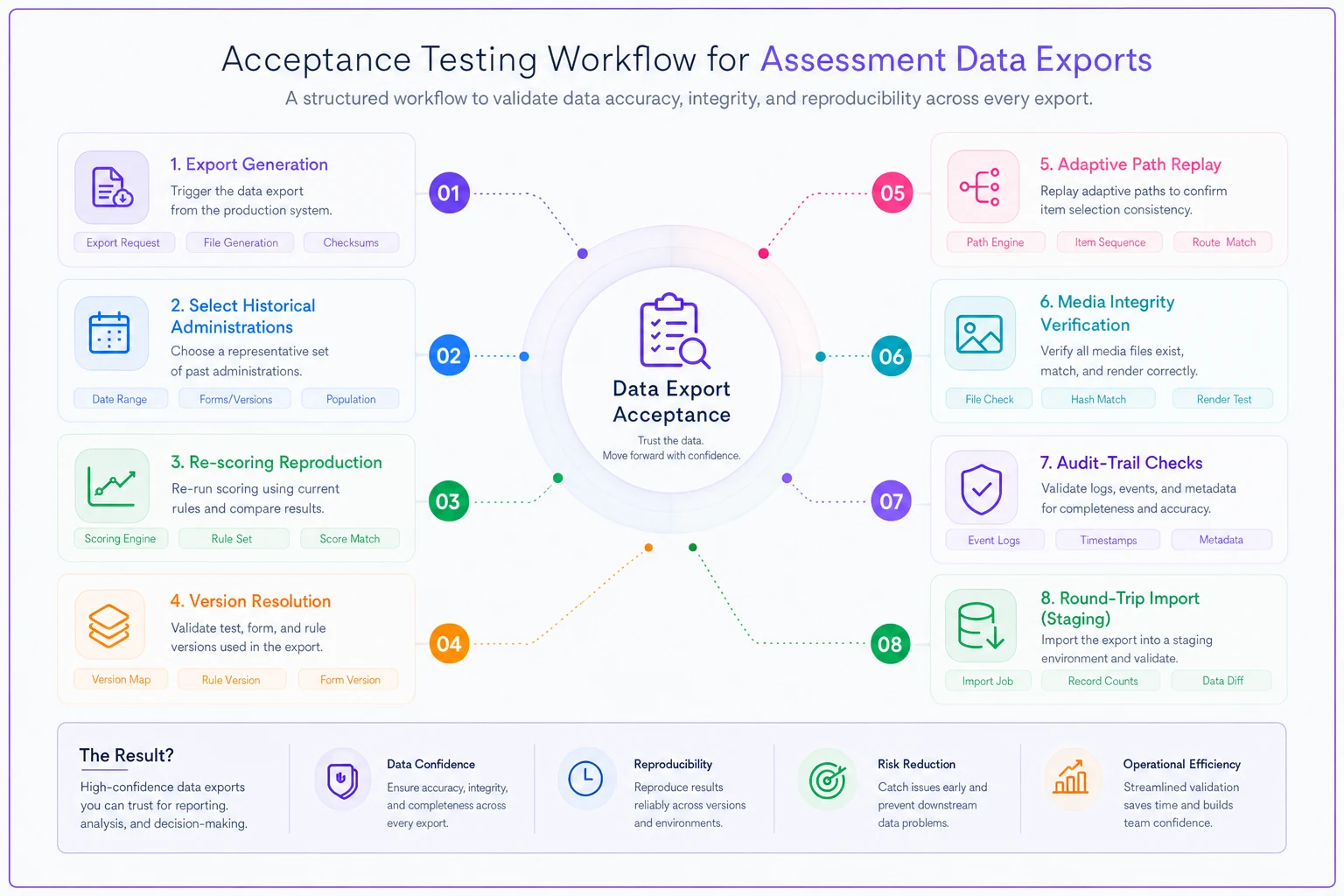
Here's a quick workflow to visualize the acceptance-test process.
-
Re-score reproduction. Take 50–100 historical administrations, export them, re-score them in a neutral tool (even a spreadsheet works for simple rules), and confirm the scores match the platform's original output. Any mismatch means scoring rules or item keys didn't export cleanly.
-
Version resolution. Pick an item that's been edited at least twice. Confirm the export shows every version, which administrations used which version, and that you can tell them apart. If all you get is the latest version, your historical records are now unreconstructable.
-
Adaptive path replay. For adaptive or branching tests, take one candidate's session and confirm you can rebuild the exact sequence of items served and why. Routing logic is the first thing to disappear in exports.
-
Media integrity. Confirm images, audio, and any stimulus files come out as actual files, not dead URLs pointing back at the vendor's servers. A link that stops working the day your contract ends is not an export.
-
Audit-trail completeness. Change an item, approve it, export, and verify the change event, the approver, and the before/after values are all present. Then delete a test record and confirm the deletion event is logged and exported too.
-
Round-trip sanity. Take the export and import it into a staging copy of your target platform (or the canonical model you plan to migrate into). Count what survived. The gap between what you exported and what imported cleanly is your real migration cost.
Teams that run these tests during evaluation almost never get surprised at exit. Teams that skip them nearly always find the gaps at the worst possible time. This kind of test belongs in your POC acceptance criteria — the same discipline covered in the assessment vendor selection checklist applies directly to portability, not just functional features.
The mapping checklist: where migrations actually die
Even a perfect export fails if nothing on the other side knows how to receive it. Mapping is the unglamorous work of lining up fields between two systems, and it's where most migration timelines blow up.
-
Item identity. Does your target system preserve the source item ID, or assign new ones? If it reassigns, how do you keep administration records pointed at the right items?
-
Scoring rule structure. Does the target express partial credit, weighted options, and cut scores the same way? Different platforms model "partial credit" in genuinely incompatible ways.
-
Taxonomy and tags. Do content tags, competencies, and accessibility flags map one-to-one, or do you lose granularity? Expect to lose some.
-
Accommodations records. Are accommodation flags stored as structured fields you can migrate, or as free-text notes that won't carry over?
-
Audit lineage. Can the new system ingest historical audit events, or does your history become a flat archive file nobody can query?
-
Timestamps and time zones. Sounds trivial. Isn't. Off-by-one-day scoring-rule boundaries have caused real re-scoring disputes.
A useful pattern: maintain a single "canonical" representation of your assessment entities that sits between platforms. Even if it's just a documented schema in a shared repo, it means you're never mapping Vendor A directly to Vendor B — you're mapping both to a stable middle. This cuts down dramatically on how much institutional knowledge lives inside any one vendor's data model.
Realistic timeline and resource estimates
Nobody budgets enough time for export validation, so here's an honest look at what it actually takes for a mid-sized program — say, a few hundred items, a handful of active test forms, and two or three years of administration history.
| Phase | Realistic effort | Who's involved |
|---|---|---|
| Export schema review + request | 1–2 weeks | Assessment lead, vendor contact |
| First full export + acceptance testing | 2–4 weeks | Psychometrician/analyst, IT |
| Mapping to target/canonical model | 3–6 weeks | Analyst, target-platform admin |
| Re-score validation at scale | 2–3 weeks | Psychometrician |
| Audit-trail and accommodations reconciliation | 1–3 weeks | Compliance/HR |
| Buffer for surprises | add ~30% | everyone |
A "simple" migration is realistically a two-to-three month part-time effort — and that's when the export actually works. When it doesn't — when re-scoring fails and you're reverse-engineering scoring logic from old documentation — that timeline stretches. I've seen it run past six months and quietly consume a quarter of someone's year.
The resource most people forget to budget isn't technical. It's the person who remembers why the scoring rules are what they are. If that person has left, your migration just got significantly harder, and no export schema fixes institutional memory loss.
Contract clauses procurement should require
This is the part that actually protects you, because it moves portability from "the vendor's goodwill" to "the vendor's obligation." Build these into procurement language before signing. Most of these pair naturally with the broader requirements in a surge-ready procurement checklist — treat portability as a first-class procurement line item, not an afterthought.
Clauses worth fighting for:
-
Defined export format and schema. The contract names the format (open, documented, machine-readable) and lists the required entities and fields — not "data export in a mutually agreed format," which means nothing.
-
Full-fidelity scoring and version export. Explicitly require scoring rules with version history and effective dates, and item version lineage. Name it, or lose it.
-
Media delivered as files. Require actual media assets, not links to vendor-hosted resources that expire.
-
Export-on-demand during the term. You should be able to pull a full export anytime, not just at exit. If you can only test portability when you're already leaving, you have no leverage.
-
Transition assistance window. A defined period (often 60–90 days post-termination) where the vendor must support export and answer migration questions, at a pre-agreed rate.
-
No data hostage clauses. Explicitly bar withholding exports over billing disputes. This happens more than vendors admit.
-
Deletion and certification. After you've confirmed a successful migration, the vendor certifies deletion of your data on a defined timeline.
Require export-on-demand during the term so you can run acceptance tests while you still have leverage.
The single clause that pays for itself is export-on-demand during the term. It lets you run your acceptance tests in month three instead of month thirty-six, which means you find the gaps while you still have a relationship — and leverage to get them fixed.
When a heavy portability push makes sense — and when it doesn't
Not every program needs the full artifact set. A one-off internal skills quiz with no compliance weight doesn't justify a months-long migration process.
Push hard on portability when:
-
Your assessments carry legal or regulatory weight (hiring, certification, licensure)
-
You need to defend historical scores against appeals or audits years later
-
You're locked into a vendor whose roadmap or pricing worries you
-
Your program is growing and vendor lock-in risk compounds over time
It's overkill when:
-
The assessment is low-stakes, short-lived, and easily rebuilt
-
You genuinely never need historical reconstruction
-
The data has no compliance or defensibility requirements
The mistake is assuming your program is in the second category when it's actually in the first. Low-stakes assessments have a way of becoming high-stakes the moment someone challenges a result — and by then your export options are whatever the contract you signed two years ago allows.
A short real scenario
A corporate certification team running role-based skills assessments — roughly 400 items, around 2,500 administrations a year — decided to switch platforms after a pricing change. They figured the export would take a few weeks.
The item and candidate exports came out clean. But when they re-scored a sample of past administrations in the new system, about 15% of scores didn't match. The cause: the old platform had applied two different cut-score versions over the previous 18 months, and the export only carried the current one. Nobody could prove which candidates had been scored under which rule.
They spent close to three extra months reconstructing scoring-rule history from change emails and old report PDFs. The fix for next time was straightforward and cheap by comparison — they rewrote their procurement template to require versioned scoring-rule export with effective dates, and added a re-score reproduction test to every POC. The second migration they ran, about a year later to consolidate a smaller tool, finished in roughly five weeks with zero scoring mismatches.
The difference wasn't a better platform. It was better artifacts, demanded before signing.
The takeaway
Portability for assessment data isn't a vague "make sure we can leave" instinct. It's four concrete deliverables: a minimal export schema that preserves item versions and scoring-rule history, acceptance tests you actually run during evaluation, a mapping checklist that catches where data drops, and contract clauses that make exports an obligation rather than a favor.
Get those in place before you sign, test them while you still have leverage, and the next time someone asks "how do we get our data out?" — you'll already have the answer, and it won't be a scramble.
Ready to revolutionize your evaluation process?
Join over 2,000 organizations using Evaloly to optimize assessments, improve learner outcomes, and make data-driven decisions.