


Most assessment platform purchases go wrong in the same quiet way: the demo looked great, the sales engineer answered every question smoothly, and then six weeks after go-live someone discovers the Workday connector only syncs one direction, essays can't be routed to a second grader, and the "role-based access" is really just three fixed roles you can't edit. By then the contract is signed for two years.
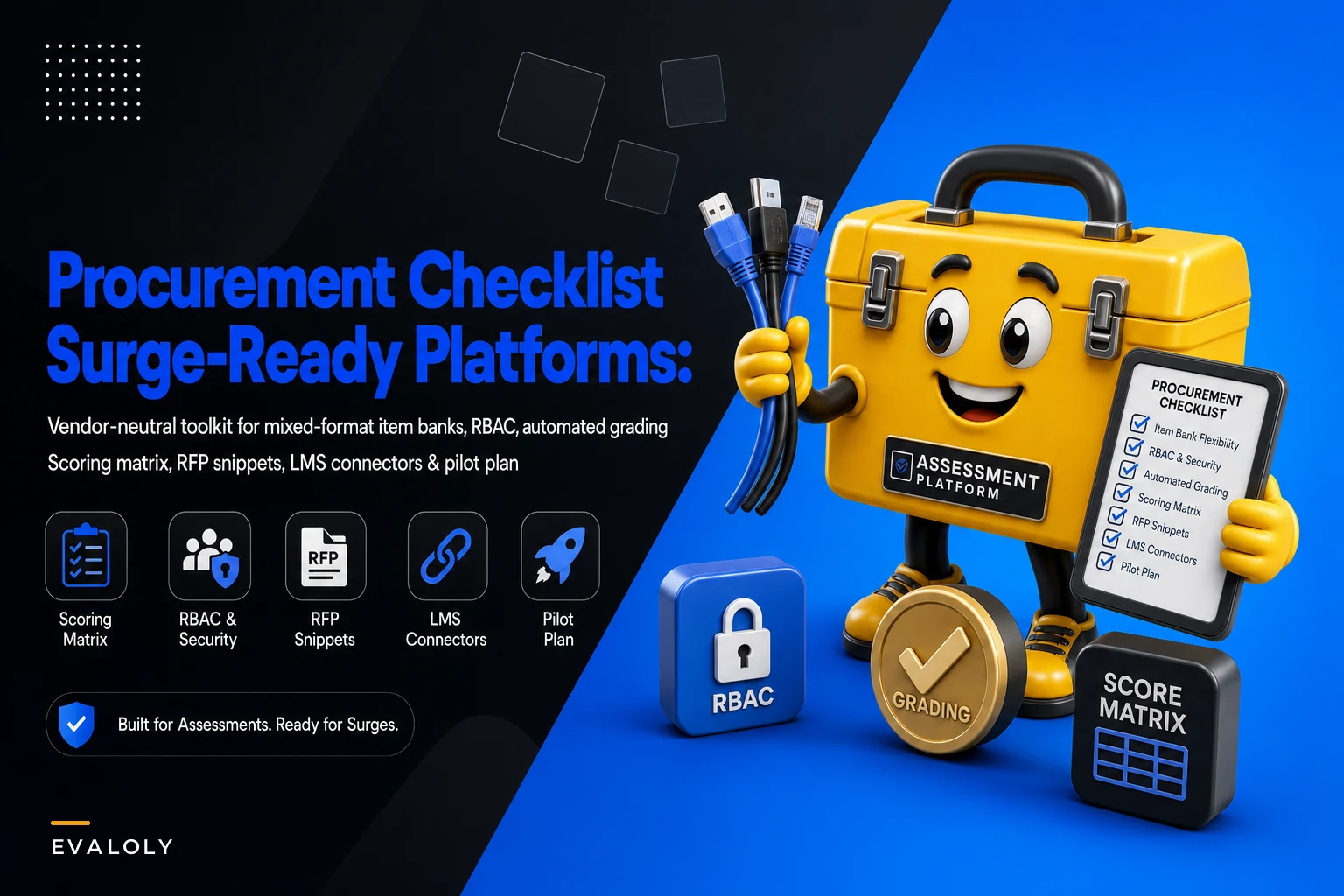
This brief exists to prevent that. It's built as an assessment platform procurement checklist you can actually run against vendors — with capability tiers mapped to org size, a scoring matrix, RFP questions that expose the gaps sales teams gloss over, and a pilot plan that tells you whether the thing works before you're locked in. Use it alongside the Hiring Surge Playbook, which covers the assessment design side. This one is purely about buying the platform that runs those assessments.
I'll assume you already know the difference between an item bank and an LMS, and that you understand why mixed-format grading is harder than it looks. We're going straight to the operational decisions.
Start by matching capability tier to your actual scale, not your ambition
The most expensive procurement mistake isn't buying too little — it's buying enterprise capability for a program that grades 400 candidates a year. You end up paying for SSO federation, custom RBAC matrices, and an implementation team you'll use twice.
Here's how capability tiers break down against real org sizes and volume:
| Capability area | Startup / small program (<2k assessments/yr) | Mid‑market (2k–25k/yr) | Enterprise (25k+/yr, multi‑region) |
|---|---|---|---|
| Item formats | MCQ, short answer, basic essay upload | Full mixed format incl. code execution | Mixed format + custom item types, versioned banks |
| RBAC | 3–5 preset roles | Configurable roles, per-item-bank scoping | Attribute-based access, delegated admin, audit trails |
| Automated grading | MCQ auto-scoring, rubric-assisted essay | Code auto-grading + human-in-loop routing | Full grading pipelines, sampling, reviewer SLAs |
| LMS connectors | Canvas or Moodle (one native) | Canvas + Moodle + Workday (bi-directional) | Multiple connectors + API for custom systems |
| Deployment | SaaS multi-tenant | SaaS with data residency options | SaaS or private tenant, region pinning |
| Realistic annual cost | ~$8k–$25k | ~$30k–$90k | $120k and up |
The pattern worth noticing: mid-market is where most teams underbuy on grading and overbuy on RBAC. They fixate on access control because it's easy to demo, then discover the automated grading pipeline can't route a coding assessment to human review when the auto-grader flags an edge case. Grading throughput is what actually breaks during a surge — not permissions.
The evaluation matrix, and how to score it without fooling yourself
A scoring matrix only works if you set the weights before you see any demos. Teams that build the matrix after watching vendor presentations end up unconsciously weighting whatever the slickest vendor happened to do well. Lock your weights first.
Eliminate assessment bottlenecks.
Evaloly simplifies every step from test design to results analysis, making assessments faster and more reliable.
- Customizable test creation
- Automated grading and analytics
- Secure distribution and proctoring
No credit card required
Use a simple 1–5 scale per criterion, multiply by weight, and require a minimum threshold on non-negotiables. Anything scoring 1 or 2 on a must-have is a disqualifier regardless of total.
Suggested weighting for a surge-ready buy:
-
Automated grading depth & routing — weight 5. Can it split a mixed-format exam, auto-score what's auto-scorable, and route essays and code to reviewers with load balancing? This carries the most weight because it's the bottleneck under volume.
-
LMS connector maturity — weight 5. Native, bi-directional, and tested against your LMS version. A "Canvas integration" that's really an LTI shim behaves very differently at scale.
-
RBAC granularity — weight 4. Can you scope a grader to one item bank without giving them access to the whole library?
-
Item bank flexibility — weight 4. Mixed formats in one bank, version control, bulk operations.
-
Security & compliance — weight 4. Data residency, SSO, audit logging, retention controls.
-
Deployment & implementation effort — weight 3.
-
Reporting & export — weight 3.
-
Total cost over 3 years — weight 3.
One scoring detail people consistently miss: score evidence, not claims. If a vendor says "yes, we support code grading," that's a 3 until they run your actual code assessment in the demo environment. It becomes a 5 only when you've seen it grade a submission that intentionally breaks. The delta between "yes we do that" and "here it is working on your data" is where the surprises tend to live.
RFP questions that actually expose the gaps
Generic RFPs get generic answers. The questions below are written to force specifics, grouped by the areas where vendors most commonly oversell.
On mixed-format item banks:
-
Can a single item bank hold MCQ, short answer, essay, and code items simultaneously, or do these live in separate banks that must be assembled at form-build time?
-
How are code items executed and sandboxed? Which languages and runtime versions are supported?
-
What happens to in-progress assessments when an item is edited mid-cycle?
On automated grading pipelines:
-
Walk through, step by step, how a 60-item exam containing 40 MCQ, 15 short-answer, and 5 essays gets graded. Where does automation stop and human review begin?
-
How do you route items to specific graders? Can you load-balance across a reviewer pool?
-
What's the fallback when the auto-grader has low confidence on a code submission?
-
Can we sample auto-graded items for human QA, and is that configurable by percentage?
On RBAC:
-
List every permission that can be independently toggled. Can access be scoped by item bank, by assessment, by candidate cohort?
-
Can a reviewer see submissions without seeing candidate identity, for blind grading?
-
Is there a full audit log of who viewed, edited, and scored what?
On LMS connectors:
-
Is the Canvas / Moodle / Workday connector native or LTI-based? What version was it last certified against?
-
Is data flow bi-directional? Specifically, do scores and status write back to the LMS/HRIS automatically?
-
What breaks when the LMS pushes an update?
That last connector question matters more than it seems. A mid-sized L&D team running assessments through Workday discovered post-launch that scores synced fine but candidate completion status didn't write back — so recruiters were manually checking two systems for every candidate. Multiply that across a few hundred candidates during a hiring push and you've created a full-time coordination job nobody budgeted for.
Test scenarios to run during the pilot
Demos are performances. Pilots are tests. In a pilot, you control the inputs. Build these scenarios and make the vendor run them in a real tenant with your data shapes.
-
The mixed-format load test. Push through a realistic exam batch — say, 200 candidates completing a 50-item mixed exam — and time how long grading takes end to end, including human review routing.
-
The broken submission. Submit code that compiles but fails half the test cases, and an essay that's off-topic. Watch how the grader handles ambiguity and whether it routes correctly.
-
The permission boundary. Give a test grader access to one item bank and try to access another. It should be impossible, cleanly.
-
The connector round-trip. Complete an assessment and confirm the score and status appear correctly in your actual LMS/HRIS instance, not a vendor sandbox.
-
The mid-cycle edit. Change an item while assessments are live and observe what happens to candidates who already answered it.
-
The export. Pull all results out in a usable format. If exporting your own data is painful during a pilot, it will be a nightmare at contract-renewal time.
Vendors that resist running scenario 4 against your real systems are almost always hiding integration immaturity. A confident vendor connects to your Canvas or Workday sandbox without drama.
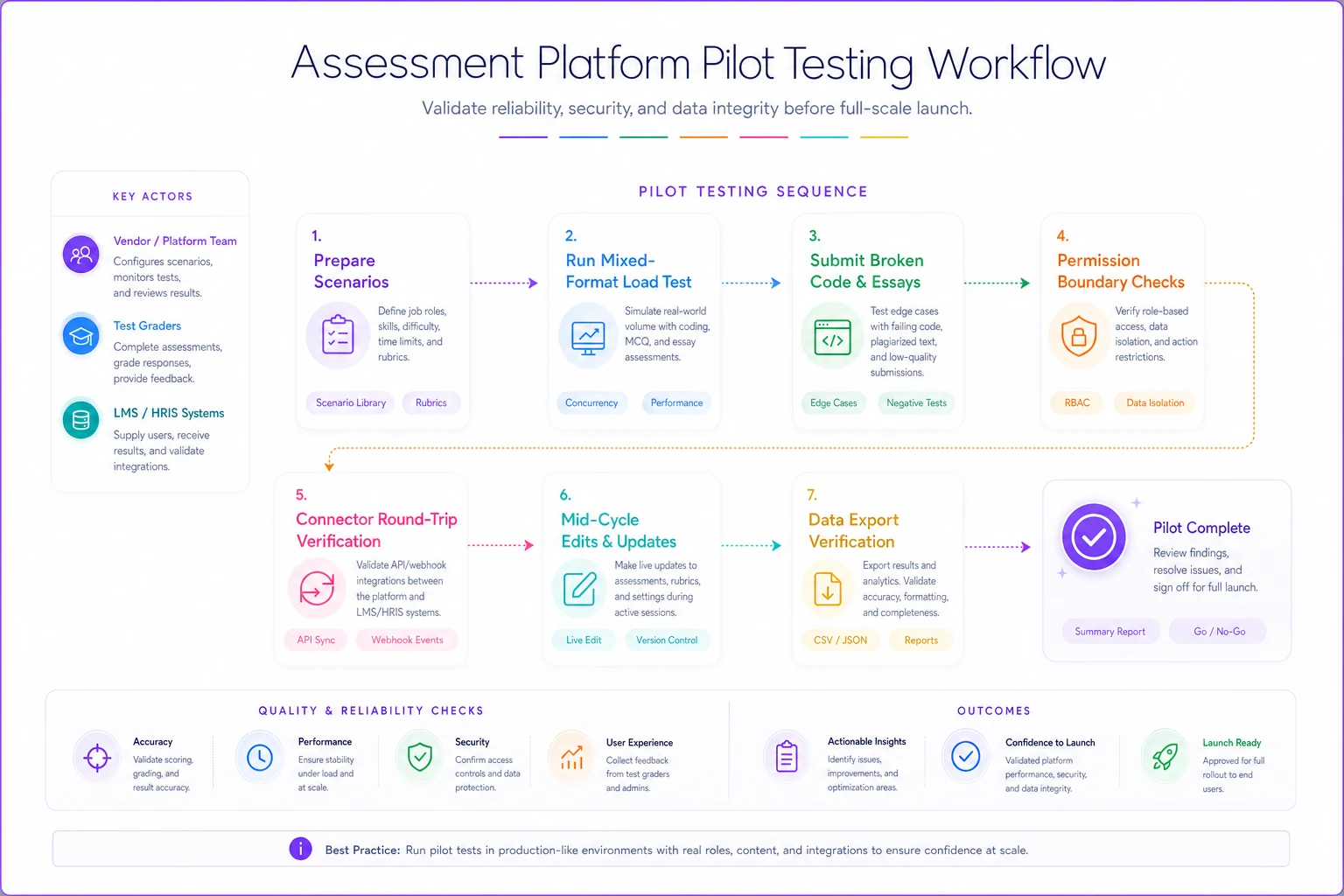
Use this workflow during pilots to make sure the vendor can actually execute the scenarios you care about.
Integration and data flow checklist
Before signing, confirm every one of these in writing:
-
[ ] Connector is native (or the LTI limitations are documented and acceptable)
-
[ ] Score write-back is automated and confirmed against your LMS version
-
[ ] Completion/status write-back is automated
-
[ ] Candidate roster sync direction is defined (who is the source of truth)
-
[ ] SSO works with your identity provider (test it, don't assume)
-
[ ] Data export is self-service, not a support ticket
-
[ ] API access and rate limits are documented if you need custom flows
-
[ ] Field mapping between platform and HRIS is agreed and documented
Security and compliance, kept operational
-
Data residency — where does candidate data physically live, and can you pin a region if you operate under regional privacy rules?
-
Retention and deletion — can you set automatic deletion schedules, and can you honor a deletion request cleanly?
-
Audit logging — full trail on access and scoring changes.
-
SSO and MFA — non-negotiable for anything at mid-market scale and up.
-
Subprocessor list — especially relevant if the grading pipeline uses third-party services for code execution or scoring.
The mistake here is treating compliance as a legal checkbox rather than an operational capability. "Can you delete candidate data" often gets a yes in the RFP and a "well, it's a manual process our support team runs quarterly" once you're a customer.
When enterprise capability actually makes sense — and when it's a trap
Buy up a tier when you're running assessments across multiple regions with different privacy rules, you have graders who must be scoped to specific banks for confidentiality, or your volume genuinely exceeds what a mid-tier grading pipeline can handle during peak. Multi-region data residency and attribute-based access aren't vanity features at that scale — they're the reason the deal survives an audit.
Don't buy up a tier when the driver is a single stakeholder who wants "future-proofing." Future-proofing is how programs end up paying enterprise pricing for four years while using a mid-market feature set. Buy for the scale you'll realistically hit in the next 18 months and negotiate an upgrade path instead.
Who should skip this entire process: a program running a few hundred low-stakes assessments a year on a single LMS. A lightweight native LMS quiz tool plus a simple rubric process is usually enough for that. Running a full enterprise RFP at that scale burns weeks you don't have.
A short real scenario
A regional healthcare employer was hiring for a clinical support role and expecting a surge — roughly 500–700 candidates over a couple of months, up from their usual trickle. Their existing setup handled MCQs fine, but every short-answer and scenario response was graded by hand in spreadsheets, then manually re-entered into Workday.
During a normal month that was tedious. During the surge it collapsed. The grading backlog hit around ten days, and two strong candidates dropped out because they'd accepted other offers while waiting for a decision. Rough cost of that delay, factoring in re-advertising and re-screening: somewhere in the low thousands per lost candidate, plus a lot of frustrated recruiters.
They re-ran procurement against the matrix above, weighted grading throughput and Workday write-back at the top, and picked a mid-market platform that could auto-score MCQs, route scenario responses to a small reviewer pool, and push both scores and status back into Workday automatically. Next surge, grading turnaround dropped to under two days and the manual re-entry disappeared entirely. Nothing exotic — they just bought for the bottleneck instead of the demo.
Cost and deployment timeline drivers
What actually moves the price and the timeline, in rough order of impact:
-
Connector complexity. A native, pre-built Canvas or Moodle connector is fast. Custom Workday field mapping or a bespoke API integration adds weeks and real cost.
-
RBAC customization. Preset roles deploy in days. Custom attribute-based access takes configuration and testing.
-
Grading pipeline setup. Rubric configuration and reviewer routing rules take real time to get right — budget for it.
-
Data migration. Moving an existing item bank in cleanly is often the slowest single step.
-
SSO and security review. Your own security team's timeline usually dictates this, not the vendor's.
A realistic mid-market implementation runs somewhere in the six-to-twelve-week range once the contract is signed. Anyone promising two weeks for a bi-directional Workday integration is either very good or not describing the same integration you think you're buying.
Running the process without dragging it out
Keep it to a tight sequence so it doesn't stall in committee:
-
Lock scoring weights and must-haves (before any demos).
-
Send the RFP with the specific questions above.
-
Shortlist to three based on written answers.
-
Run the six pilot scenarios in a real tenant with your data.
-
Score against the locked matrix using evidence, not claims.
-
Negotiate an upgrade path and confirm the integration checklist in writing.
-
Sign, then run one final connector round-trip test before go-live.
The teams that get this right treat the pilot as the real decision point and the demo as background noise. The ones that get burned reverse that order.
Assessment platform buying rewards specificity. Every gap that costs you later — the one-way connector, the ungradeable code item, the graders who can see too much — was answerable during procurement if someone had asked the pointed version of the question. Use the checklist to ask them.
Ready to revolutionize your evaluation process?
Join over 2,000 organizations using Evaloly to optimize assessments, improve learner outcomes, and make data-driven decisions.