


Most assessment buying goes sideways for the same reason: the demo looks great, but the item bank only really handles two formats well, the "automated grading" turns out to be MCQ-only, and the LMS connector is a CSV export someone on your team runs manually every Friday. By the time you find out, you've already signed a two-year contract and migrated 4,000 items.
This guide is built to prevent that. It shortlists five vendors that genuinely support mixed-format item banks (MCQ, short answer, essay, and code), role-based access, automated grading pipelines, and prebuilt connectors to the big LMS/HRIS platforms — Canvas, Moodle, and Workday. For each one you get a one-line differentiator, the org size it actually fits, and the limitations vendors tend to leave off the slide deck. Then a decision matrix, a procurement checklist, RFP questions worth asking, integration and migration notes, and a realistic evaluation timeline.
If you're using this during a hiring spike, pair it with the Hiring Surge Playbook — the buying criteria shift when you need something live in three weeks instead of three months, and I'll flag those moments as they come up.
What "mixed-format" actually needs to mean before you shortlist anything
The phrase gets thrown around loosely. When you're actually comparing vendors on mixed-format item bank capability, four things separate real support from marketing:
-
Native item types, not workarounds. Essays and code should be first-class item types with their own metadata, scoring config, and versioning — not a "file upload" question type bolted on.
-
A single bank, not four banks. You want one repository where an MCQ, a short-answer prompt, and a coding challenge can live in the same blueprint, tagged against the same competencies.
-
Grading that fits the format. Auto-scoring for MCQ is table stakes. The real question is whether short answer, essay, and code each have their own grading path (rubric, model-assisted, unit-test execution) and whether those paths route to humans cleanly when they need to.
-
Connectors that pass the right data both ways. Rostering in, scores and completion out, and ideally gradebook sync — with Canvas, Moodle, and Workday, since those cover most education and corporate stacks.
A common mistake: teams weight "number of question types" heavily in their scoring. It doesn't matter much. A platform with 22 question types where essays can't be rubric-scored is worse than one with five types that all grade properly. Weight depth per format, not count of formats.
One more thing before the list. None of these vendors is "the best." Fit depends on whether you're a university department, a certification body, or an HR org running technical hiring. I've noted org-size fit for exactly that reason.
The shortlist
The five below cover the realistic spread — from lean L&D teams that need something live fast, to certification programs that need psychometrics and audit trails. The names here represent vendor archetypes you'll encounter in the market; use the differentiators and limitations as your evaluation lens.
Eliminate assessment bottlenecks.
Evaloly simplifies every step from test design to results analysis, making assessments faster and more reliable.
- Customizable test creation
- Automated grading and analytics
- Secure distribution and proctoring
No credit card required
1. A code-first technical assessment platform
Key differentiator: Best-in-class automated code grading with real compiler and unit-test execution, plus plagiarism detection built in.
Typical org-size fit: Mid-to-large companies doing high-volume technical hiring (engineering, data, security roles) — roughly 200+ hires a year where coding evaluation is the core need.
Known limitations: Essay and short-answer grading is usually thinner — often model-assisted with weaker rubric controls. Education-side LMS depth (Canvas/Moodle gradebook nuance) tends to lag behind the Workday/ATS integrations. Pricing scales aggressively with concurrent candidates, which stings during a surge.
Where this archetype wins: if 70% of your assessment volume is code, the grading pipeline pays for itself. Where it hurts: teams that thought they were buying a general mixed-format platform and discover the essay workflow is an afterthought.
2. An education-native assessment and item-banking system
Key differentiator: Deep item-banking with psychometrics, versioning, and mature Canvas/Moodle connectors that sync rosters and grades bidirectionally.
Typical org-size fit: Universities, large school systems, and certification bodies. Works well from a single large department up to institution-wide.
Known limitations: Code assessment is often the weak spot — either not supported natively or handled through a third-party plugin. Role-based access is granular but complex to configure; small teams find it heavy. Workday integration may exist but is usually less polished than the LMS side.
This is the archetype to look at if comparability, equating, and defensible scoring matter more than speed. If you've dealt with multiple-form comparability before, this category supports it properly out of the box.
3. An enterprise talent-assessment suite
Key differentiator: Tight Workday and ATS integration with role-based workflows designed for HR governance and compliance reporting.
Typical org-size fit: Large enterprises (1,000+ employees) where assessments feed hiring, promotion, and internal mobility decisions.
Known limitations: Mixed-format depth varies — strong on structured items and behavioral/situational judgment content, weaker on code and open-ended essay scoring. Configuration is consultant-heavy; expect professional services fees. Not agile for a small L&D team that just wants to run a quick skills check.
These suites tend to get bought by procurement and IT as much as by L&D, so the buying cycle is longer. Budget for that in your timeline.
4. A flexible mid-market assessment platform
Key differentiator: Genuine breadth — MCQ, short answer, essay, and code all supported natively with configurable auto-grading and human-in-the-loop review.
Typical org-size fit: Mid-sized companies, training providers, and mid-sized education programs (roughly 50–500 active users) that need all four formats without enterprise overhead.
Known limitations: Jack-of-all-trades means no single format is best-in-class. Code execution may support fewer languages. Connectors exist for Canvas, Moodle, and Workday but occasionally require light configuration rather than one-click install. Reporting is decent but not deep enough for heavy psychometric work.
For most people reading this, this archetype is the realistic default. It handles the actual mix — an essay here, a code task there, a bank of MCQs — without forcing you into a specialist tool for each format.
5. An open, developer-friendly assessment engine
Key differentiator: API-first and highly customizable, with strong Moodle roots and the flexibility to build grading pipelines you control.
Typical org-size fit: Teams with in-house technical resources — ed-tech companies, larger university IT groups, or L&D teams embedded alongside engineering.
Known limitations: You're doing more of the assembly yourself. Out-of-the-box automated grading for essays and code often needs building or integrating. Canvas and Workday connectors may be community-maintained rather than vendor-backed, which is a real support risk. Without technical staff, this becomes a liability fast.
The trap with this archetype: teams love the flexibility in the demo and underestimate the maintenance burden. If nobody on your team will own integrations long-term, skip it.
Decision matrix
Score each vendor 1–5 against your weighted criteria. The weights below are a starting point — adjust based on whether you're education- or hiring-driven.
| Criterion | Suggested weight | Code-first | Education-native | Enterprise talent | Mid-market flexible | Open/dev engine |
|---|---|---|---|---|---|---|
| Mixed-format depth (all 4 native) | 20% | 3 | 3 | 3 | 5 | 3 |
| Automated grading pipelines | 20% | 5 | 4 | 4 | 4 | 3 |
| Role-based access controls | 15% | 3 | 5 | 5 | 4 | 4 |
| Canvas / Moodle connectors | 15% | 2 | 5 | 3 | 4 | 4 |
| Workday connector | 10% | 4 | 3 | 5 | 4 | 2 |
| Speed to deploy | 10% | 4 | 2 | 2 | 4 | 2 |
| Total cost predictability | 10% | 2 | 3 | 2 | 4 | 4 |
Two notes on using this. First, don't average blindly — a "1" on a criterion that's a hard requirement is a disqualifier, not something to offset with high scores elsewhere.
Second, the speed to deploy row matters far more during a hiring surge; if you're staffing up fast, temporarily double its weight and watch how the ranking shifts.
Procurement checklist
Run through this before you sign anything. Every item here maps to somewhere I've watched deals go wrong.
-
[ ] Confirmed all four formats (MCQ, short answer, essay, code) are native item types, seen in a live sandbox — not slides
-
[ ] Watched a real grading run for essay and code, including how failed or ambiguous cases route to a human
-
[ ] Verified the LMS/HRIS connector you need (Canvas, Moodle, or Workday) is vendor-supported, with a version number and support SLA
-
[ ] Tested bidirectional data flow
roster in, scores and completion out, gradebook sync if you need it
-
[ ] Reviewed role-based access with your actual roles (item writer, reviewer, proctor, admin, viewer) configured, not defaults
-
[ ] Got pricing modeled at surge volume, not baseline — ask what happens if candidate count triples in a month
-
[ ] Confirmed data export in a usable format if you ever leave (items and results)
-
[ ] Checked accessibility support for each item type, including code and essay editors
-
[ ] Asked for two reference customers matching your org size and use case
-
[ ] Read the data processing terms — where results live, retention defaults, and deletion process
The single most skipped item on this list is the surge-pricing question. Teams price at today's volume and get blindsided when a hiring push doubles their bill. Ask early.
Sample RFP questions worth including
Generic RFPs get generic answers. These are the ones that actually produce useful differentiation:
-
Walk us through the exact grading path for (a) an essay, (b) a short-answer item, and (c) a coding task. Where does automation stop and human review begin?
-
For your Canvas / Moodle / Workday connector
is it vendor-built and vendor-supported? What's the update cadence when the LMS/HRIS releases a new version?
-
Show role-based permissions at the field level. Can a reviewer see scores but not candidate PII? Can an item writer edit but not publish?
-
How do you handle a mid-cycle spike from, say, 200 to 900 candidates in two weeks? What breaks first, and what does it cost?
-
What does migrating an existing item bank of around 5,000 mixed-format items look like — supported formats, mapping effort, and who does the work?
-
If automated essay or code scoring is model-assisted, how do you surface confidence, log decisions, and let humans override?
-
What's your standard data retention, and how do we bulk-export items and results on exit?
That last one — model-assisted scoring transparency — deserves real scrutiny. If a vendor can't explain how its automated grading logs decisions and enables override, treat it as a governance gap, not a feature gap.
Integration and migration notes
The integration story is where "supports Canvas" quietly falls apart. A few things worth knowing:
Connectors aren't equal. A vendor-built, certified LTI 1.3 connector for Canvas is a different animal from a community plugin someone maintains on evenings. Ask for the certification and the last update date. For Workday, confirm whether it's a native integration or a middleware step you'll end up owning.
Migration effort tracks item complexity, not item count. Moving 5,000 MCQs is mostly mechanical. Moving 5,000 items where a third are essays with rubrics and a chunk are coding tasks with test cases is a real project. Rubrics and test cases rarely map cleanly between platforms — budget human review time for those specifically. A typical mid-market migration of a mixed bank runs a few weeks of part-time work, longer if metadata and competency tags need remapping.
Metadata is where quality leaks. When items move, tags, difficulty stats, and version history are the first things lost. If your competency mapping matters — and for role-based skill assessment it should — validate that tags survive migration in a small pilot batch of 50–100 items before committing to the full move.
Sequence the cutover. Run the new platform in parallel for one full assessment cycle before retiring the old one. The cost of a quiet gradebook-sync failure discovered mid-term is far higher than the cost of a month of overlap.
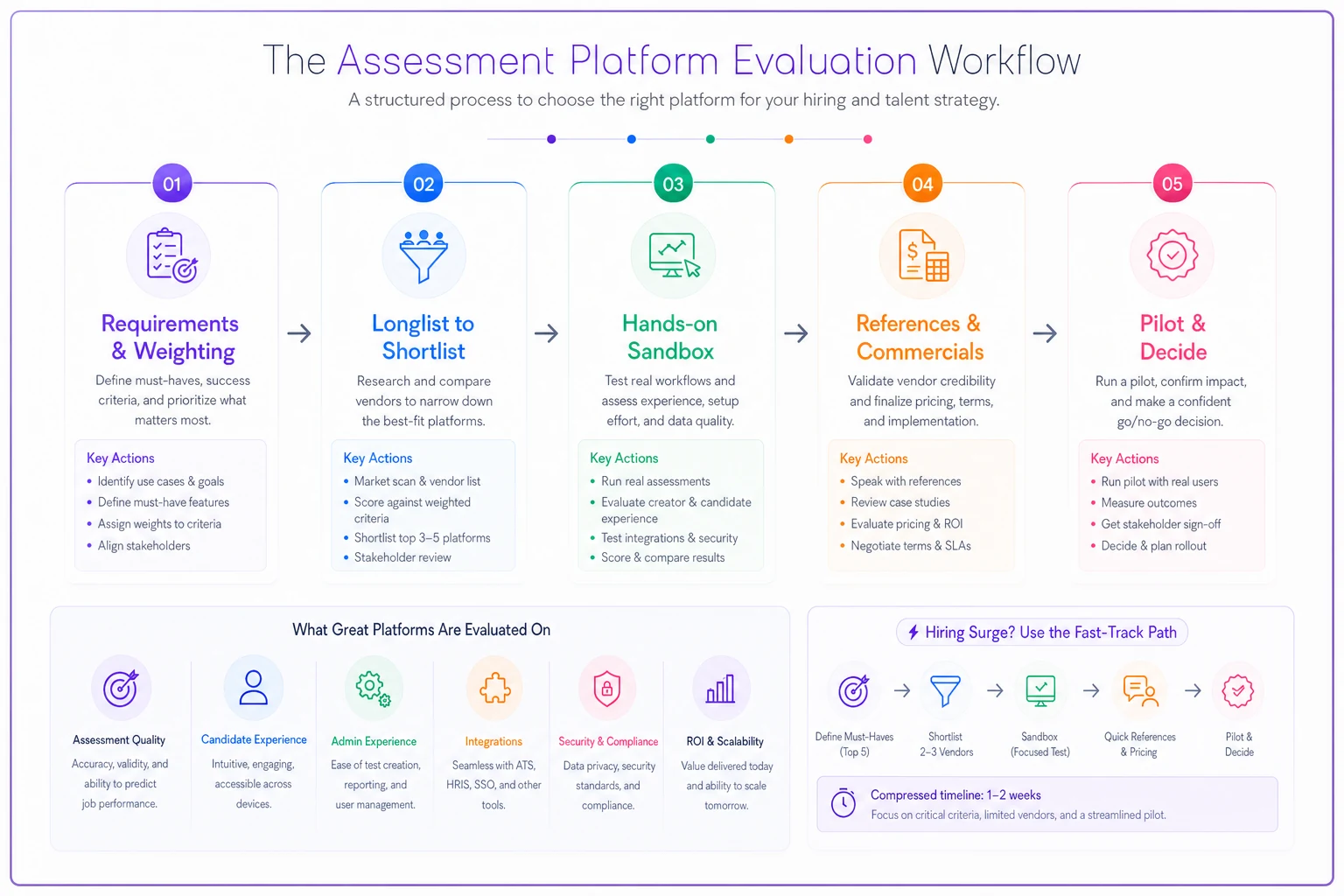
A realistic evaluation timeline
For a mid-sized team buying without a hard deadline, a sane pace looks like this:
-
Weeks 1–2
Requirements and weighting.
Lock your must-haves, set matrix weights, identify the one LMS/HRIS connector that's non-negotiable. -
Weeks 3–4
Longlist to shortlist.
Send the RFP, cut to three vendors based on written answers plus the procurement checklist. -
Weeks 5–7
Hands-on sandbox.
Not demos — sandboxes. Build a real blueprint with all four formats, run grading, test the connector with sample rostering. -
Weeks 8–9
References and commercials.
Two reference calls each, surge-volume pricing, data and exit terms reviewed by whoever owns procurement. -
Weeks 10–12
Pilot and decide.
Run a small live pilot — one cohort, real items, real grading — then score the matrix and sign.
That's roughly a three-month cycle done properly. Enterprise talent suites stretch longer because IT and procurement get involved; open/dev engines stretch longer because you're evaluating build effort, not just fit.
When the timeline compresses
If you're in a hiring surge, you don't have twelve weeks. The move is to skip the longlist, go straight to one or two vendors that fit your dominant format, and lean hard on the sandbox and surge-pricing questions. The Hiring Surge Playbook covers how to deploy competency-based assessments fast without abandoning the checks that keep scoring defensible — read it alongside this guide if speed is the constraint.
This diagram shows the evaluation workflow.
If you're in a hiring surge, you don't have twelve weeks. The move is to skip the longlist, go straight to one or two vendors that fit your dominant format, and lean hard on the sandbox and surge-pricing questions. The Hiring Surge Playbook covers how to deploy competency-based assessments fast without abandoning the checks that keep scoring defensible — read it alongside this guide if speed is the constraint.
When each choice makes sense — and when it doesn't
Go code-first when technical hiring is the majority of your volume. Don't if essays and open-ended reasoning carry equal weight — you'll fight the grading tooling.
Go education-native when comparability, psychometrics, and Canvas/Moodle depth matter and you have time to configure. Don't if you need code assessment as a core format or want something running next week.
Go enterprise talent suite when assessments feed formal HR decisions and you need governance and Workday integration. Don't if you're a small L&D team — the consultant overhead will bury you.
Go mid-market flexible when you genuinely need all four formats and don't want a specialist tool per format. Don't if any single format needs to be best-in-class.
Go open/dev engine when you have technical staff who'll own it long-term. Don't — really, don't — if nobody's accountable for integrations after launch.
A short real scenario
A mid-sized training provider running certification programs for IT roles had been stitching things together: MCQs in their LMS, coding tasks in a separate tool, and essays graded in spreadsheets. Their team was manually reconciling scores across three systems for roughly 300 candidates a cycle, and that reconciliation alone ate about two staff days per cycle — with occasional score-entry errors they only caught on appeal.
They evaluated against the matrix above, weighted mixed-format depth and Moodle connector heavily, and landed on the mid-market flexible archetype. Migration of their bank — around 3,800 items, including coding tasks with test cases — took a little over three weeks with part-time effort, most of it spent validating that rubrics and test cases had carried over cleanly. After cutover, grading and score sync ran through one pipeline. The two-day reconciliation dropped to a few hours of spot-checking, and the score-entry errors on appeal effectively disappeared. Not a dramatic revenue story — just a quieter operation and staff who stopped dreading results week.
The lesson there isn't the tool. It's that they scored against their weighted criteria and validated migration on a small batch before committing. That's the part most teams skip.
Bringing it together
Shortlisting assessment vendors for mixed-format item banks is less about finding a winner and more about matching depth-per-format, grading pipelines, access controls, and connectors to how your organization actually works. Weight your matrix honestly, insist on sandboxes over demos, ask the surge-pricing and grading-path questions early, and validate migration on a small batch before you move thousands of items.
Do that, and the two-year contract you sign will match the platform you actually needed — not the one that demoed well. And if you're buying under pressure because openings just spiked, compress the timeline deliberately rather than cutting the checks that keep your scoring defensible.
Shortlisting assessment vendors for mixed-format item banks is less about finding a winner and more about matching depth-per-format, grading pipelines, access controls, and connectors to how your organization actually works. Weight your matrix honestly, insist on sandboxes over demos, ask the surge-pricing and grading-path questions early, and validate migration on a small batch before you move thousands of items.
Do that, and the two-year contract you sign will match the platform you actually needed — not the one that demoed well. And if you're buying under pressure because openings just spiked, compress the timeline deliberately rather than cutting the checks that keep your scoring defensible.
Ready to revolutionize your evaluation process?
Join over 2,000 organizations using Evaloly to optimize assessments, improve learner outcomes, and make data-driven decisions.