

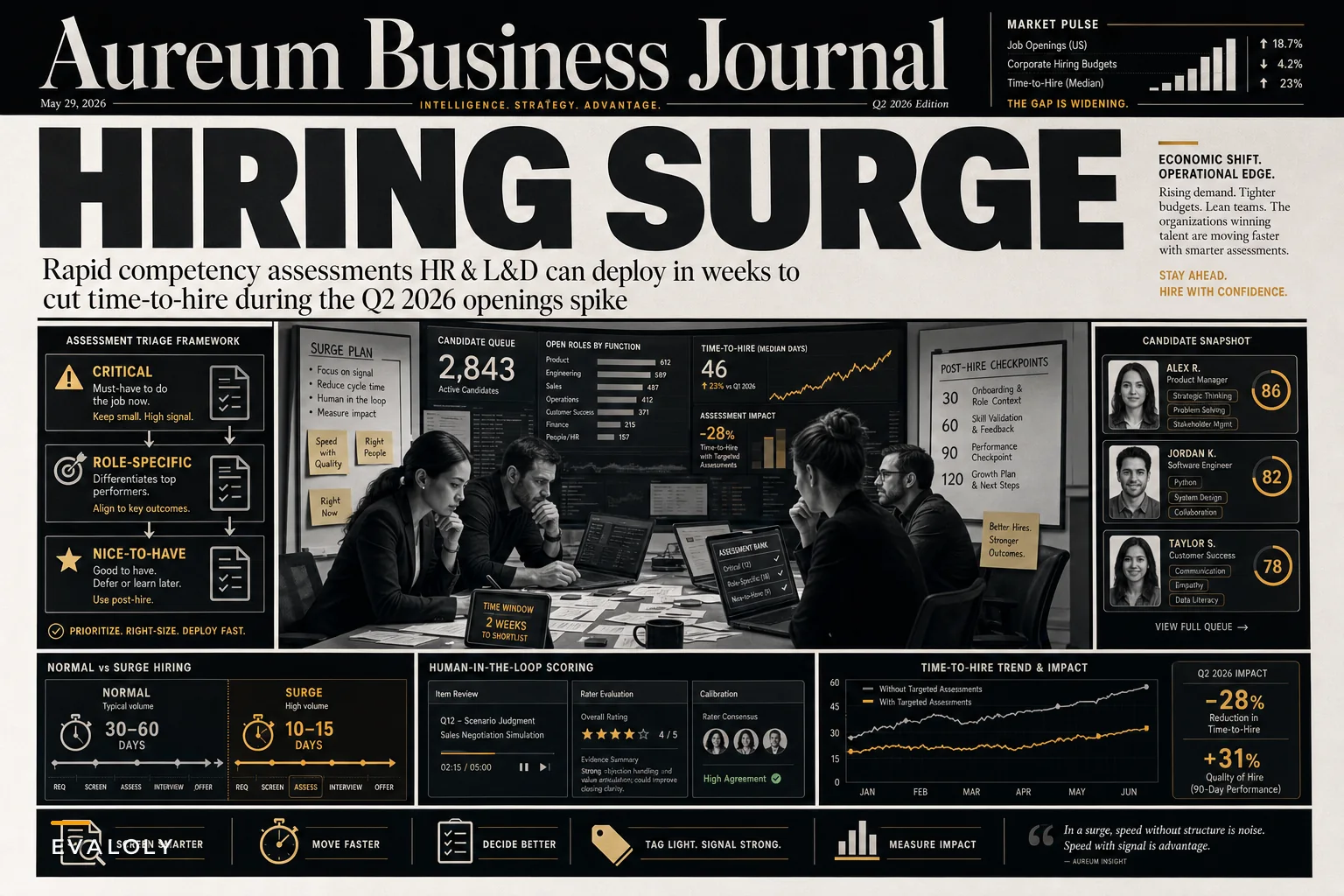

The labor market just threw another curveball. U.S. job openings hit a near two-year high in May, jumping to 8.1 million according to the latest JOLTS data. For HR teams already stretched thin, this creates an immediate operational squeeze: more requisitions, shorter decision windows, and the same headcount trying to keep up.
What this means for assessment operations is pretty straightforward. Hiring managers start pushing for faster candidate evaluations. Those competency assessments that normally take 3-4 days to score and review? Now they need results in 24 hours. That quarterly skills gap analysis you run for internal mobility? Leadership wants it monthly — maybe weekly — to figure out who can be upskilled instead of pulled from an already competitive external market.
The pressure isn't just volume, though. It's staying consistent on quality while everything speeds up. A mid-size tech company tried handling a roughly 40% hiring spike by simply running assessments faster — cut review steps, skipped calibration sessions, pushed unvalidated questions into production. Six weeks later they had two discrimination complaints and a bad-hire rate noticeably higher than their baseline. Moving fast without a framework doesn't save time. It just moves the damage downstream.
The broken assessment model that stops scaling
Most organizations build their competency-based assessments around steady-state hiring. Maybe 15-20 roles per month, predictable skill requirements, enough breathing room between candidates for proper validation. Then a surge hits and things fall apart in pretty predictable ways.
Subject matter experts who normally review results get overwhelmed. They start rubber-stamping evaluations or, worse, become bottlenecks that freeze everything. One healthcare system had their nursing competency assessments backed up three weeks because their two clinical reviewers couldn't keep pace with 180 candidates suddenly in the pipeline.
The assessment platform itself starts creaking under the load. Questions get reused too often. Candidates share answers on forums. Carefully calibrated difficulty levels collapse when you're drawing from a depleted item bank. Security protocols get quietly bypassed because "we need results today."
But the biggest failure mode? Organizations abandon their competency frameworks entirely. Instead of measuring specific skills — data analysis proficiency, customer de-escalation techniques — they switch to generic assessments that tell you almost nothing about actual job performance. It feels like a reasonable shortcut. It rarely is.
Building surge-ready competency assessments
Organizations that handle hiring surges well don't scramble to build new systems mid-chaos. They've already built modular assessment components that can be mixed, matched, and deployed based on urgency and role.
Eliminate assessment bottlenecks.
Evaloly simplifies every step from test design to results analysis, making assessments faster and more reliable.
- Customizable test creation
- Automated grading and analytics
- Secure distribution and proctoring
No credit card required
Start with a tiered competency model. Not every position needs the same assessment depth during a surge. Three levels work well:
Critical competencies (must assess, no shortcuts): Non-negotiable skills that directly affect safety, compliance, or core operations. For a nurse, medication administration knowledge. For an accountant, GAAP fundamentals. You never skip or rush these, regardless of what's happening with volume.
Role-specific competencies (assess if time allows): Skills that separate good performers from great ones, but aren't deal-breakers. Presentation skills for a sales engineer. Project management chops for a senior developer. During surges, these often get moved post-hire.
Nice-to-have competencies (defer to probation): Cultural fit indicators, secondary skills, growth potential markers. Save them for 30 or 90-day reviews when there's actual bandwidth.
Here's what that looks like operationally:
| Assessment Tier | Normal Hiring (5-day window) | Surge Hiring (24-hour window) | Post-Hire Follow-up |
|---|---|---|---|
| Critical | 60-minute skills test + behavioral interview | 30-minute adaptive test | None needed |
| Role-specific | 30-minute simulation + peer review | 10-minute screening quiz | 2-week checkpoint |
| Nice-to-have | Culture fit survey + reference checks | Skip entirely | 30-day assessment |
A quick visual of how to select and deploy tiered assessments during a surge.
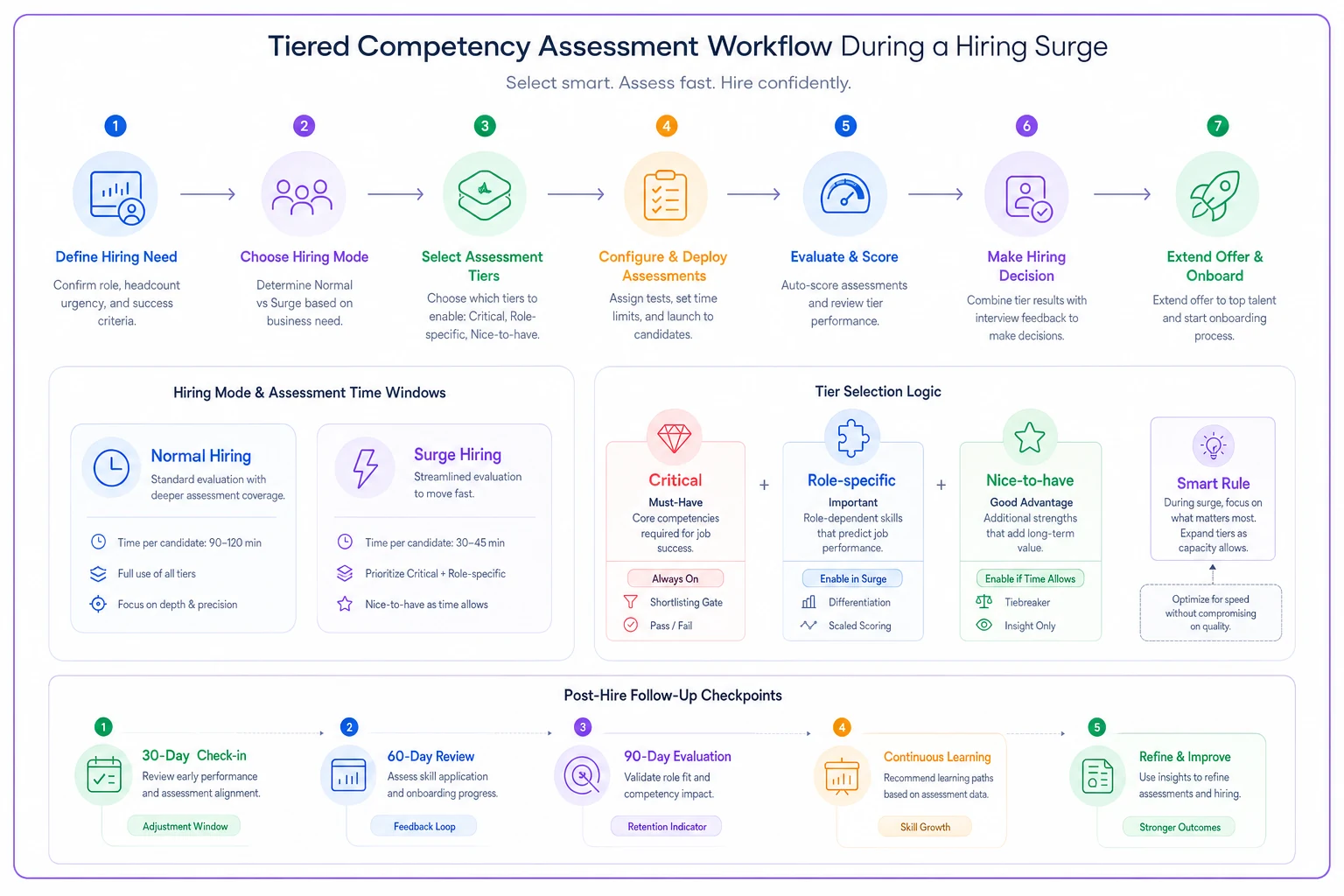
The key is having these tiers defined before you need them. When surge hiring hits, you're executing a predetermined playbook — not making panicked decisions about what to cut.
Automating competency verification without sacrificing validity
Manual scoring kills assessment programs during surges. But pure automation without human oversight leads to the kind of outcomes that show up in employment lawsuits.
The workable middle ground uses structured automation with specific human checkpoints. Set up your platform to auto-score objective competencies — technical knowledge, regulatory requirements, standard procedures. These have clear right/wrong answers that machines handle reliably.
For behavioral competencies and judgment-based scenarios, AI-assisted scoring works well as a first pass, but edge cases should still get human review. Done right, this approach can cut scoring time significantly while keeping accuracy within a couple percentage points of full manual review.
One manufacturing company built this out for their maintenance technician assessments. Each candidate previously took around 3 hours to evaluate across 12 competencies. They automated scoring for 8 technical ones — electrical safety, equipment diagnostics, preventive maintenance — while keeping human review for 4 behavioral competencies around communication and safety leadership.
The result: 500 candidates assessed in a single month with the same team that previously handled around 120.
The upskilling pivot that hiring surges trigger
When external hiring gets expensive and competitive, smart organizations shift their assessment infrastructure toward internal talent. The problem is most internal competency assessments are built for annual reviews, not rapid redeployment decisions.
You need a different model for upskilling sprints. Instead of comprehensive evaluations, create micro-assessments that measure specific skill gaps. Can this customer service rep learn basic SQL in two weeks to move to a data analyst role? Does this warehouse supervisor have the foundational knowledge to become an operations manager with 30 days of targeted training?
These aren't full competency validations. They're potential indicators — focused on learning ability, foundational knowledge, and motivation rather than current expertise.
A retail chain facing a surge in e-commerce roles used this approach rather than hire 50 new digital marketers. They assessed 200 store associates for:
-
Basic digital literacy (can they navigate analytics dashboards?)
-
Writing ability (can they put together compelling product descriptions?)
-
Data interpretation (can they read conversion metrics and act on them?)
They identified 35 internal candidates who could transition with 2-3 weeks of training, filling 70% of their open needs internally at roughly a third of what external hiring would have cost.
Integration with existing competency banks
During a surge, you don't have time to create new assessment content from scratch. This is where well-maintained competency-based question banks become critical infrastructure — not a nice-to-have repository.
The problem is most organizations' question banks are in rough shape. Questions tagged incorrectly, difficulty levels uncalibrated, no version control. When you need to rapidly deploy assessments for 15 different roles, you can't spend days cleaning up metadata.
-
Primary and secondary competency tags
-
Difficulty rating based on actual candidate performance data
-
Time-to-complete estimates
-
Discrimination index (how well it separates strong from weak candidates)
-
Last-used date to prevent overexposure
With proper tagging, generating a valid 20-question assessment for any role takes under five minutes. Without it, you're manually searching through thousands of items hoping to find something relevant.
Creating competency assessment templates for role families
Rather than building assessments position by position, create templates for role families that share core competencies. All your software engineers — frontend, backend, full-stack — probably need to demonstrate problem-solving, code quality, and system design thinking. Build that core once, then layer on role-specific modules.
A typical template structure:
-
Core competencies (40% of assessment)
Shared across all roles in the family
-
Specialization competencies (40%)
Specific to the exact position
-
Level modifiers (20%)
Adjusts for seniority — junior vs. senior vs. lead
This modular approach means when a surge hits, you're assembling assessments from validated components rather than building from scratch. The time difference is real — something closer to 30 minutes versus several hours per new assessment.
The scoring bottleneck nobody talks about
Even with solid assessments and automation in place, human review still matters for high-stakes hiring. But most organizations don't plan for reviewer capacity until they're already underwater.
During normal hiring you might need 2-3 trained reviewers. During a surge, that number can jump to 15-20. Where do they come from, and how do you keep evaluations consistent across that many people?
Smart HR teams maintain a reviewer bench — employees trained in assessment review who can be activated when volume spikes. These aren't full-time roles. They're high-performers across various departments who understand competency evaluation and can commit 5-10 hours per week during peak periods.
Keep a bench of high-performing reviewers trained quarterly so you can activate them quickly during spikes.
Train them quarterly even when you don't need them. Run calibration sessions where everyone scores the same candidate responses and talks through the gaps. Document scoring rubrics in enough detail that two reviewers working independently reach the same conclusion most of the time.
One financial services firm keeps around 30 trained reviewers across their organization. During a hiring surge in early 2026, they activated 18 of them, each handling 10-15 assessments per week alongside their regular work. They held their 48-hour turnaround standard even with hiring volume tripling.
When to break your own competency rules
Sometimes surge conditions require uncomfortable tradeoffs. The key is making those calls deliberately rather than reactively.
Conditional passes can work for candidates who score in the 85-90% range on critical competencies but haven't been fully assessed on role-specific ones. Hire them with a structured 30-day competency completion plan. They start working but must complete the remaining assessments within the probation window.
Competency waivers make sense in specific scenarios. A candidate with 10 years of directly relevant experience might skip certain technical assessments if work samples clearly demonstrate those competencies. Not ideal, but losing a strong candidate while they wait for an assessment slot isn't ideal either.
Whatever you decide, document every deviation from standard process and track outcomes closely. If conditional hires fail at higher rates, adjust your thresholds. If waived assessments keep creating capability gaps, narrow the criteria.
Building your surge response playbook
Don't wait for the next spike to figure this out. Build the playbook now while you have time to be thoughtful about it.
Start with triggers. At what point do you shift from normal to surge procedures? When open requisitions exceed 150% of monthly average? When time-to-fill drops below 15 days? When assessment backlog exceeds a week? Pick specific thresholds rather than relying on someone's gut feeling.
Map your degradation path. If you have to cut assessment components, what goes first? What's absolutely protected? Which roles can use abbreviated assessments versus which require full evaluation regardless of urgency?
Test your surge procedures quarterly. Run a mock exercise where you process 3x normal volume using abbreviated assessments and your expanded reviewer pool. Find the breaking points before they matter in a live situation.
The technology stack that scales
Your assessment platform needs specific capabilities to actually handle surges. API-based integration with your ATS so candidate data flows automatically. Adaptive testing that shortens assessments for clear passes or fails. Real-time reporting so you can spot bottlenecks as they develop rather than after the fact.
But the most critical feature is flexible workflow configuration. During surges, you need to route assessments differently, parallelize reviews that normally run sequentially, and adjust approval thresholds without rebuilding your entire process from scratch. Platforms with AI-powered scoring and automated workflow management can absorb significant volume increases without adding proportional headcount. The upfront configuration work pays off quickly once conditions get intense.
Maintaining quality during the chaos
The temptation during a surge is to push candidates through and fix problems later. But bad hires made during a surge create compounding problems — extra training, missed performance standards, replacement costs — often within the first six months.
Build quality checkpoints that can't be skipped regardless of urgency:
-
Every 50th assessment gets a full audit
-
Weekly calibration sessions continue even during surges
-
Adverse impact monitoring runs daily, not monthly
-
New hire performance gets tracked at 30, 60, and 90 days
One retail organization skipped their normal quality reviews during a holiday hiring surge to hit volume targets. Six months later they discovered their abbreviated assessments had adverse impact on Spanish-speaking candidates. The EEOC investigation and settlement cost considerably more than properly staffing their assessment team would have.
The morning after the surge
When the pressure finally eases, resist the urge to immediately return to business as usual. This is the window to actually strengthen the system.
Go through every deviation from standard process. Which shortcuts worked fine? Which created problems downstream? Update the playbook based on what actually happened, not what you theorized might happen.
Review your competency models honestly. Did the surge reveal that some "critical" competencies aren't actually that critical? Did you discover new skills that predict success but aren't in your current framework?
And maintain your surge infrastructure during steady-state operations. Keep your reviewer bench trained. Keep assessment templates current. Keep automation rules tuned. The next surge will come — the question is whether you're ready for it or scrambling again from square one.
And maintain your surge infrastructure during steady-state operations. Keep your reviewer bench trained. Keep assessment templates current. Keep automation rules tuned. The next surge will come — the question is whether you're ready for it or scrambling again from square one.
Ready to revolutionize your evaluation process?
Join over 2,000 organizations using Evaloly to optimize assessments, improve learner outcomes, and make data-driven decisions.