


The problem with most appeals isn't that people disagree with their scores. It's that the people handling them are improvising. Someone emails HR saying the certification exam "wasn't fair," a manager forwards it to three people, nobody knows who owns the decision, and two weeks later the candidate is escalating to legal while the assessment lead is digging through Slack trying to reconstruct which question was even in dispute.
This is the part of the assessment appeals process that nobody designs ahead of time, and it's exactly what gets programs into trouble. When an appeal is handled inconsistently — one candidate gets a rescore, another with an identical complaint gets a form rejection — you've created a defensibility gap that a lawyer, an auditor, or an angry cohort can walk straight through.
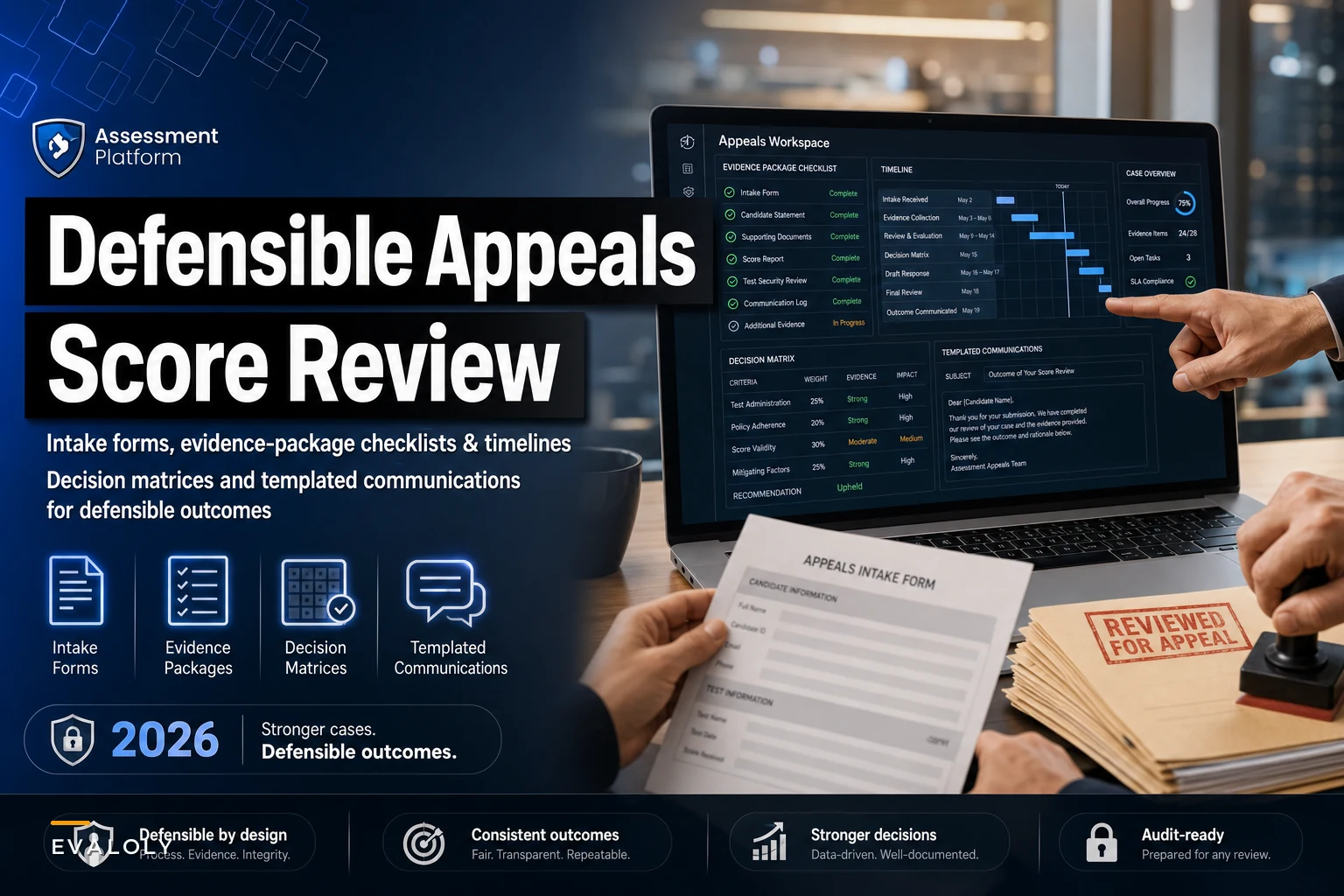
So this is about building the thing that stops that: intake forms that capture what matters the first time, evidence packages that make decisions reviewable, timelines people actually follow, and templated communications that keep tone and legal exposure under control.
Why appeals fall apart before anyone even reviews the score
In most organizations, appeals arrive through whatever channel the candidate happens to have access to. A proctored-exam candidate replies to a confirmation email. A nursing student files through a portal. An internal promotion candidate complains to their manager. Each entry point captures different information, and most of them capture almost nothing useful.
The pattern that comes up constantly: the appeal arrives as a feeling ("I know more than this score shows") instead of a claim ("item 14 had two defensible answers"). Without a structured intake, your reviewers spend the first three back-and-forth emails just trying to figure out what's actually being disputed. By the time that's clarified, you've burned half your response window and the candidate already thinks you're stalling.
The second failure is ownership. When there's no named decision-maker per appeal type, appeals bounce. A scoring dispute needs a psychometrician or SME. An accommodations dispute needs someone fluent in the accommodations policy. A proctoring or conduct dispute needs whoever manages exam security. Blur those lines and you get a committee of five people, none of whom feel fully responsible, and a decision that takes a month because every reply is waiting on someone's inbox.
The real cost of inconsistency
A mid-sized credentialing body — somewhere around 4,000 candidates a year — handled appeals ad hoc for a long time. The numbers eventually told the story. Appeals took an average of 19 days to resolve, and when they audited a year's worth of decisions, they found that candidates with nearly identical complaints had received different outcomes roughly a third of the time. Not because the cases were different. Because different staff handled them differently.
Eliminate assessment bottlenecks.
Evaloly simplifies every step from test design to results analysis, making assessments faster and more reliable.
- Customizable test creation
- Automated grading and analytics
- Secure distribution and proctoring
No credit card required
That inconsistency is the liability. It's not the occasional rescore that costs you — it's the appearance that outcomes depend on who you happened to get, not what you actually argued. In regulated hiring, licensure, or academic settings, that's what turns a single appeal into a class complaint. One candidate discovering their peer got a rescore for the same reason they were denied is all it takes.
There's also a quieter cost: reviewer time. When every appeal is a fresh investigation with no template, your most expensive people — SMEs, psychometricians — burn hours reconstructing context that a decent intake form would have captured in two minutes.
The four appeal types, and why you shouldn't treat them the same
Before building any forms, separate appeals into types. The evidence and the decision logic are genuinely different for each.
| Appeal type | Core question | Who decides | Key evidence |
|---|---|---|---|
| Scoring/keying dispute | Was the item scored correctly? | SME + psychometric reviewer | Item text, answer key, item stats, candidate response |
| Administration/technical | Did a disruption affect performance? | Exam operations lead | Proctor logs, system logs, timestamps, incident reports |
| Accommodations | Was the candidate given what they were entitled to? | Accommodations coordinator | Approved accommodations, delivery records, candidate account |
| Conduct/security flag | Was an irregularity flag valid? | Security/integrity lead | Proctoring evidence, flag rationale, response pattern data |
The mistake is running all four through one generic "appeals form" and one generic reviewer. A keying dispute and a proctoring flag have almost nothing in common operationally. If accommodations appeals keep getting tangled up in this, it's worth checking whether the underlying policy is airtight — a lot of appeal volume traces back to gaps in the accommodations policy itself, not the appeals handling.
The intake form that actually does work for you
A good intake form isn't about collecting more information — it's about forcing the appeal into a reviewable shape. The candidate should not be able to submit "this was unfair" and nothing else.
-
Appeal type (the four above — make them pick one, this routes the whole case)
-
Specific claim — the exact item number, section, or event being disputed, not a general grievance
-
Requested outcome — rescore, re-sit, score adjustment, flag removal (makes the ceiling of the dispute explicit)
-
Supporting rationale — why the candidate believes the outcome was wrong
-
Any new information — documentation, timestamps, screenshots they're attaching
-
Timeline confirmation — acknowledgment of when results were released, so the filing window is on record
-
Prior contact — whether they've already raised this and with whom
The most valuable field is the forced appeal-type selection, because it determines routing. Close behind is "requested outcome," because it stops the open-ended disputes where a candidate keeps escalating because nobody ever asked them to define what a win looks like.
One practical note from programs that do this well: cap the free-text fields. Unlimited text produces three-page emotional essays that bury the one factual claim your reviewer needs.
One practical note from programs that do this well: cap the free-text fields. Unlimited text produces three-page emotional essays that bury the one factual claim your reviewer needs. A 500-character limit forces precision.
Building the evidence package
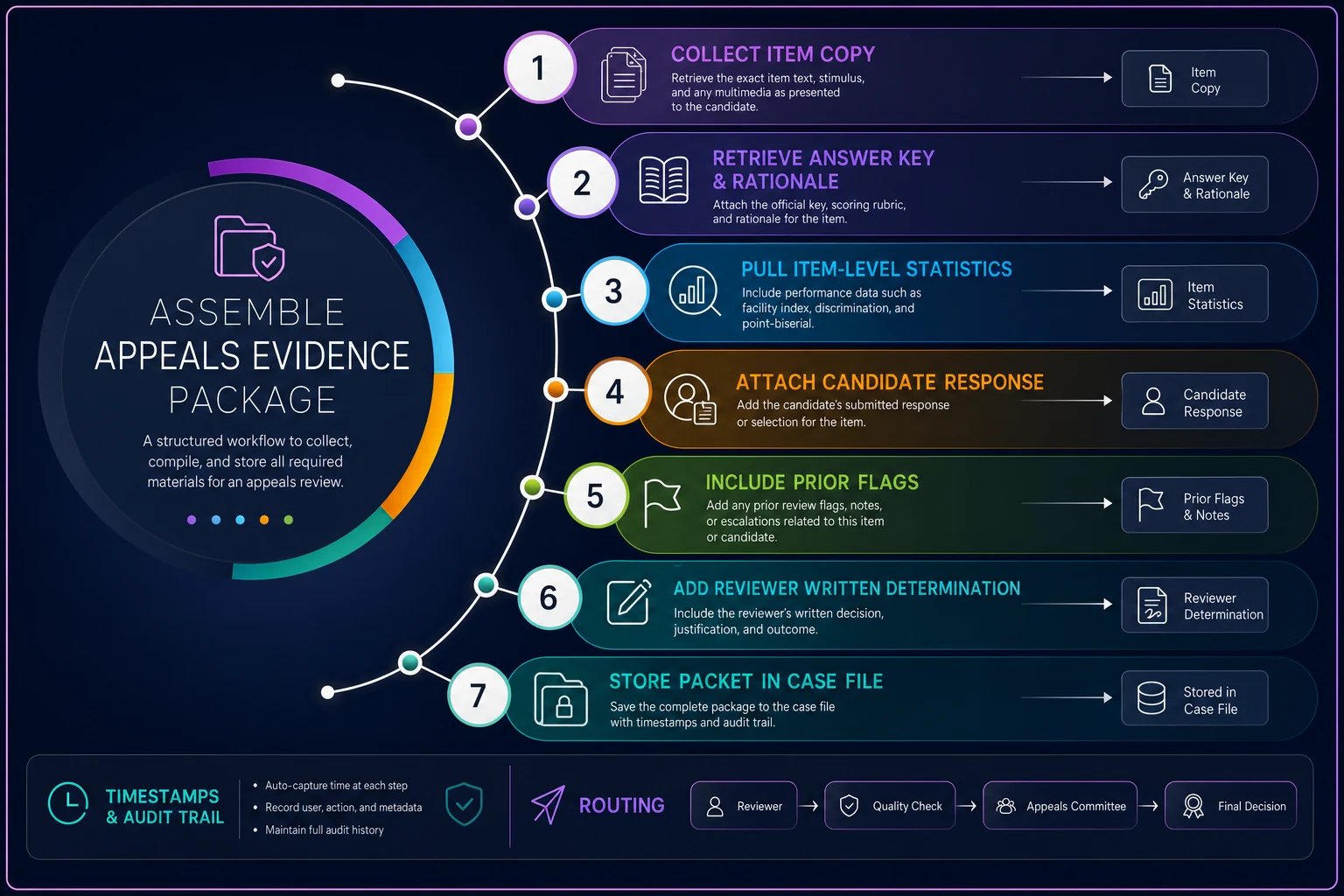
The evidence package is what makes a decision defensible six months later when a candidate's attorney asks why. For each appeal type, you assemble a standard packet before the reviewer ever weighs in — so they're deciding on a complete record, not whatever ended up in the email thread.
-
The item exactly as presented to the candidate (including the specific form or version they saw)
-
The answer key and the keying rationale
-
Item-level statistics — p-value, point-biserial, how the distractors behaved
-
The candidate's actual response
-
Any prior flags on that item from field testing or earlier review
-
The reviewer's written determination
That sixth item is the one everyone skips and later regrets. A decision without a recorded rationale is indefensible by definition. "We reviewed it and the key stands" is not a determination — it's a dismissal. The record needs to show what was reviewed and why the conclusion follows.
The discipline is assembling the package the same way every time. When reviewers receive a consistent, complete packet, their decisions get more consistent too — because they're all looking at the same evidence in the same order, not reacting to whatever the candidate chose to emphasize.
When reviewers receive a consistent, complete packet, their decisions get more consistent too — because they're all looking at the same evidence in the same order, not reacting to whatever the candidate chose to emphasize.
Timelines that people actually hit
A timeline nobody follows is worse than no timeline, because now you've published a commitment you're breaking. The fix is making each stage short, clearly owned, and gated.
-
Filing window candidate has 10 business days from score release to file. Hard cutoff, stated in the results communication.
-
Acknowledgment confirm receipt within 2 business days. This single step eliminates most "you ignored me" escalations.
-
Completeness check within 3 business days, either accept the appeal as complete or request the one missing piece. Don't let a half-complete appeal sit for a week before telling someone something's missing.
-
Review and determination 10 business days from a complete file.
-
Communication of outcome within 2 business days of the determination.
The hidden failure in most timelines is the completeness check. Programs skip it, let incomplete appeals enter the review queue, and then the reviewer stalls waiting on information nobody formally requested. Gating completeness up front means the review clock only starts when the file is actually reviewable — which is both faster and fairer.
Second-level appeals need their own, tighter window and a different decision-maker than the first round. Having the same person hear both levels defeats the entire point of a two-tier process.
The decision matrix: removing "it depends"
This is where consistency is won or lost. A decision matrix maps each type of claim, under each condition, to a standard outcome. It doesn't remove judgment — it removes arbitrary judgment.
| Condition | Standard outcome |
|---|---|
| Item has a genuine keying error (two correct answers) | Rescore for all affected candidates, not just the appellant |
| Item is defensible; candidate misread | Uphold score, explain the keying rationale |
| Item is statistically flawed (negative point-biserial, misbehaving) | Flag item for review/removal; adjust scores per policy |
| Candidate disputes difficulty, not correctness | Uphold; difficulty is not grounds for appeal |
That first row matters more than people realize. When an appeal reveals a real keying error, you cannot fix it only for the person who complained. Every candidate who saw that item is affected, and a defensible program rescores all of them. Fixing it only for the appellant creates exactly the inconsistency you were trying to prevent — now the outcome depends on whether someone complained, which is the opposite of defensible.
The matrix also protects reviewers. When an SME can point to a documented rule — "difficulty isn't grounds for appeal" — they're not making an unpopular personal call. They're applying a published standard, which takes the heat off them and keeps decisions aligned across reviewers.
Templated communications that don't make things worse
Communication is where tone-deaf handling turns a resolvable dispute into a formal complaint. Templates for each stage, written once and reviewed with a legal eye, are worth the investment.
-
Acknowledgment — confirms receipt, states the timeline, names no outcome
-
Completeness request — specific about exactly what's missing, with a deadline
-
Uphold decision — explains the rationale plainly, references the standard applied, states next-level options
-
Rescore/adjustment decision — confirms the change and when it takes effect
-
Second-level outcome — the final word, clearly marked as final
The uphold template is the one that gets programs into trouble most often. A denial written defensively ("after thorough review, your appeal is denied") reads as a brush-off and invites escalation. A denial that actually explains — "item 14 was reviewed by two SMEs; the keyed answer is correct because X, and the option you selected is incorrect because Y" — tends to close the dispute even when the candidate isn't happy about it. People escalate when they feel unheard far more than when they feel they lost fairly.
Keep templates factual and avoid anything that reads as an admission beyond the specific decision. "We're sorry you had a poor experience" sounds considerate but can be read as conceding a flaw you haven't established. Stick to the determination and the reasoning.
A short real scenario
A regional professional-licensure program — around 2,500 annual test-takers — was drowning in appeals after moving to remote delivery. Appeals were handled by whoever picked them up, resolution routinely dragged past three weeks, and an internal review found inconsistent outcomes on similar complaints often enough to make people nervous.
They rebuilt around four things: a routed intake form, standard evidence packages per appeal type, a gated timeline with a mandatory completeness check, and a decision matrix their SMEs actually used. Nothing exotic. Within a couple of exam cycles, resolution time dropped to roughly 8–9 days, and when they audited outcomes again, the inconsistency had largely closed — because every reviewer was working from the same packet against the same published rules.
The more interesting result wasn't the speed. Overall appeal volume fell, because the uphold communications finally explained reasoning. Candidates who received a clear, specific "here's why" stopped re-filing and stopped escalating.
Where tooling genuinely helps — and where it doesn't
Most of this is process, not software. A defensible appeals process can run in a spreadsheet and a shared folder if the discipline is there. What tooling actually buys you is the thing discipline alone struggles with at volume: the audit trail.
When appeals live across email threads, Slack messages, and someone's desktop, reconstructing a decision history is painful and the record is always incomplete. A workflow system that captures intake, routes by appeal type, timestamps each stage, stores the evidence package against the case, and logs both the determination and the communication sent — that's what makes everything genuinely defensible under later scrutiny. Some teams use AI-powered operational software to handle the mechanical pieces: sending acknowledgments the moment an appeal is filed, flagging cases approaching a deadline, and pulling the standard evidence set into the case file so reviewers aren't assembling it by hand every time.
That's useful, but keep the priority straight. Automating a bad appeals process just produces bad outcomes faster. Build the four core components first — intake, evidence, timeline, matrix — and let the tooling carry the record-keeping and reminders once the logic is sound.
When a heavy appeals process makes sense — and when it doesn't
A full playbook like this is worth building when appeals are high-stakes: licensure, certification, regulated hiring, anything where a decision affects someone's career or where an auditor or court could eventually review it. In those contexts, defensibility is the entire point, and the overhead pays for itself the first time a decision gets challenged.
It's overkill for low-stakes internal quizzes or formative assessments where disputes are really just feedback requests. If a wrong answer on a training check-in has no real consequence, you don't need a decision matrix — you need a quick explanation and to move on. Forcing a formal appeals process onto low-stakes assessment just adds friction and makes people resent the whole program.
The teams that get this wrong tend toward one of two extremes: no process at all for high-stakes exams, or a bureaucratic maze bolted onto trivial ones. Match the weight of the process to the weight of the decision.
The point of all of this isn't to deny more appeals or win more disputes. It's to make sure two candidates with the same complaint get the same answer, that every decision can be explained from the record, and that the people handling appeals aren't inventing the process fresh each time. Get the intake, evidence, timeline, matrix, and communications right, and most of what currently feels like chaos becomes something routine — faster for your staff, fairer for candidates, and capable of withstanding whatever scrutiny eventually comes.
Ready to revolutionize your evaluation process?
Join over 2,000 organizations using Evaloly to optimize assessments, improve learner outcomes, and make data-driven decisions.