

Assessment accommodations feel straightforward until you're staring at a federal lawsuit. Most organizations handle accommodation requests with good intentions and zero operational structure—approving extra time here, allowing a reader there, maybe documenting it in an email somewhere. Then the audit comes, or worse, the discrimination complaint lands on your desk.
The problem isn't that people don't care about fairness. It's that accommodations live in this weird gap between legal compliance, assessment integrity, and actual human needs. HR owns the ADA piece, Learning & Development owns the test, IT owns the testing platform, and somehow nobody owns the workflow connecting all three. What starts as "just give them extra time" turns into a validity nightmare that undermines your entire assessment program.
I've watched organizations scramble through accommodation audits, desperately trying to piece together decision trails from scattered emails and inconsistent spreadsheets. One healthcare training company discovered they'd been granting accommodations that fundamentally changed what their certification tests actually measured. Their nursing competency exam included timed medication calculations—a core safety skill. When they allowed unlimited time as an accommodation, they weren't measuring the same competency anymore. The test became legally indefensible.
Why accommodations break at the operational level
The typical accommodation workflow looks deceptively simple. Someone requests an accommodation, somebody approves it, the test gets modified, everyone moves on. But watch what happens across a few dozen requests and the chaos becomes obvious.
Requests come in through multiple channels—some through HR, some directly to trainers, others through testing platform support tickets. Each channel has different documentation standards. HR might require medical documentation, while a well-meaning manager approves based on a verbal conversation. The testing team finds out about accommodations minutes before the exam starts, if at all.
Approval decisions get made by whoever's available. The HR specialist who understands ADA requirements might approve extended time without realizing the assessment measures speed as a critical competency. The subject matter expert who knows the test inside-out denies reasonable requests because they don't understand legal obligations. Neither documents their reasoning in a way that holds up under scrutiny.
Implementation becomes its own mess. Your standard testing platform might handle extra time fine, but what about read-aloud features? Alternative formats? Modified instructions? Testing coordinators end up creating workarounds—running separate sessions, using a different platform, or in the worst cases, just adjusting scores manually afterward. Every workaround introduces new validity threats and audit gaps.
Then six months later, when someone challenges their results or files a complaint, you need to prove accommodations were implemented consistently. But the approval emails are scattered across five inboxes, modifications aren't logged anywhere, and nobody can explain why one person got double time while another got time-and-a-half for the same documented condition.
The validity trap nobody talks about
What keeps assessment professionals up at night: accommodations can completely invalidate your test results, but refusing them can violate federal law. You're required to provide equal access, but you also need to maintain measurement fundamentals that ensure your assessments actually measure what they claim to.
Eliminate assessment bottlenecks.
Evaloly simplifies every step from test design to results analysis, making assessments faster and more reliable.
- Customizable test creation
- Automated grading and analytics
- Secure distribution and proctoring
No credit card required
Take a customer service assessment that includes responding to timed chat scenarios. The timing element isn't arbitrary—it reflects the real-world requirement where customers expect responses within specific windows. Grant unlimited time as an accommodation, and you're no longer measuring job-relevant performance. But deny the accommodation without proper documentation of why timing is essential, and you're facing a discrimination claim.
The validity issues compound when accommodations aren't tracked properly. Statistical analyses assume all test-takers completed the same assessment under comparable conditions. When some candidates have modifications you didn't account for, your percentile rankings become meaningless, your cut scores lose their foundation, and your entire validation study might be compromised.
Most organizations discover these problems during litigation. A candidate challenges their failure, the investigation reveals inconsistent accommodation practices, and suddenly the entire assessment program is under scrutiny. The legal team asks for documentation that doesn't exist. The validation studies didn't account for modified conditions. What seemed like individual accommodations snowball into systemic validity questions.
Building an assessment accommodations policy that actually works
A functioning accommodations policy starts with clarity about what you're actually measuring. Not the generic "knowledge and skills" language from your competency framework—the specific constructs your assessment targets. If speed is essential to the job, document why. If working memory matters, explain how. This isn't about limiting accommodations. It's about understanding which modifications preserve validity and which ones change what you're measuring entirely.
Your intake process needs structure that captures the right information upfront. Not a 10-page medical questionnaire, but targeted fields that connect the requested accommodation to specific assessment barriers. What aspect of the standard testing format creates the barrier? How does the requested modification address it? What alternative modifications might achieve the same access goal?
The approval workflow requires clear ownership and timelines. Who reviews medical documentation? Who determines whether a modification affects validity? Who has final approval authority? One organization I worked with created a simple review panel—HR specialist for legal compliance, subject matter expert for validity concerns, and testing coordinator for implementation feasibility. Requests got reviewed within 72 hours, decisions were documented centrally, and everyone knew their role. Not complicated, but it worked.
Implementation standards prevent the chaos of one-off workarounds. Define exactly how each approved accommodation type gets implemented. Extra time means exactly 50% additional, not "roughly double" depending on who's proctoring. Read-aloud means using the platform's built-in screen reader, not having someone read over their shoulder. Every modification needs a standard protocol that testing staff can execute consistently.
Flag accommodated results in your analysis pipeline so validity checks run automatically on every reporting cycle.
Post-assessment validity checks close the loop. Flag accommodated results in your analysis. Run separate statistics to confirm that modified conditions didn't systematically advantage or disadvantage anyone. Document validity limitations for stakeholders. This isn't about questioning individual results—it's about maintaining the integrity of your overall program.
The operational checklist that prevents disasters
Intake Documentation Requirements:
-
Specific barrier identified (not just the disability category)
-
Connection between barrier and requested modification
-
Previous accommodations received for similar assessments
-
Alternative modifications considered
-
Timing requirements (when accommodation is needed)
Approval Decision Points:
-
Does the modification fundamentally alter what we're measuring?
-
Can we achieve equal access through alternative means?
-
Do we have technical capability to implement as requested?
-
Have we provided similar modifications for comparable situations?
-
Is the approval timeline reasonable for implementation?
Implementation Standards:
-
Testing platform configuration requirements
-
Proctor instructions and training needs
-
Separate testing sessions or locations needed
-
Modified materials preparation timeline
-
Technical testing requirements before live assessment
Audit Trail Essentials:
-
Request date and channel
-
Reviewer names and roles
-
Decision rationale documented
-
Implementation confirmation
-
Post-assessment validity flags
-
Result reporting modifications
Quality Control Checks:
-
Monthly review of approval consistency
-
Quarterly validity impact analysis
-
Annual policy compliance audit
-
Incident documentation and resolution tracking
-
Stakeholder feedback integration
Quality Control Checks:
Real templates that standardize your accommodations workflow
Accommodation Request Intake Form:
Section 1: Assessment Information
-
Assessment name and date
-
Purpose (certification, placement, diagnostic)
-
Standard testing conditions (time, format, environment)
Section 2: Barrier Identification
-
Specific assessment features creating barriers
-
How barriers prevent demonstrating knowledge/skills
-
Impact without accommodation
Section 3: Requested Modifications
-
Primary accommodation requested
-
How modification addresses identified barrier
-
Previous accommodations that worked/didn't work
Section 4: Documentation
-
Professional documentation attached (Y/N)
-
Documentation date and provider
-
Functional limitations described
Approval Decision Record:
Review Panel Assessment:
-
Legal compliance review (HR)
[APPROVED/CONCERNS/DENIED]
-
Validity impact review (SME)
[NO IMPACT/MINOR IMPACT/MAJOR IMPACT]
-
Implementation feasibility (Testing)
[STANDARD/CUSTOM/NOT POSSIBLE]
Decision:
-
Accommodation approved as requested
-
Alternative accommodation offered
-
Accommodation denied with rationale
Implementation Notes:
-
Specific modifications to standard protocol
-
Required preparations
-
Assigned coordinator
-
Confirmation method
Post-Assessment Validity Report:
| Section | Details |
|---|---|
| Accommodation Statistics | Total accommodated: X of Y test-takers; Types granted: Extended time (X%), Format changes (Y%), Environment (Z%); Implementation issues noted: [LIST] |
| Validity Analysis | Score distribution comparison (accommodated vs standard); Completion rate differences; Item performance variations; Time utilization patterns |
| Recommendations | Policy adjustments needed; Training requirements identified; System improvements suggested |
Post-Assessment Validity Report:
The coordination reality across HR, L&D, and operations
Accommodations sit at the intersection of three organizational worlds that rarely talk to each other effectively. HR owns compliance but doesn't understand assessment validity. L&D owns the test content but doesn't grasp legal requirements. Operations handles the actual testing but gets caught between conflicting directives.
Watch what happens with a typical request. It lands in HR because the employee knows that's where ADA issues go. HR approves extended time because that's the standard accommodation for the documented condition. They send an email to L&D saying "give Jamie extra time on Thursday's assessment." L&D forwards this to whoever's proctoring with no context. The proctor, managing fifteen other test-takers, tries to figure out how to add time in a system they barely understand.
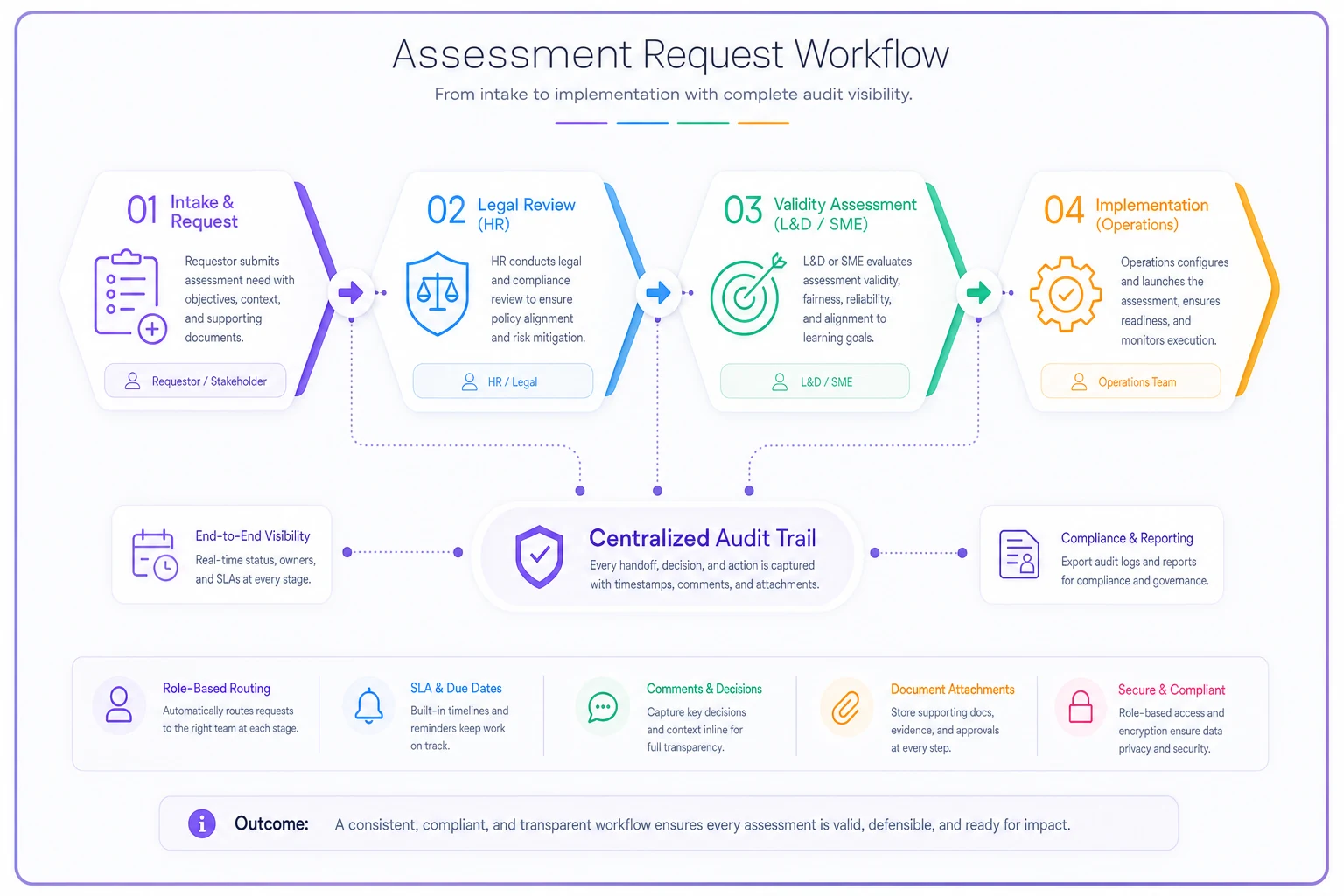
This diagram shows the handoffs and the centralized audit trail that captures each department's actions.
Nobody told the reporting team that Jamie's results need different interpretation. Validity wasn't assessed because the SME never knew about the modification. The implementation wasn't documented because everyone assumed someone else was tracking it. Three departments touched the accommodation, and nobody owned the full workflow.
The fix isn't more meetings. It's clear handoffs with specific accountability. HR validates legal compliance and documents the functional need. L&D assesses validity impact and defines implementation requirements. Operations confirms technical capability and executes the modification. Each step has an owner, a timeline, and a documentation requirement.
One pharmaceutical company restructured their accommodation workflow after a near-miss with FDA auditors. They built a shared tracking system—not fancy software, just a structured spreadsheet all three departments could access. Every accommodation request got a tracking number. Each department logged their piece: HR's compliance check, L&D's validity assessment, Operations' implementation confirmation. The full decision trail lived in one place. Their next audit went from three weeks of scrambling to a two-hour document review.
When accommodations become an operational advantage
Most organizations miss this: a well-run accommodations process actually improves your entire assessment operation. The discipline required to handle accommodations properly forces you to clarify what you're measuring, standardize implementations, and document decisions. These improvements benefit everyone.
The clarity you develop about essential test requirements helps you design better assessments. When you've documented that timing is essential because the job requires rapid decision-making under pressure, you build better time-pressured scenarios. When you've identified that visual pattern recognition is core to the role, you create more targeted assessments. The accommodation analysis makes your standard tests stronger.
The implementation protocols you create for accommodations also standardize your overall testing operations. The checklist for setting up extended time sessions becomes the foundation for all special testing situations. Documentation requirements for modifications improve your general record-keeping. Quality controls for accommodated assessments catch problems in your standard process too.
Some organizations have turned their accommodation capabilities into actual competitive advantages. A tech company's robust accommodation process became a recruiting tool—candidates with disabilities knew they'd get a fair shot. A healthcare system's detailed accommodation tracking helped them defend against three separate legal challenges. A financial services firm's accommodation data revealed that certain modifications improved validity for specific roles, leading to better overall test design.
The software coordination gap
Managing accommodations across disconnected systems creates most of the operational chaos. Requests come through email or paper forms. Approvals live in HR systems. Implementations happen in testing platforms. Documentation is scattered. Every handoff introduces risk, delays, and lost information.
Modern assessment platforms need accommodation workflows built into their core operations, not tacked on as an afterthought. The intake form should route automatically to the right reviewers. Approval decisions should trigger implementation protocols. Modifications should be logged automatically with results. The audit trail should generate itself through normal operations.
AI-assisted platforms help by standardizing the repetitive parts while preserving human judgment where it matters. Automated workflows ensure nothing falls through the cracks—if HR approves but L&D hasn't reviewed validity within 48 hours, the system escalates. Implementation checklists surface automatically for testing coordinators based on the approved modifications. The system handles routing, tracking, and standard implementations. People handle the judgment calls, edge cases, and quality assurance.
That balance matters. Over-relying on automated controls without maintaining human oversight creates its own risks—whether in proctoring, accommodation enforcement, or any other part of your testing operation. The goal is reducing the manual coordination burden, not removing human accountability from decisions that affect real people.
Moving from reactive scrambling to systematic accommodation
Stop treating accommodations as exceptions to manage and start seeing them as core operations to optimize. Every organization that conducts assessments will face accommodation requests. The question isn't whether you'll need these processes—it's whether you'll build them before or after the crisis hits.
Start with a basic intake form that captures what you actually need to make decisions. Not perfect, just better than scattered emails. Define approval authority—who can say yes to what. Document decisions somewhere centralized, even if it's just a shared spreadsheet. Create basic implementation protocols for your most common accommodations. Set up quarterly reviews to spot patterns and problems.
Most importantly, stop letting accommodations live in isolation. Connect them to your broader assessment strategy. Use accommodation patterns to improve test design. Let modification requests reveal barriers in your standard process. Track accommodation outcomes alongside your regular validity studies.
The organizations getting this right don't have perfect systems or unlimited resources. They've accepted that accommodations are part of running assessments, not an annoying exception. They've built simple processes that scale. They've trained their teams on both legal requirements and validity concerns. They've created documentation habits that protect everyone—the organization, the test-takers, and the assessment program itself.
Your assessment accommodations policy isn't just about compliance or avoiding lawsuits. It's about maintaining the integrity of your entire assessment operation while ensuring fair access for everyone. The same operational discipline that handles accommodations well improves your standard testing, strengthens your validity arguments, and builds trust in your results.
The templates and checklists aren't bureaucracy—they're the infrastructure that lets you deliver on both fairness and validity, consistently, at scale.
Ready to revolutionize your evaluation process?
Join over 2,000 organizations using Evaloly to optimize assessments, improve learner outcomes, and make data-driven decisions.