


The hardest question in any learning program isn't "did people pass the assessment?" It's "are they still using this six weeks later, and did it change anything that matters to the business?"
Most teams answer the first question well and completely dodge the second. They run a post-course quiz, see an 84% pass rate, and call it a win. Then a VP asks, "Okay, but did onboarding time actually drop?" and the room goes quiet. That gap — between a clean assessment score and a defensible impact claim — is where measuring learning retention lives, and it's mostly an operational problem, not a statistical one.
This is about the cohort mechanics: how to pick who you measure, when you measure them again, what confounders will wreck your conclusion, and how to write the whole thing up so a skeptical executive believes you without needing a stats degree.
The core failure: measuring the wrong people at the wrong time
There's a pattern that quietly ruins most retention studies.
A company rolls out a new customer-service training. Everyone takes it in Q1. Six months later, complaint-handling time is down 12%, and L&D claims the win. Except three other things happened in those six months: a new CRM shipped, two senior reps got promoted into coaching roles, and the team stopped handling a low-margin product line that generated the messiest tickets.
So which one moved the number? Nobody knows. The training might have done nothing, or it might have done everything. The measurement was set up in a way that made attribution impossible from day one.
The failure almost never happens at the analysis stage. It happens at the design stage, when someone decides "we'll just measure everyone before and after" without thinking about comparison groups, timing, or what else is changing in the environment. By the time you're staring at the data, the damage is already baked in.
Cohort selection: who you measure decides what you can claim
The instinct is to measure everyone who took the training. Feels thorough. It's actually the weakest possible design, because you have nothing to compare against. A pre/post change with no comparison group can always be explained away by "things would have improved anyway."
Eliminate assessment bottlenecks.
Evaloly simplifies every step from test design to results analysis, making assessments faster and more reliable.
- Customizable test creation
- Automated grading and analytics
- Secure distribution and proctoring
No credit card required
You need a comparison. The question is how much rigor the decision actually justifies. A $4k lunch-and-learn doesn't need a randomized trial. A $200k leadership program that leadership wants to expand company-wide does.
| Design | What it controls for | Effort | Use when |
|---|---|---|---|
| Single-group pre/post | Almost nothing | Very low | Low-stakes, you just want a directional signal |
| Non-equivalent comparison group | Some external events | Medium | You have a similar untrained group available |
| Staggered rollout (wait-list) | Timing + external events | Medium-high | You're rolling out in phases anyway |
| Matched cohorts | Individual differences | High | High-stakes claim, no random assignment possible |
The staggered rollout is underused and it's often free. If you're deploying training to five regions over four months anyway, you've accidentally created a natural experiment. Region 1 trained in January becomes the "treated" group; Regions 4 and 5, not yet trained, become your comparison for that window. You didn't add cost — you just sequenced the rollout deliberately and measured the untrained regions during the same period.
Sample-selection heuristics that keep you honest
-
Don't let people self-select into the "measured" group. Volunteers who sign up for follow-up assessments are systematically more engaged. Their retention will look great and mean nothing.
-
Include the dropouts. If 30 people started and 22 finished, and you only measure the 22, you're measuring survivors. Report both, and be honest that the 8 who left might have struggled most.
-
Match on the thing that predicts your outcome, not on convenience. If you're measuring sales-skill retention, match cohorts on baseline sales numbers and tenure — not on which office they sit in.
-
Keep cohorts small enough to actually track. A tight group of 40 people you follow completely beats 400 people you follow at a 20% response rate. Sparse follow-up data is where studies go to die.
The mistake that comes up constantly: teams optimize for a big N and end up with a huge, half-empty dataset that can't support any conclusion. A smaller, fully-tracked cohort is worth more.
Pre and post measures: measure the behavior, not just the recall
A post-training quiz measures whether someone can recognize the right answer. Retention — the thing you actually care about — is whether they do the right thing weeks later when no one's watching.
So your pre/post measures should include at least one thing that isn't a knowledge check. Three types worth using:
-
Knowledge measure — the quiz. Fine as a baseline, weakest as an impact claim.
-
Applied measure — a scenario or work-sample task. "Here's a messy customer ticket, handle it." This survives the "but do they actually apply it?" objection.
-
Behavioral/operational measure — something pulled from real work: average handle time, error rate, code review rejections, upsell rate. This is what executives believe.
The trap with applied and behavioral measures is that they need a clean baseline. You can't claim "handle time dropped" if you never captured handle time before the training with the same definition. An astonishing number of programs discover, three months in, that the pre-period data was measured differently and isn't comparable. Lock your measurement definitions before the training starts and write them down.
One more thing on pre-tests: they can contaminate your results. If people take a pre-test and it primes them on exactly what to focus on, the post-test improvement partly reflects the pre-test, not the training. For high-stakes designs, give the pre-test to only half the group so you can check whether pre-testing itself moved the needle.
Follow-up intervals: the curve is steeper than you think
The single most common timing mistake is measuring retention once, right after the course, and calling it retention. That's not retention — that's short-term recall, and it decays fast.
Real skill and knowledge follow a rough decay curve. Without reinforcement, a significant chunk of freshly-trained content fades within the first few weeks. If you measure only at week one, your numbers are inflated. If you measure only at month six, you miss whether there was ever a spike at all and can't tell decay from "it never landed."
-
Immediate (day 0–3) confirms the material transferred at all. Baseline for decay.
-
Short (week 3–4) catches the first, steepest drop. This is where most forgetting happens.
-
Medium (week 8–12) the interval that actually predicts whether it stuck.
-
Long (month 6+) only worth doing for high-value programs or when you're deciding whether to invest in refreshers.
You don't need all four for every program. For a routine compliance refresher, day-0 and week-8 is plenty. For a flagship leadership program you're spending real money on, you want the full curve because the shape of the decay tells you where to add reinforcement.
Practical note: response rates crater at longer intervals. Plan for it. Build the follow-up into an existing touchpoint — a team meeting, a QBR, a system people already log into — rather than sending a standalone survey that gets ignored. A follow-up assessment that lives inside a workflow people already use will get triple the response of a cold email.
Confounder checks: the part everyone skips
This is where most retention claims fall apart under questioning, so it's worth being systematic. Before you write a single sentence of your impact narrative, run through the things that could explain your result other than the training.
-
History — something else happened in the same window (new tool, reorg, market shift, seasonality). The CRM example from earlier.
-
Maturation — people just get better at their jobs over time regardless of training. New hires especially improve fast in their first months no matter what you do.
-
Selection — your groups weren't comparable to begin with.
-
Regression to the mean — if you trained the worst performers, they'd likely improve anyway, because extreme scores drift back toward average on their own. This one fools people constantly.
-
Instrumentation drift — you changed how you measured mid-study. Different rater, different definition, new dashboard logic.
-
Attrition — the people who left were different from the people who stayed.
A simple confounder check workflow that takes an afternoon:
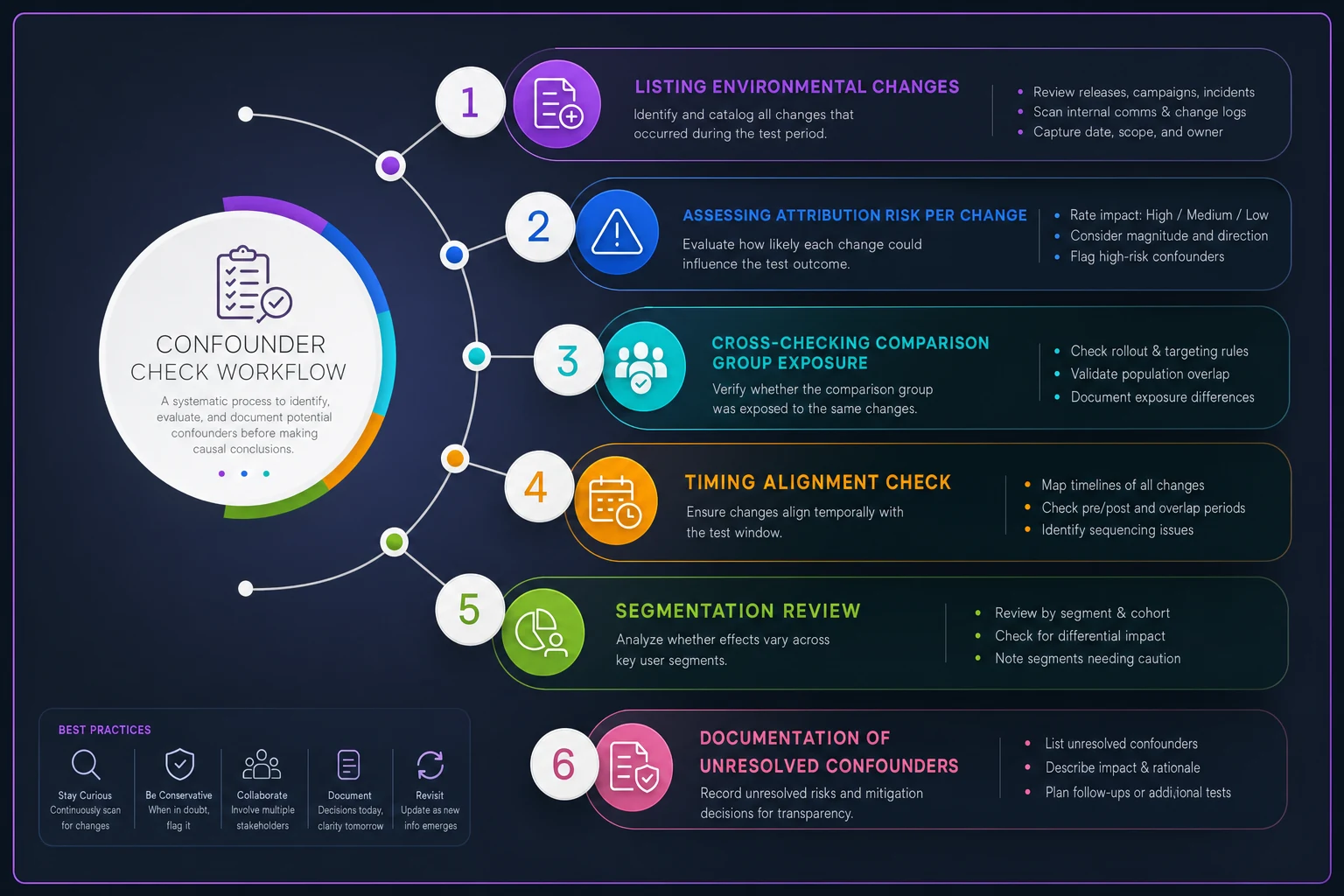
Use this quick workflow to surface the things that could plausibly explain your result.
-
List every significant change that hit the target group during your measurement window. Actually ask the managers — they know about the reorg you forgot.
-
For each change, ask
"Could this alone produce the result I'm seeing?" If yes, you can't cleanly attribute the effect to training.
-
Check your comparison group for the same confounders. If the CRM shipped to both the trained and untrained groups, it's controlled for and you can relax.
-
Look at the timing. If the outcome improved before the training was fully delivered, the training didn't cause it.
-
Segment your result. If the improvement is concentrated entirely in one team that also got a new manager, be suspicious.
The honest teams document the confounders they couldn't rule out and say so in the write-up. Counterintuitively, this makes stakeholders trust the whole report more, because it signals you're not just selling a win.
When rigorous measurement is a bad idea
Not every program deserves this level of scrutiny. Applying a matched-cohort, four-interval design to a 45-minute onboarding module is a waste of everyone's time and makes your team look like it's inventing work.
Skip the heavy design when:
-
The training is cheap, mandatory, and not up for a spend decision.
-
The stakes of being wrong are low.
-
You don't have a plausible comparison group and can't create one.
-
The outcome you'd measure is too noisy to detect a realistic effect — if handle time swings 40% week to week for unrelated reasons, you won't see a 5% training effect no matter how clean your design.
In those cases, a simple completion metric and a light satisfaction check is the right amount of effort. Spend your rigor budget on the programs where a real decision hangs on the answer.
A real scenario: onboarding retention at a mid-size services firm
A professional-services firm with around 180 employees revamped its new-hire onboarding for billable consultants. The old program was a two-day firehose; the new one spread the same content over four weeks with spaced practice. L&D wanted to prove the redesign was worth the added coordination effort before rolling it firm-wide.
Instead of measuring everyone, they used the rollout timing. New hires starting in Q1 got the old program; new hires in Q2 got the redesign — same roles, similar backgrounds, roughly 20 people per cohort. They defined the outcome upfront: weeks to first fully-billable engagement, pulled straight from the timesheet system, plus an applied case exercise at week 3 and week 10.
Results after tracking both cohorts:
-
Time-to-billable dropped from roughly 9 weeks to about 6.5 weeks in the redesign cohort.
-
Week-10 applied scores held far steadier — the old cohort's scores had visibly decayed from week 3, the new cohort's barely moved.
-
One confounder surfaced
the Q2 cohort had two people with prior consulting experience, which could inflate the result. They re-ran the comparison excluding those two and the effect held, just slightly smaller.
The reason leadership approved the firm-wide rollout wasn't the headline number. It was that L&D presented the confounder check and the "excluding outliers" version proactively. There was no gotcha left for the CFO to find.
Turning it into a stakeholder-ready narrative
A defensible study still fails if the write-up reads like a stats appendix. Executives don't reward rigor they can't follow. The narrative has to carry the evidence in plain language while keeping the honesty intact.
-
The decision this informs. One sentence. "We're deciding whether to expand the onboarding redesign firm-wide." Frame it around a decision, not around data.
-
What we measured and why that measure matters to you. Tie it to something the stakeholder already cares about — time-to-billable, error rate, turnover.
-
What we found — the plain-language result with the number. "New hires reached full billing about 2–3 weeks sooner."
-
What we ruled out. The confounder check, stated simply. "We checked whether this was just the new CRM or a stronger hiring class — it held up after accounting for both."
-
What we couldn't rule out. The honest caveat. This is the trust-builder.
-
The recommendation and what it costs. End on the decision, not the analysis.
The instinct to bury the caveats is exactly backwards. The caveat section is what separates a credible report from marketing. For a deeper treatment of shaping these reports for different audiences, the approach in turning assessment data into decisions with stakeholder-specific reporting templates pairs directly with the narrative structure above — same principle, applied to who's in the room.
One phrasing rule worth internalizing: never say "the training caused" when your design can only support "the training was associated with." Executives who've been burned by inflated ROI claims notice the difference, and the moment they catch you overstating one result, they discount everything else you present.
The checklist before you run any retention study
Run through this before you collect a single data point:
-
- [ ] Have I defined the outcome measure and locked its definition in writing?
-
- [ ] Do I have a comparison group, or can I create one through rollout timing?
-
- [ ] Are the groups actually comparable on the things that predict the outcome?
-
- [ ] Did I capture a clean baseline using the exact same measurement I'll use later?
-
- [ ] Have I planned my follow-up intervals to catch the early decay, not just the immediate spike?
-
- [ ] Have I built follow-up into an existing workflow so response rates don't collapse?
-
- [ ] Did I list every major change in the environment during my measurement window?
-
- [ ] Am I including dropouts and non-responders, not just survivors?
-
- [ ] Does the effect I'm hoping to detect stand a chance against the natural noise in this metric?
-
- [ ] Do I have a plan to report what I couldn't rule out?
If more than a couple of these are unchecked, you're not measuring retention — you're generating a number you'll have to defend and can't.
The takeaway
Measuring learning retention rarely fails because the statistics were too hard. It fails because the cohort was chosen for convenience, the baseline was never captured cleanly, the follow-up happened once at the wrong time, and the confounders were never listed until someone in the room pointed one out.
Get the design right up front — a real comparison group, locked measures, follow-up intervals that respect the decay curve, and an honest confounder pass — and the analysis becomes almost boring. That's the goal. Boring analysis and a narrative that admits its own limits will win more budget than a dramatic result nobody trusts.
Measuring learning retention rarely fails because the statistics were too hard. It fails because the cohort was chosen for convenience, the baseline was never captured cleanly, the follow-up happened once at the wrong time, and the confounders were never listed until someone in the room pointed one out.
Get the design right up front — a real comparison group, locked measures, follow-up intervals that respect the decay curve, and an honest confounder pass — and the analysis becomes almost boring. That's the goal. Boring analysis and a narrative that admits its own limits will win more budget than a dramatic result nobody trusts.
Ready to revolutionize your evaluation process?
Join over 2,000 organizations using Evaloly to optimize assessments, improve learner outcomes, and make data-driven decisions.