
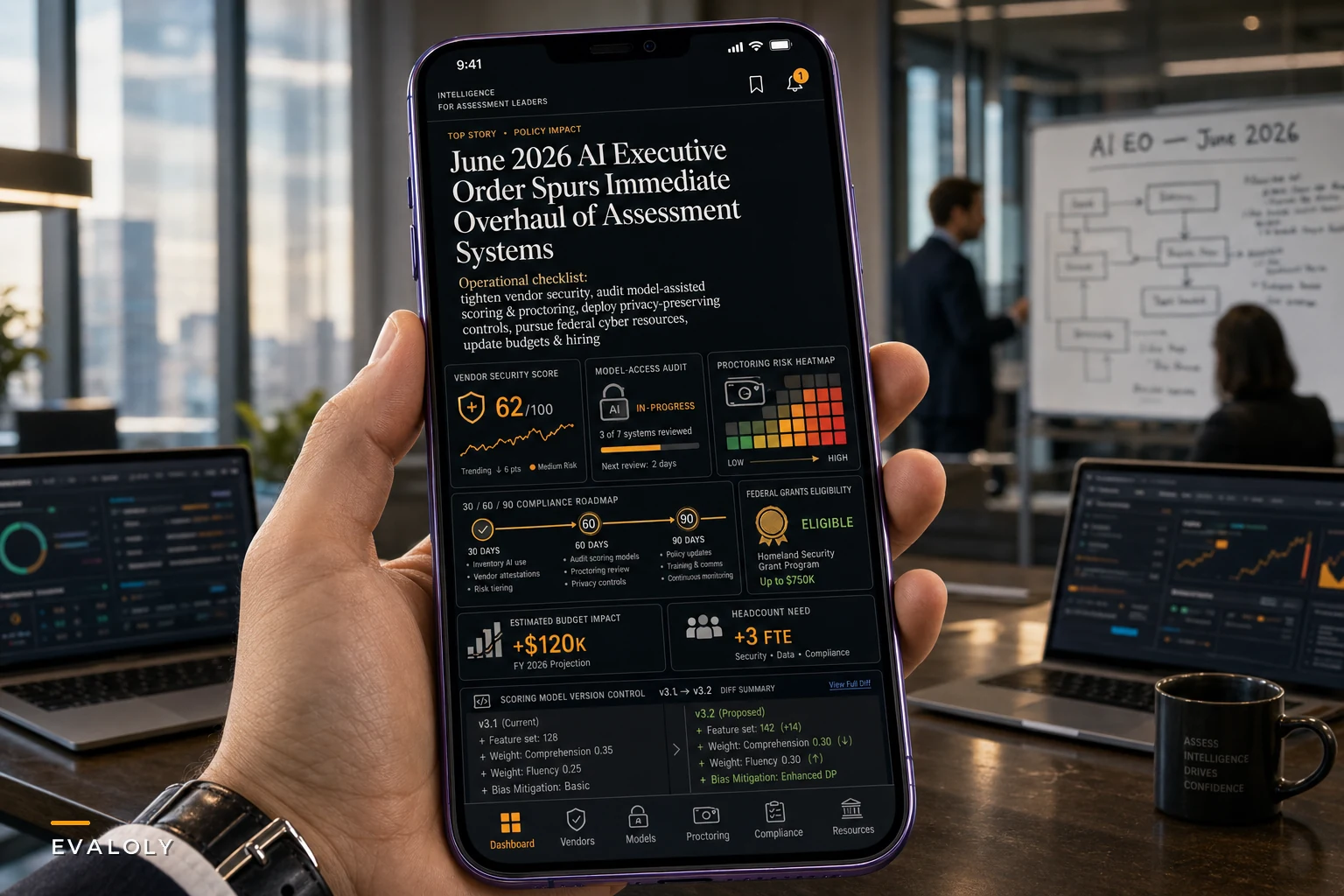

The new federal AI executive order just threw a wrench into every assessment platform in the country. According to the White House announcement, agencies have 30 to 60 days to establish binding cybersecurity directives for AI systems. That's basically tomorrow in institutional time.
If you manage assessments for a school district, corporate training program, or HR department, you're probably staring at vendor contracts right now wondering what this means for your testing platforms, proctoring tools, and scoring systems.
Most assessment vendors are nowhere near ready for the security requirements coming down the pipeline. The platforms collecting biometric data during remote proctoring, the AI scoring engines processing student essays, the adaptive testing algorithms adjusting difficulty in real-time — they're all about to face scrutiny levels they've never dealt with before.
The vendor problem nobody wants to talk about
Your assessment vendor probably runs on a stack of third-party AI services. The proctoring comes from one company, natural language processing for essay scoring from another, the adaptive algorithms from somewhere else entirely. Each layer introduces security risks that most procurement teams never even ask about.
A university IT team recently discovered their online testing platform was routing video feeds through servers in four different countries before the "AI-powered cheating detection" kicked in. The vendor's response? That's just how modern proctoring works. The privacy team nearly had a heart attack.
The executive order's requirement for early model access and vulnerability reporting means these nested vendor relationships become your problem. When the feds start asking assessment platforms about their AI supply chain, those questions roll downhill fast. Your vendor will ask their vendors, who'll ask their vendors, and suddenly you're trying to map security protocols for companies you've never heard of.
Most contracts don't even mention AI model updates or algorithm changes. The vendor can swap out their entire scoring engine overnight and you'd never know until students start getting wildly different results. Under the new guidelines, that kind of opacity won't fly. Federal contractors and grant recipients will need documentation about every AI component touching their assessment data.
Why traditional proctoring just became a massive liability
Remote proctoring was already walking a tightrope between security and privacy. Now that balance is completely shot. The order's emphasis on cybersecurity means assessment platforms need to lock down their AI systems, but the growing backlash against invasive monitoring means they can't just double down on surveillance.
Eliminate assessment bottlenecks.
Evaloly simplifies every step from test design to results analysis, making assessments faster and more reliable.
- Customizable test creation
- Automated grading and analytics
- Secure distribution and proctoring
No credit card required
Most proctoring systems do this: continuous video recording, browser lockdown, eye tracking, background audio monitoring, room scans. All that data feeds into AI models that flag "suspicious behavior." But vendors don't advertise that those models are often black boxes trained on datasets nobody can audit.
A corporate training manager told me about an incident where their proctoring AI flagged 40% of test-takers for "abnormal eye movement" during a certification exam. Turns out the model had been trained primarily on college students taking tests on laptops. Professional adults taking the same test on desktop monitors with larger screens naturally had different eye patterns. The vendor couldn't explain exactly why the flags happened or adjust the model without affecting their entire client base.
Under the new federal requirements, that kind of algorithmic mystery becomes a compliance nightmare. If your assessment system can't explain why it flagged someone, how do you defend that decision when federal auditors come knocking?
The privacy-first alternative most people haven't considered
This whole situation pushes assessment managers toward a different approach: privacy-preserving controls that secure tests without invasive monitoring. Instead of trying to watch everything a test-taker does, you design assessments that are inherently harder to cheat on.
Dynamic question pools with contextual variations
Rather than everyone getting the same 50 questions, each test pulls from a pool of 200+ items with slight variations. A math problem about calculating interest rates might appear with different numbers, timeframes, or scenarios for each test-taker. The core competency being tested stays consistent, but direct answer sharing becomes useless.
Time-boxed sequential sections
Break assessments into timed segments that must be completed in order. Once someone moves past section A, they can't go back. This prevents the classic "reconnaissance" approach where someone blazes through to see all questions, then retakes with prepared answers.
Open-resource design with application focus
Instead of trying to prevent access to external materials, design questions that assume test-takers have full internet access. Test their ability to apply, analyze, and synthesize rather than recall. A coding assessment might provide the documentation but require solving a novel problem. A compliance certification could present a complex scenario requiring interpretation of multiple regulations.
Behavioral baselines without surveillance
Track patterns like typing cadence, answer-change frequency, and time-per-question ratios — not through invasive monitoring but through normal test-taking metadata. Significant deviations from a user's established baseline trigger manual review, not automatic failure.
These methods work because they change the fundamental economics of cheating. Traditional proctoring tries to catch people in the act. Privacy-preserving controls make the act itself less valuable or practically impossible.
Building your vendor evaluation framework
With federal deadlines looming, you need a systematic way to evaluate assessment vendor security that goes beyond checking boxes on a standard questionnaire.
Start by mapping your data flow. Where does test content live? How do student responses travel from their device to the scoring system? Which third parties touch that data along the way? A midwest school district discovered their assessment platform was backing up to consumer-grade cloud storage without encryption. They only found out when preparing for a routine state audit.
| Security Layer | Questions to Ask | Red Flags to Watch For |
|---|---|---|
| Data Storage | Where specifically is assessment data stored? What encryption standards are used? | "Industry standard encryption" without specifics; data stored in regions with weak privacy laws |
| AI Model Access | Which AI models process our data? Can we audit them? How often do they change? | Proprietary models with no transparency; frequent unannounced updates |
| Third-Party Dependencies | What other companies' services are involved? What happens if one fails? | Long chains of subprocessors; no contingency plans for service outages |
| Incident Response | What's the notification timeline for breaches? Who's liable for AI-related errors? | Notification periods over 24 hours; liability waivers for algorithmic decisions |
| Compliance Documentation | Can you provide AI model cards? Security audit results? | "We're working on documentation"; audits older than 6 months |
Your vendors will push back on transparency requests. They'll claim proprietary concerns, competitive advantages, the usual deflections. But CNBC's coverage of the executive order makes it clear that voluntary compliance today becomes mandatory tomorrow. Vendors who won't share security details now won't survive the federal requirements coming next quarter.
Request model cards and recent security audit reports with specific deadlines during procurement to avoid vague 'industry standard' answers.
The evaluation process takes longer than most people expect. Plan for at least 3-4 weeks to get meaningful responses from vendors, longer if they need to coordinate with their own subprocessors. Start this immediately if you haven't already.
The budget conversation everyone's avoiding
Assessment security upgrades aren't cheap, and the executive order's timeline doesn't leave room for next year's budget cycle. You're looking at immediate costs across multiple categories.
First, the obvious stuff: upgraded platforms, enhanced security features, new proctoring systems that balance security with privacy. Figure somewhere between $15-40 per test-taker annually for enterprise-grade assessment platforms with proper AI governance built in. That's before you factor in migration costs, training, and the inevitable compatibility issues with existing systems.
But the hidden costs hit harder. You'll need someone who actually understands AI security to manage vendor relationships. Not just general IT security — someone who can evaluate whether a natural language processing model for essay scoring has appropriate bias testing, or whether your adaptive testing algorithm's decision tree could be reverse-engineered by students.
Then there's the compliance documentation burden. Every AI component needs documentation, regular audits, and ongoing monitoring. A university system in the southeast just hired two full-time positions solely to maintain AI governance documentation for their assessment platforms. That's $140k-180k annually that wasn't in anyone's budget six months ago.
Some organizations are pooling resources for shared evaluation and monitoring. Three community colleges in the same state negotiated as a group with their assessment vendor, getting better security terms and splitting the cost of third-party security audits. Still expensive, but manageable when distributed across institutions.
The math gets particularly painful for smaller organizations. A single community college might only have 3,000 assessment sessions per semester. Spreading enterprise security costs across that volume pushes per-test costs above $50. That's why the pooled purchasing approach makes so much sense for regional consortiums or related organizations.
What happens when you don't act fast enough
The penalties for non-compliance won't be abstract. Federal grant recipients who can't demonstrate proper AI security protocols risk funding suspension. One delayed federal education grant can crater an entire department's budget.
Beyond official penalties, the operational disruptions hurt worse. Imagine discovering your assessment platform doesn't meet new security requirements two weeks before certification exams. Or finding out mid-semester that your proctoring vendor got flagged in a federal security review. The scramble to find alternatives while maintaining testing integrity becomes a logistical nightmare.
A corporate training division went through this last year with a different compliance requirement. Their assessment vendor couldn't provide adequate documentation for GDPR compliance related to their AI scoring. They had three weeks to either get compliant documentation or switch platforms. They ended up running paper-based assessments for two months while migrating systems. The productivity hit was brutal — what normally took their team 20 hours per week suddenly required 60.
Emergency migrations cost roughly 3-5x normal implementation timelines. You're paying rush fees to new vendors, overtime to your team, and usually accepting suboptimal solutions because you don't have time to properly evaluate alternatives. One state university spent $180k on an emergency assessment platform switch that they later replaced again six months later with a better solution they didn't have time to find initially.
Making the pivot to operational efficiency
Smart assessment managers are using this compliance push as cover for broader operational improvements. If you're going to overhaul vendor contracts and security protocols anyway, might as well fix the workflow problems that have been plaguing your team for years.
This means centralizing assessment data that's currently scattered across platforms. Building automated workflows for test deployment and result processing. Creating unified dashboards that track everything from question performance to security incidents. The compliance requirements force vendor coordination, so use that leverage to demand better integration and data portability.
Here's a simple workflow diagram to illustrate how centralizing data and automating assessments can reduce manual work and improve compliance.
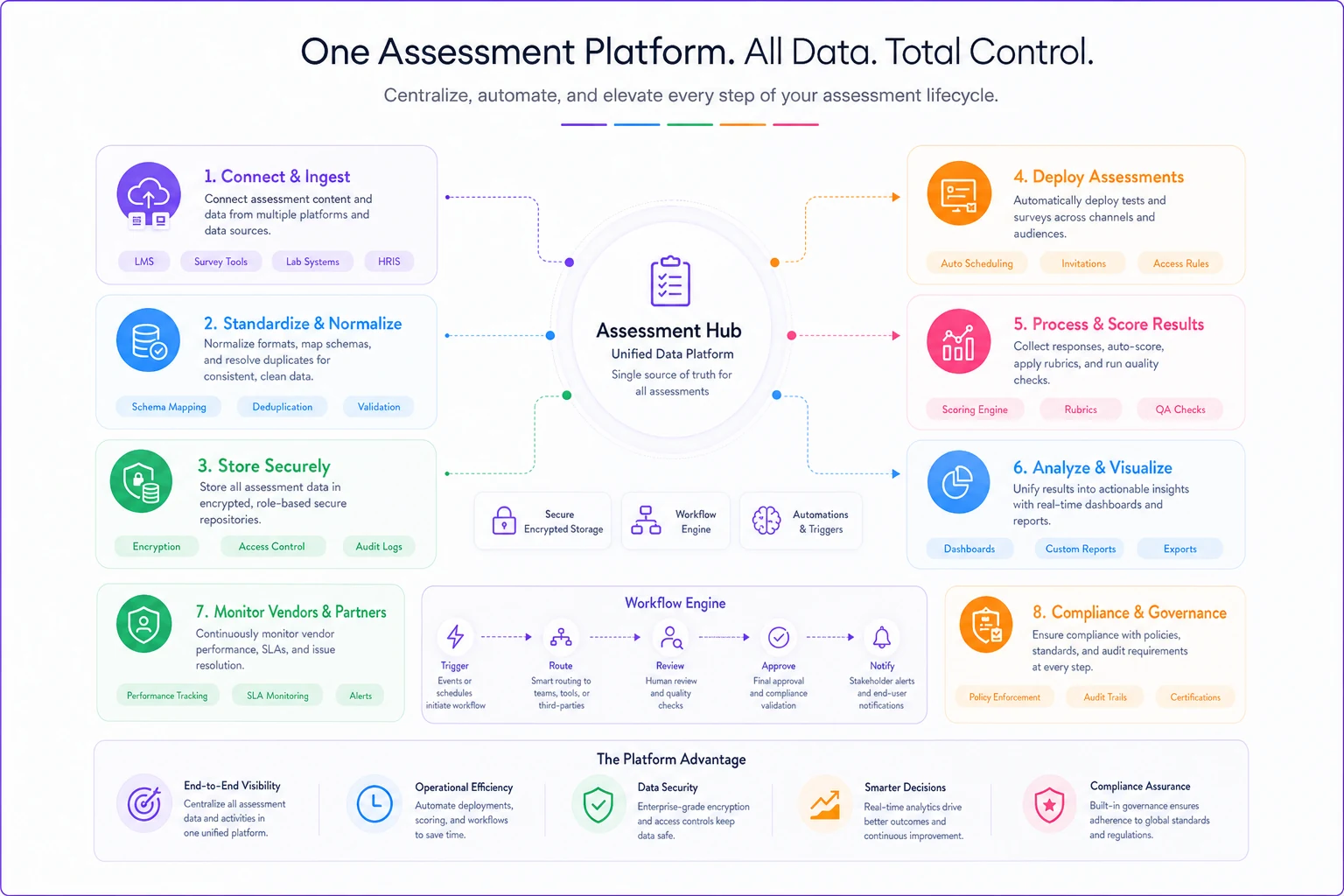
AI-powered operational software becomes particularly valuable here — not for proctoring or scoring, but for managing the entire assessment ecosystem. Automated vendor monitoring that tracks security updates and compliance certificates. Workflow engines that route assessments through appropriate security checks based on stakes and regulatory requirements. Intelligent scheduling systems that balance security requirements with practical constraints like bandwidth limitations and proctor availability.
The platforms that survive this transition won't be the ones with the most invasive proctoring or the fanciest AI scoring. They'll be the ones that help assessment managers maintain security and compliance without drowning in manual processes. Think less about surveillance, more about systematic risk management and operational efficiency.
The next 60 days
Federal agencies have their deadlines, but yours are even tighter. While they're developing frameworks and guidelines, you need to audit current systems, evaluate vendors, and potentially begin platform migrations.
-
Document your current AI exposure — every platform, every algorithm, every automated decision in your assessment workflow
-
Request security documentation from all vendors — do this in writing, with specific deadlines
-
Identify critical vulnerabilities — particularly around high-stakes assessments or sensitive data
-
Begin conversations with procurement and legal — contract modifications take time
-
Start budgeting for Q3/Q4 upgrades — whether emergency funds or reallocation
The assessment platforms that adapt quickly will use this as an opportunity to differentiate. They'll provide transparent security documentation, invest in privacy-preserving technologies, and build the operational tools that help customers manage compliance. The ones that drag their feet or hide behind proprietary concerns will find themselves locked out of institutional contracts.
For educators, HR managers, and trainers managing assessments, this executive order isn't just another compliance checkbox. It's forcing a long-overdue reckoning with how AI systems handle sensitive testing data and make decisions about people's futures. The organizations that get ahead of these requirements — prioritizing both security and privacy, building robust vendor management processes, and investing in operational efficiency — will come out stronger.
The clock's ticking. Sixty days isn't long when you're trying to untangle years of vendor relationships and technical debt. But for those willing to make hard decisions quickly, this compliance push might actually solve more problems than it creates.
Ready to revolutionize your evaluation process?
Join over 2,000 organizations using Evaloly to optimize assessments, improve learner outcomes, and make data-driven decisions.