

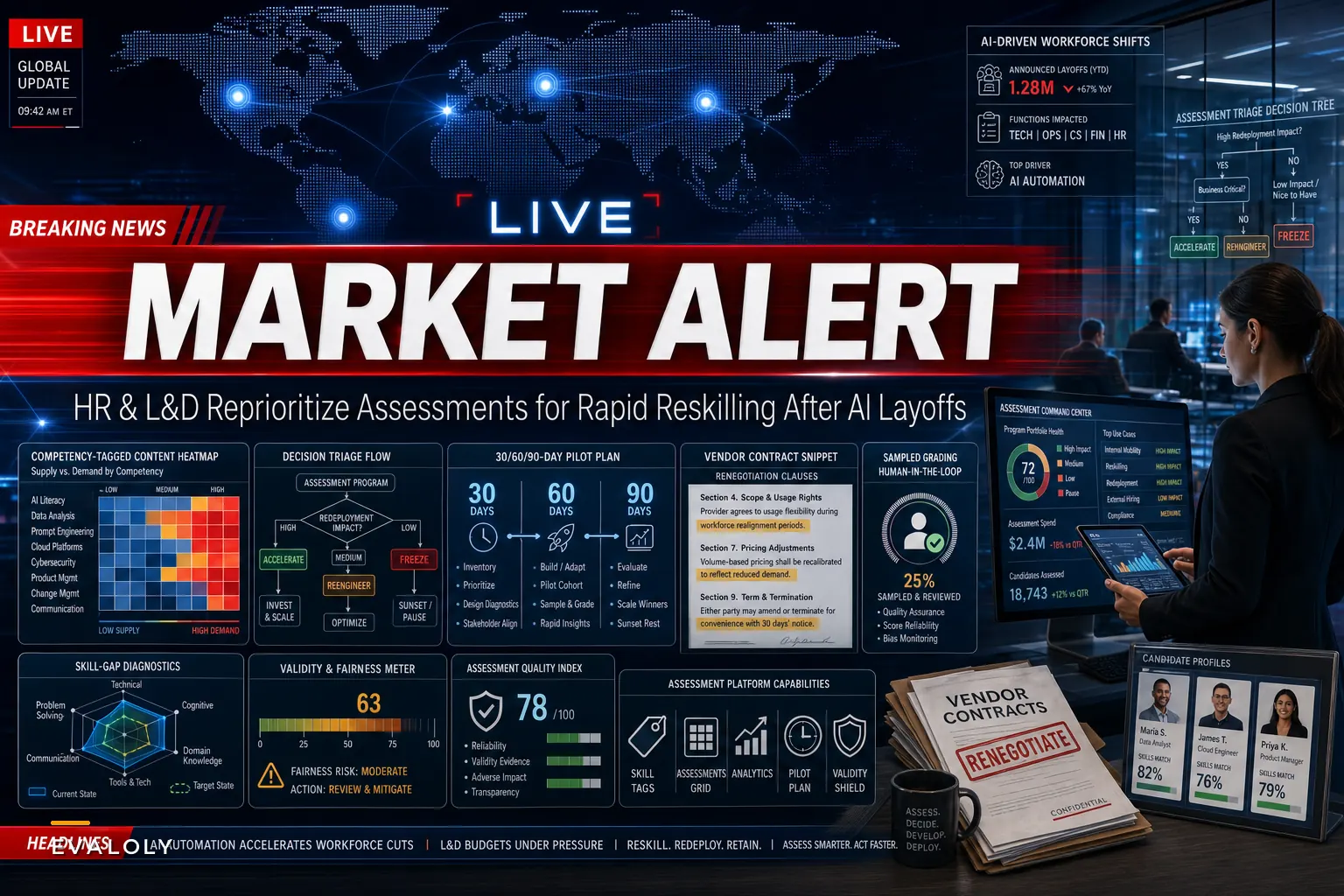

The layoff announcements piling up over the last two weeks have a different flavor than the ones from a few years ago. These aren't purely cost-cutting moves. According to Reuters reporting from late October, companies across tech, consumer products, and logistics are trimming headcount specifically to redirect capital toward AI and automation. Qualcomm ran performance-focused cuts worldwide. Amazon pared back its devices unit right after a wave of product launches. The pattern is less "we're in trouble" and more "we're reallocating."
That distinction matters a lot if you run assessment programs inside HR or L&D — and most people in those seats haven't fully adjusted to it yet. When layoffs are purely defensive, your job is to survive the budget cut. When layoffs are a reallocation toward automation, your job changes completely: you're suddenly the function responsible for figuring out who stays, who moves, and who gets retrained into roles that didn't get automated. Your assessment portfolio stops being a compliance expense and becomes the engine for internal mobility decisions.
Most assessment teams are not built for that pivot. This piece is about making it.
The quiet problem these layoffs expose in your assessment stack
Most corporate assessment portfolios were designed for hiring and certification, not redeployment. They answer the question "should we let this person in?" They're terrible at answering "this person's role is disappearing in Q2 — where can they go and how fast can we get them there?"
Those are different measurement problems. A hiring assessment filters. A reskilling assessment has to locate someone on a skill map and chart the shortest path to an adjacent role. If your item banks are tagged by job title instead of underlying competency, you can't do the second thing even if you wanted to. The data model simply won't support it.
This is the gap the current layoff wave exposes. HR leaders are walking into executive meetings being asked "how many of these 400 affected people can we move internally instead of paying severance?" — and the honest answer from most assessment teams is "we don't have a clean way to tell you." That's not a tooling failure. It's a prioritization failure that's been sitting dormant until demand forced it into the open.
Triage first, build later
The instinct when budgets tighten is to protect everything a little and cut nothing decisively. That's the worst move here. When assessment spend is flat or shrinking while reskilling demand spikes, you have to actively starve some programs to feed others.
Eliminate assessment bottlenecks.
Evaloly simplifies every step from test design to results analysis, making assessments faster and more reliable.
- Customizable test creation
- Automated grading and analytics
- Secure distribution and proctoring
No credit card required
The cleanest way to think about it: sort every assessment program you run into one of three buckets based on whether it moves people into the organization, around the organization, or out of it.
| Program type | Primary question it answers | Priority during AI-driven layoffs |
|---|---|---|
| External hiring assessments | Should we bring this person in? | Lower — hiring is frozen or slowed in most affected functions |
| Internal mobility / skill-gap assessments | Where can this person move, and what's missing? | Highest — this is where redeployment ROI lives |
| Reskilling progress / mastery checks | Did the training close the gap? | High — proves the mobility bet is working |
| Compliance / mandatory certification | Are we legally covered? | Protected — low spend, non-negotiable |
| Legacy / "we've always run it" assessments | (often unclear) | Sunset candidates — reclaim capacity here |
The programs in that last row are where you find the budget to fund the top rows. Almost every organization carries assessments that nobody champions, that feed no active decision, and that persist out of inertia. During a normal year, letting them ride is harmless. In a reallocation year, they're actively stealing item-bank maintenance hours and vendor spend from the mobility work you urgently need.
If you want a structured way to make these keep/cut calls rather than eyeballing them, the decision rubric in our guide to prioritizing your assessment portfolio walks through the investment, sunset, and ROI scoring in detail. The short version: a program that doesn't connect to a live decision owner and a measurable outcome is a sunset candidate, full stop.
A realistic triage sequence
When a team is overwhelmed by a sudden reskilling mandate, the problem is almost always that they're trying to redesign the whole program at once instead of running triage in order. Sequence matters more than ambition here.
-
Freeze net-new external hiring assessment work in affected functions. Not forever — just stop pouring item-writing and validation hours into roles you're not filling this quarter.
-
Inventory what you already have that measures competencies, not titles. You probably have more reusable content than you think; it's just tagged wrong.
-
Identify the 5–8 "destination roles" people are most likely to be redeployed into. Don't try to map all mobility paths. Map the high-volume ones.
-
Build or adapt skill-gap diagnostics for those destination roles only. A rough diagnostic shipped in three weeks beats a perfect one in four months.
-
Stand up lightweight mastery checks to prove reskilling actually took — so you can defend the redeployment decision later if it gets questioned.
-
Sunset the dead-weight programs and reallocate that freed capacity to steps 3–5.
A simple visualization of this sequence can help align stakeholders quickly.
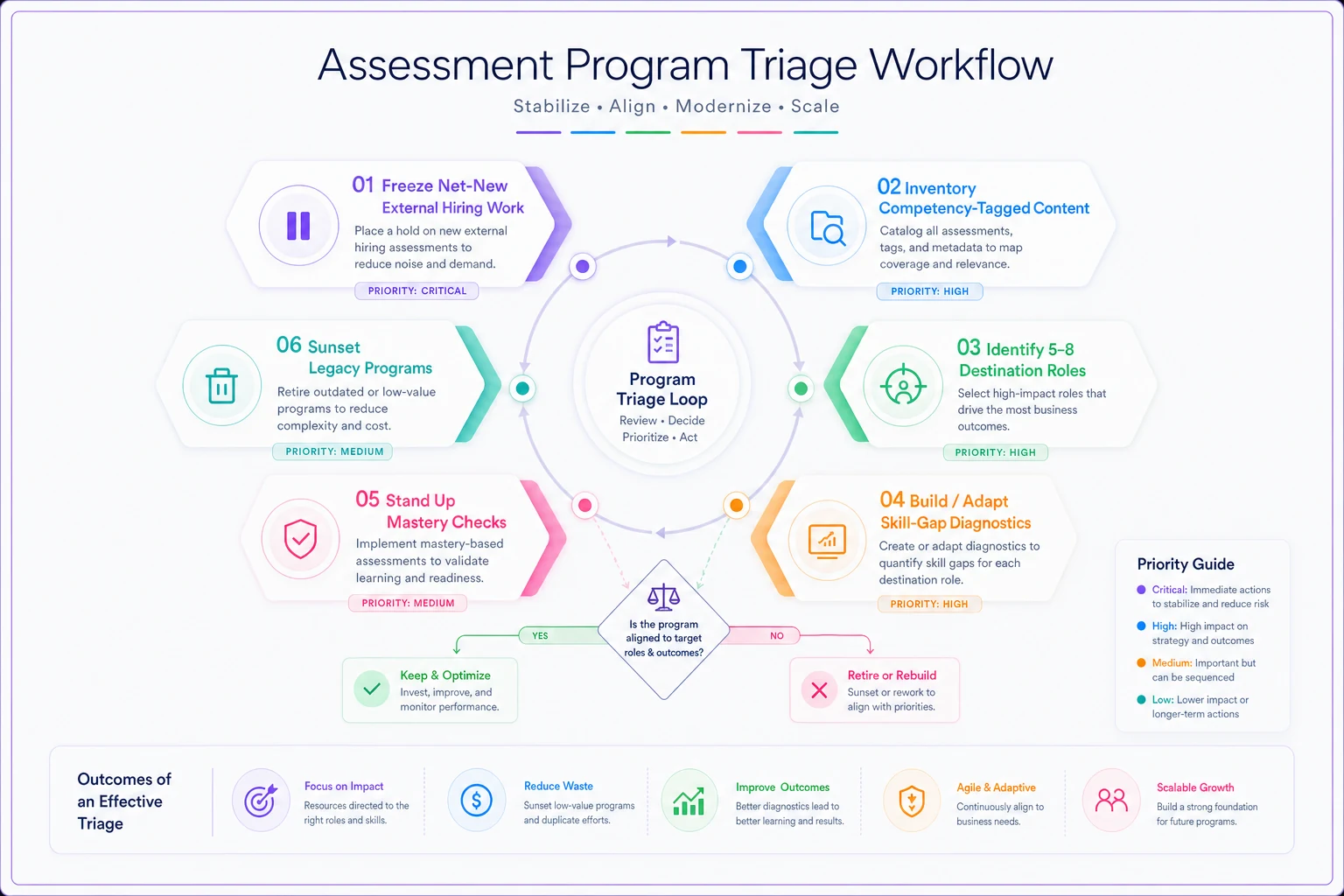
Notice that sunsetting comes near the end, not the start. Teams that lead with cutting tend to cut emotionally and create gaps. Teams that lead with inventory and destination-role mapping end up knowing exactly what they can afford to drop.
Why competency tagging is the whole ballgame
If your assessment content is organized around "QA Engineer Level 2 Exam" rather than around the competencies inside it — debugging, test automation, requirements analysis, whatever — then every mobility question requires manual, human reinterpretation.
A typical example: a logistics company cuts a chunk of its manual coordination roles to automation and wants to move people into exception-handling and vendor-management roles that didn't get automated. The skills overlap more than you'd guess — attention to detail, process judgment, basic data literacy. But the assessment team can't surface that overlap because their items are locked inside role-named exams. So they end up re-testing people from scratch, which is slow, expensive, and demoralizing for employees who already demonstrated those skills in their old role.
Use AI-assisted tagging as a first pass to bulk-classify legacy items against a competency framework, then have psychometric staff review and correct.
When content is tagged at the competency level, the same situation becomes a matter of querying your bank: "show me every item measuring process-exception judgment" and assembling a short, targeted diagnostic. You test the gap, not the whole person. This is also where AI-assisted tagging genuinely earns its place — bulk-classifying a legacy item bank against a competency framework is tedious, error-prone human work that automation handles well as a first pass, with your psychometric staff reviewing and correcting rather than tagging from zero. The point isn't the technology; it's that you can't run fast redeployment on a title-based data model, and retagging by hand during a crisis is a non-starter.
Cutting cost without cutting defensibility
Reskilling assessments live in a tough spot: they inform decisions about people's livelihoods during layoffs, so they will get challenged — but the budget to build them bulletproof isn't there. You need methods that are cheap and defensible at the same time.
A few that actually work under budget pressure:
-
Sampling-based validation instead of full-census validation. You don't need every item fully field-tested before deploying a mobility diagnostic. A conservative sample, with clear "pause and review" thresholds, gets you moving responsibly.
-
Human-in-the-loop grading on constructed-response items. Automated scoring handles the bulk; your reviewers sample and spot-check. This slashes grading hours without surrendering judgment on the borderline cases that matter most in redeployment.
-
Reuse validated items across destination roles. If three target roles share a competency, one well-validated item set serves all three. Stop building parallel content.
-
Audit trails on every mobility decision from day one. Not as an afterthought — as the thing that protects you when someone appeals being passed over for redeployment.
That last point deserves emphasis. The cheapest insurance you can buy right now is clean documentation of why each redeployment decision was made and what evidence supported it. When cuts are tied to automation investment, scrutiny runs higher, and "we have the records" is worth more than a marginally more precise instrument with no paper trail.
When this pivot makes sense — and when it doesn't
Not every organization should be racing to rebuild assessments around mobility right now.
This makes sense when: your layoffs are genuinely a reallocation toward automation (like the pattern in the recent Qualcomm and Amazon cuts), you have a meaningful population of affected employees whose skills plausibly transfer, and leadership is actually willing to fund internal moves over severance. Those conditions together make reskilling assessment the highest-ROI work your team can do.
This is a bad idea when: the cuts are a pure downsizing with no reinvestment, the affected roles have no realistic internal destination, or — frankly — when leadership says "redeploy people" but hasn't budgeted a single training dollar. In that last case, building elaborate mobility diagnostics just creates expensive theater. Be honest with yourself about which situation you're actually in.
Who should not over-invest here: small teams with no clean competency framework and no bandwidth to build one. If you're starting from fully title-based banks with three people, don't attempt a full redeployment infrastructure mid-crisis. Pick the single highest-volume mobility path, build one solid diagnostic for it, prove the concept, and expand later.
A real scenario
A mid-sized consumer-electronics firm — roughly 2,800 employees — automated a large share of its tier-1 support and order-processing work. About 180 roles were affected. The initial plan was severance across the board, projected at a painful seven-figure number.
Their L&D team pushed for a redeployment-first approach instead. They didn't try to boil the ocean. They mapped three destination roles that were still growing: technical support specialist, returns/exceptions analyst, and a junior data-cleanup role tied to the new automation. Then they pulled competency-level items they already owned — scattered across old role-based exams — and assembled short gap diagnostics for each path. Roughly three weeks of focused work, mostly reuse rather than new authoring.
The outcome wasn't a fairy tale. They couldn't move everyone. But they redeployed somewhere in the range of 60–70 of the 180 affected employees into those three destination roles, with mastery checks confirming the reskilling held. The avoided severance plus retained institutional knowledge more than covered the assessment and training spend, and the documented gap-diagnostic results gave HR clean footing when a handful of non-selected employees raised questions. The quiet win underneath it all: because they'd finally tagged a slice of their bank by competency, the next reorg started from a much better position.
Where to put your attention this quarter
The layoff wave isn't primarily a budget event for assessment teams — it's a purpose event. You're being pulled from gatekeeping into navigation, from "who gets in" to "where can people go."
The teams that struggle are the ones still running their hiring-era portfolio while demand screams for mobility. The teams that come out ahead triage ruthlessly, starve the dead programs, tag their content by competency, and lean on cheap-but-defensible validation to move fast without creating appeal nightmares later.
You don't need a perfect system. You need a portfolio that can answer the redeployment question this quarter, documented well enough to defend, built mostly from content you already own. Start with the destination roles. The rest follows from there.
Ready to revolutionize your evaluation process?
Join over 2,000 organizations using Evaloly to optimize assessments, improve learner outcomes, and make data-driven decisions.