


Most assessment programs don't fail because of one bad exam. They erode because nobody is making deliberate decisions about which initiatives deserve money, which ones should be retired, and which ones are quietly draining budget while producing almost nothing usable. You end up with a hiring assessment nobody trusts anymore, a certification track that costs more to maintain than it returns, and a training program that got funded three years ago because a VP liked it.
The core issue is that assessment work rarely gets managed as a portfolio. Individual projects get approved in isolation, each with its own champion, its own budget line, and its own vague promise of "better decisions." Nobody stitches them together. So when budget season hits, you're comparing apples to a completely different fruit — and the loudest stakeholder usually wins.
This piece is about building a decision framework that treats hiring, training, and certification initiatives as competing investments in the same portfolio, scored against the same rubric, with clear rules for funding, holding, and sunsetting. Less about statistics, more about how the money and decisions actually flow.
Why assessment portfolios drift into a mess
The drift almost always starts the same way. Someone needs to solve a specific problem — a hiring bottleneck, a compliance requirement, a skills gap. They build or buy an assessment. It works, or seems to. Then the original problem changes, the sponsor moves on, and the assessment keeps running because turning it off feels risky and nobody owns that decision.
A few patterns show up repeatedly:
-
No shared scoring language. A certification exam gets evaluated on pass rates. A hiring screen gets evaluated on time-to-fill. A training assessment gets evaluated on satisfaction scores. None of these are comparable, so leadership can't rank them.
-
Costs are invisible until renewal. The obvious cost is the vendor invoice. The hidden costs — SME time for item review, psychometric analysis, proctoring, legal review, candidate support — never get tallied into one number. A "cheap" assessment might actually be the most expensive thing you run.
-
Sunsetting is nobody's job. New initiatives have champions. Retiring old ones has none. So the portfolio only grows.
This usually snowballs when an organization goes from a handful of assessments to a couple dozen. At small scale, one person keeps the whole picture in their head. Past a certain point, that mental model breaks and the program starts paying maintenance costs on things it forgot it owned.
What actually breaks as the portfolio scales
Scale changes the failure mode. A five-assessment program fails through neglect — one exam goes stale. A forty-assessment program fails through conflict and duplication.
Eliminate assessment bottlenecks.
Evaloly simplifies every step from test design to results analysis, making assessments faster and more reliable.
- Customizable test creation
- Automated grading and analytics
- Secure distribution and proctoring
No credit card required
Two different departments build competency assessments for overlapping roles because neither knew the other existed. A certification program and a hiring screen test the same skill using different rubrics, and now you can't defend either one when someone asks why a candidate "passed" one and "failed" the other. Legal reviews get bottlenecked because every initiative escalates independently instead of running through a shared queue. The coordination cost is the part people underestimate. When you have three assessments, coordinating SME reviewers, refresh cycles, and reporting is a scheduling annoyance. When you have thirty, it's a full-time function — and if you don't staff it, the work doesn't disappear. It just gets done badly and late. This is the same coordination breakdown that shows up when you turn assessment data into decisions across HR, L&D, and executives: without a shared structure, everyone reports their own initiative in their own format and leadership can't see the portfolio at all.
The scored rubric: comparing hiring vs training vs certification on the same scale
The whole point of a rubric is to force wildly different initiatives into a comparable score. You're not trying to be perfectly precise — you're trying to make the ranking defensible and repeatable.
-
Strategic alignment — Does this directly support a current business priority, or one that expired two reorgs ago?
-
Decision impact — How consequential is the decision this assessment drives? A hiring gate filtering thousands of candidates scores higher than a training quiz nobody acts on.
-
Evidence quality — Do we have validity, reliability, and fairness evidence that holds up? Or are we running on faith?
-
Cost-to-value ratio — Full lifecycle cost against the value of the decisions it improves.
-
Risk exposure — Legal, compliance, reputational, and security risk if this assessment is wrong or breached.
What makes this useful is scoring across categories with the same dimensions. Here's how three different initiative types tend to land:
| Dimension | Hiring screen (high-volume role) | Compliance certification | Internal training assessment |
|---|---|---|---|
| Strategic alignment | 5 — tied to active hiring surge | 4 — regulatory requirement | 2 — legacy, sponsor left |
| Decision impact | 5 — gates thousands of candidates | 3 — mostly pass/fail formality | 2 — rarely changes anything |
| Evidence quality | 3 — decent but aging norms | 4 — well-documented | 2 — never validated |
| Cost-to-value | 4 — high value per dollar | 2 — expensive to maintain | 3 — cheap but low value |
| Risk exposure | 2 — adverse-impact exposure | 5 — audit risk if wrong | 4 — low risk |
| Weighted signal | Fund + monitor | Fund but reduce cost | Sunset candidate |
Notice the certification scores well on evidence and alignment but poorly on cost-to-value. That doesn't mean kill it — regulatory items you often can't kill. It means the decision is "keep, but attack the maintenance cost," which is a completely different action than "keep and invest."
One mistake that comes up constantly: teams weight every dimension equally. Don't. A high-volume hiring assessment with adverse-impact exposure should have risk weighted heavily because a fairness problem there is catastrophic. A low-stakes internal quiz shouldn't. Set the weights per initiative class, not per initiative, so you're not re-litigating the framework every cycle.
Lifecycle cost: the number that changes every decision
The single most decision-altering thing you can do is build a real lifecycle cost model. Not the invoice — the total cost of owning an assessment across its life.
-
Build/acquire cost vendor licensing, item development, SME time to author, initial validation study
-
Run cost (annual) delivery/proctoring fees, candidate support, scoring, reporting
-
Maintain cost (annual) item refresh, re-validation, drift analysis, security/exposure monitoring
-
Governance cost (annual) legal review, accessibility audits, data governance, incident readiness
-
Retirement cost (one-time) data archiving, candidate communications, transition to a replacement
Take a mid-sized certification program running around 800 candidates a year. The vendor invoice looks like roughly $18k–$22k annually, which seems reasonable. But when you add SME item-refresh time, an outside validity review every couple of years, accessibility remediation, and legal sign-off, the real annual cost lands closer to $55k–$65k. Suddenly the "cheap" certification is one of your most expensive per-candidate assessments — and that changes whether you renew, renegotiate, or consolidate it with something else.
The lifecycle view also exposes assessments that are cheap to run but expensive to ignore. An old hiring screen with no maintenance budget isn't free — it's accruing risk. That risk is a cost even if it never shows up on an invoice.
Sunset criteria: making "kill it" a normal, unemotional decision
Sunsetting fails because it's treated as an admission of failure instead of routine portfolio hygiene. The fix is to define trigger conditions in advance, so retirement becomes a rule, not a fight.
A practical sunset trigger fires when an initiative hits any of these:
-
Usage collapse — administration volume drops below a threshold you set at launch (fewer than a defined number of administrations per quarter for two consecutive quarters, for example).
-
Evidence expiry — validity or fairness evidence is older than your defined shelf life with no plan or budget to refresh it.
-
Strategic orphaning — the business priority it supported no longer exists and no current sponsor will claim it.
-
Cost inversion — full lifecycle cost per useful decision exceeds a ceiling relative to the value it produces.
-
Redundancy — another assessment now covers the same construct better or cheaper.
The key move is writing the sunset criteria when you fund the thing, not years later. When an initiative is born with a defined end condition, retiring it isn't a betrayal — it's the plan working as designed. Programs that do this well review sunset triggers on the same cycle as funding decisions, so nothing lingers unexamined.
When sunsetting is actually a bad idea
A few cases where the trigger fires but you should override it:
-
Regulatory floors. If a certification is legally required, low usage or bad cost-to-value doesn't matter — you fix the cost, you don't kill the requirement.
-
Seasonal assessments. A hiring surge assessment might look dormant for months and then be critical. Judge it on the surge, not the quiet period.
-
Foundational infrastructure. Some assessments feed downstream decisions or long-term comparisons. Killing them breaks cohort continuity, which is a much bigger cost than it appears.
Programs that do this well review sunset triggers on the same cycle as funding decisions, so nothing lingers unexamined.
The business-case template for funding committees
Funding committees make bad assessment decisions when every request shows up in a different format telling a different story. Standardize the ask, and the committee can actually compare.
A one-page business case for any assessment initiative should force the requester to answer:
-
The decision it improves. What real decision does this assessment make better? If you can't name a decision, you don't have a business case — you have a hobby.
-
Portfolio fit. Does this overlap with anything we already run? If yes, why not extend the existing one?
-
Rubric score. The five-dimension score, so the committee sees it on the same scale as everything else.
-
Full lifecycle cost. Build + run + maintain + governance, not just the invoice.
-
Value estimate. Even a rough range. Tie it back to how learning goals become measurable ROI so value isn't just asserted — it's traced to an outcome.
-
Sunset conditions. The pre-committed triggers that will retire this initiative.
-
What we stop doing. If this gets funded, what leaves the portfolio to make room?
That last question is the one most requests dodge, and it's the most important. A portfolio with no exit discipline just accumulates. Forcing every funding request to name a trade-off keeps the whole thing from bloating.
A real scenario: a corporate L&D team untangling their portfolio
A corporate L&D group supporting a workforce of a few thousand employees had accumulated somewhere around 30 active assessments — a mix of hiring screens, compliance certifications, and training checks built up over roughly six years. Nobody had a full inventory. Renewal decisions happened whenever a vendor invoice landed.
They ran the whole set through a lifecycle cost pass and the rubric. Two things surfaced fast. First, three separate assessments were testing nearly identical competencies for overlapping roles, built by different teams who never talked. Second, about a quarter of the portfolio scored as sunset candidates: low usage, orphaned sponsors, no recent evidence.
They consolidated the three overlapping assessments into one, retired four orphaned ones, and renegotiated two certification contracts once they could show the real per-candidate cost. The reclaimed budget — somewhere in the range of $40k–$50k annually plus a meaningful chunk of SME time — got redirected into properly validating the hiring screens that actually gated high-volume roles. The outcome wasn't a dramatic revenue story. The portfolio shrank, the surviving assessments got better funded, and for the first time the committee could rank initiatives against each other instead of rubber-stamping renewals. The next budget cycle took a fraction of the time because the framework did the arguing.
Making the portfolio review a repeatable operation
The framework only works if it runs on a cadence. A one-time cleanup feels great and then decays within a year as new initiatives arrive with no rubric score and no sunset triggers. Organizations that keep their portfolios healthy fold three things into their operating rhythm:
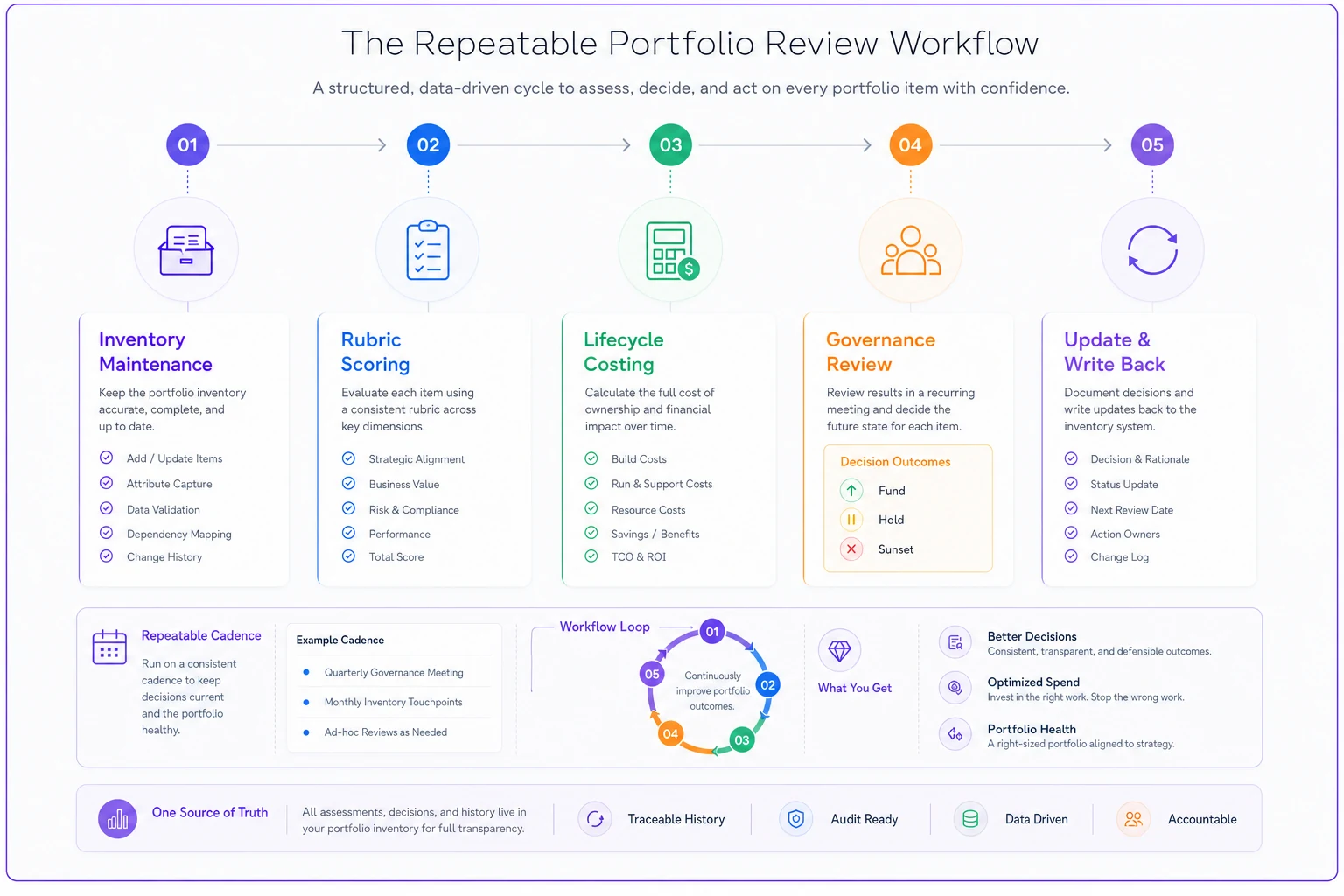
A simple visual to pin to your operating rhythm can make the cadence stick.
-
A living inventory where every assessment carries its rubric score, lifecycle cost, sponsor, and sunset triggers as standing metadata — not something reconstructed in a panic each budget season.
-
A shared review cadence where funding and sunset decisions happen at the same table on the same schedule, so growth and pruning are one conversation.
-
A standard intake so no new assessment enters the portfolio without a business case, a score, and a defined end condition.
Keeping that inventory current across a couple dozen initiatives is exactly the kind of coordination that quietly falls apart when it lives in scattered spreadsheets and a few people's memories. This is where an operational assessment platform earns its keep — not by making the decisions for you, but by keeping cost data, scores, evidence status, and review dates in one place so the portfolio review is a report you run, not a project you launch. The judgment stays human; the bookkeeping stops eating your quarter.
Bottom line
The point of an assessment portfolio strategy isn't to be clever about statistics. It's to stop treating individual assessments as pet projects and start treating them as competing investments that earn their place — or don't. A scored rubric makes hiring, training, and certification comparable. Lifecycle costing exposes the assessments that are quietly expensive. Pre-committed sunset criteria make retirement routine instead of political. A standard business case forces every funding request to name the decision it improves and the trade-off it demands.
Most programs already have the pieces — the scoring instincts, the cost data, the knowledge of which assessments nobody trusts anymore. What they lack is the discipline to put those pieces in one framework and run it on a schedule. Build that, and budget season stops being a fight and starts being a decision.
Ready to revolutionize your evaluation process?
Join over 2,000 organizations using Evaloly to optimize assessments, improve learner outcomes, and make data-driven decisions.