


Most assessment programs don't fail their privacy obligations because someone did something reckless. They fail because the data quietly outlives the reason it was collected, spreads across five systems nobody fully controls, and ends up in a spreadsheet on someone's laptop that survives three job changes. By the time a data subject request or an audit shows up, nobody can say with confidence where every copy of a candidate's score history lives, who touched it, or why it's still there.
That's the real shape of the problem. Assessment data governance isn't a document you write once and file away. It's a lifecycle — item creation, delivery, scoring, reporting, retention, deletion — and each stage generates records that fall under different legal expectations depending on who your test-takers are and where they sit. A licensure exam for nurses, a Title I district's benchmark tests, and a corporate hiring assessment might use nearly identical software, but the governance obligations underneath them look completely different.
This playbook walks through the whole lifecycle as a system: where the data flows, where it breaks, and how to tie your roles/access matrices, retention schedules, pseudonymization, and audit artifacts to the regimes you're actually operating under — GDPR, FERPA, and the growing patchwork of U.S. state privacy laws. You'll get templates you can adapt, not theory.
Start by mapping data categories, not systems
The most common early mistake is organizing governance around your tools — "here's what's in the LMS, here's what's in the item bank" — instead of around data categories. Tools change. Vendors get swapped. The categories of assessment data you hold stay remarkably stable, and each one carries a different sensitivity profile and a different legal trigger.
For assessment operations, the categories that matter break down roughly like this:
| Data category | Examples | Typical sensitivity | Primary regime triggers |
|---|---|---|---|
| Item content | Live items, keys, rubrics, exposure history | High (security, not privacy) | IP / contractual, exam security |
| Candidate identity | Name, email, ID number, demographics | High (privacy) | GDPR, FERPA, state laws |
| Response data | Item-level answers, timestamps, keystroke logs | Very high | GDPR (special category risk), FERPA |
| Score histories | Raw + scaled scores, attempts, pass/fail | High | FERPA, state laws, employment law |
| Accommodation records | Disability status, approved supports | Very high (special category) | GDPR Art. 9, ADA, FERPA |
| Operational logs | Access logs, scoring overrides, model decisions | Medium–high | Audit, explainability obligations |
Accommodation records and item-level response data are the two categories programs consistently underestimate. Accommodation data is special-category personal data under GDPR and effectively health-adjacent everywhere else — yet it routinely lives in loosely-controlled email threads and shared drives. If you haven't tightened this area specifically, the operational side is worth reading alongside an assessment accommodations policy with an audit checklist, because the governance and validity concerns are tangled together in ways that aren't always obvious.
Response data is the other trap. Keystroke logs, response times, and proctoring signals feel like operational exhaust, but they're personal data — and in some interpretations they edge toward behavioral profiling. The working rule: if it can be tied back to a person and it says something about how they think or behave, treat it as sensitive whether or not the law explicitly names it.
The roles and access matrix that actually holds up
Access control in assessment programs tends to rot in a predictable way. On day one, three people have admin rights because the program is small and everyone does everything. Two years later, eleven people have admin rights, four of them have left the department, and nobody remembers why the marketing coordinator can see raw score files.
Eliminate assessment bottlenecks.
Evaloly simplifies every step from test design to results analysis, making assessments faster and more reliable.
- Customizable test creation
- Automated grading and analytics
- Secure distribution and proctoring
No credit card required
A workable roles/access matrix separates function from data category and defines access at the intersection — not by handing out broad system roles. Here's a template structure you can adapt:
| Role | Item content | Candidate identity | Response data | Score histories | Accommodation records | Logs |
|---|---|---|---|---|---|---|
| Item writer | Create/edit (draft) | None | None | None | None | Own actions |
| Psychometrician | Read (final) | Pseudonymized | Pseudonymized | Read | Aggregate only | Read |
| Test admin / proctor | None | Read (session) | Read (session) | None | Read (flags only) | Own actions |
| Scoring reviewer | Read (relevant) | Pseudonymized | Read | Create/edit | None | Own actions |
| Program manager | Read | Read | Aggregate | Read | Read (approvals) | Read |
| Data protection lead | None | Read (for DSARs) | Read | Read | Read | Full |
A few principles make this hold up over time rather than drifting back into chaos:
-
Pseudonymized-by-default for analytics roles. Your psychometrician almost never needs to know that response pattern belongs to a specific person. They need a stable pseudonymous ID. This one change removes a significant chunk of exposure with almost no operational cost.
-
Session-scoped access for proctors and admins. A proctor needs candidate identity during a testing window, not permanently. Access that expires automatically is worth far more than access someone remembers to revoke.
-
Separate the person who can delete from the person who can decide to delete. Deletion authority concentrated in one role is how you get accidental purges — and how you get retention violations, because that person becomes the bottleneck and starts cutting corners.
Automate session-scoped access expirations so temporary permissions don't rely on manual revocation.
In real operations, the failure usually happens at role transitions. Someone moves from scoring to program management and keeps their old permissions stacked on top of the new ones. After eighteen months of that, your matrix means nothing. The fix isn't a better matrix — it's a quarterly access review that reconciles who has access against who should, with a named owner who signs off.
The fix isn't a better matrix — it's a quarterly access review that reconciles who has access against who should, with a named owner who signs off.
Retention schedules: the part everyone gets backwards
Programs keep everything forever "just in case," believing more data is always safer. It isn't. Every record you hold past its legitimate purpose is a record you have to secure, a record that surfaces in a breach, and a record a regulator can ask you to justify.
But aggressive deletion creates its own problems, because assessment data has real downstream obligations — equating chains, appeals windows, legal defensibility for high-stakes decisions, validity research. The answer is a retention schedule tied to purpose, not a single blanket number applied to everything.
A sample assessment retention schedule:
| Data category | Retention trigger | Typical retention | Rationale |
|---|---|---|---|
| Draft items (rejected) | Rejection date | 12–24 months | QA history, reuse decisions |
| Live item content | Retirement date | Per exam-security policy | IP + equating |
| Candidate identity | Last test activity | Duration of relationship + statutory period | DSAR, legal defensibility |
| Item-level responses | Test date | 3–7 years (high-stakes) / shorter (formative) | Appeals, validity, defensibility |
| Score histories | Score report date | Often 5+ years; sometimes permanent (transcripts) | FERPA transcript rules, credentialing |
| Accommodation records | Case close | Minimum necessary; often shorter than scores | Data minimization, special category |
| Proctoring artifacts | Session close | Weeks to months, rarely longer | High risk, low ongoing value |
Two things worth flagging. First, proctoring artifacts — video, screen recordings, behavioral flags — should have the shortest retention of anything you hold. They're high-risk and lose value fast once an incident review window closes. Keeping proctoring footage for years is one of the clearest governance red flags an auditor will find.
Second, score histories and item-level responses can carry different retention periods. A candidate's official score may need to persist for credentialing, but you often don't need to keep every keystroke behind that score for the same duration. Separating these lets you shed the highest-risk data while preserving whatever record you're legally required to maintain.
Pseudonymization done at the operational layer
Pseudonymization gets treated as a technical checkbox, but operationally it's a workflow decision about when in the pipeline identity gets stripped. The earlier you separate identity from response data, the smaller the exposure surface for everyone downstream.
A practical pipeline:
-
At delivery, the candidate is fully identified — they have to be, to take the test.
-
At scoring hand-off, responses get tagged with a pseudonymous ID and the identity mapping table is stored separately, with tighter access controls than the response data itself.
-
At the analytics layer, psychometricians and reviewers work entirely from pseudonymous IDs. They can flag an anomaly by ID without ever pulling a name.
-
At re-identification (appeals, DSARs, verified score requests), a small, logged, permission-gated process joins the mapping table back — and every join is recorded as an audit event.
The part most programs miss: pseudonymization only protects you if the mapping table is genuinely harder to reach than the data it protects. If the same three admins can freely access both, you've built a lock and left the key taped to the door. The mapping table deserves its own access tier, its own logging, and ideally a separate approval step for any bulk re-identification.
Here's a quick diagram of that pipeline.
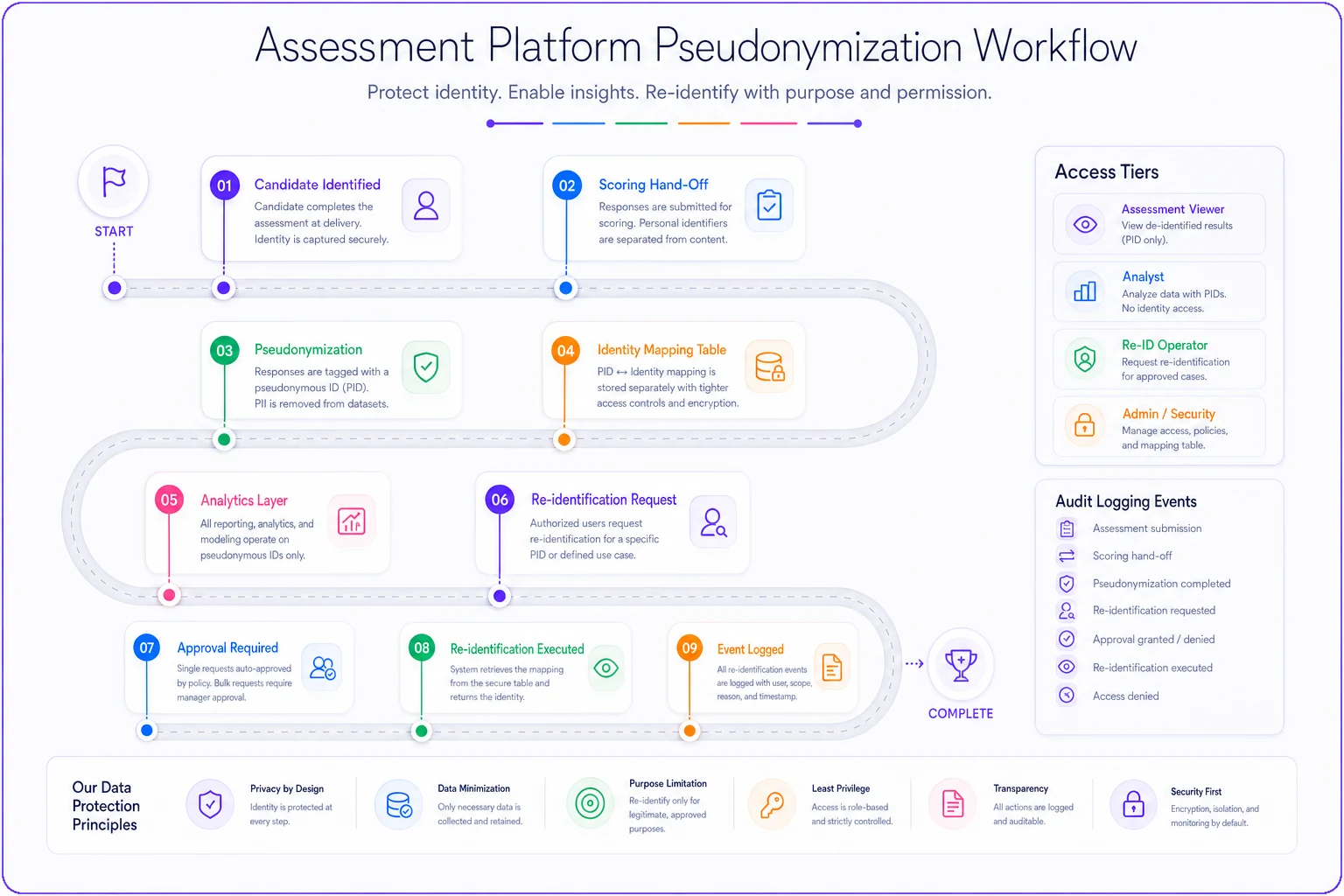
The mapping table deserves its own access tier, its own logging, and ideally a separate approval step for any bulk re-identification.
There's also a validity angle here. When psychometricians work from pseudonymous data by default, you reduce the risk of unconscious bias creeping into item review — and you keep clean separation between the people who see identities and the people making measurement judgments.
Explainable logging and audit artifacts
When a regulator, an auditor, or an aggrieved candidate comes asking, the question is almost never "do you have a policy?" It's "show me what happened to this record." If your logs can't answer that, the policy doesn't help you.
Explainable logging for assessments means capturing, at minimum:
-
Who accessed or modified a record (identity + role)
-
What they accessed or changed (record + field-level where feasible)
-
When it happened (timestamp, immutable)
-
Why, where a reason is required — score overrides, re-identification, deletions, accommodation approvals
Score overrides and any automated or model-assisted scoring decisions deserve special attention, because those are the ones most likely to be challenged. A scoring reviewer changing a candidate's constructed-response score from a 2 to a 3 should generate a log entry capturing the before value, the after value, the reviewer, and the rationale. If part of your scoring or item pipeline uses AI, the logging bar is higher — the reasoning behind an explainability log and operational guardrail approach for AI in assessments applies directly to how you'd structure these records so a decision can be reconstructed later.
The audit artifacts you want to be able to produce on demand — think of this as your evidence kit:
-
Current roles/access matrix + the last several access-review sign-offs
-
Retention schedule + evidence of executed deletions (deletion logs, not just stated intentions)
-
Pseudonymization design + re-identification event log
-
Data processing records / ROPA entries for each assessment activity
-
Vendor/processor agreements and their data handling terms
-
DSAR / appeal handling log with response times
-
Incident history, if any, with response documentation
The pattern worth internalizing: an audit tests your artifacts, not your intentions. A program with a modest policy and clean, queryable logs will fare better than one with a beautiful 40-page policy and no evidence trail.
Mapping the lifecycle to the regimes
The same lifecycle carries different obligations depending on who you're testing.
GDPR (EU test-takers, or EU-based operations): You need a lawful basis for each processing activity, records of processing, honored data subject rights (access, erasure, portability), and heightened controls for special-category data — which pulls accommodation records and potentially some behavioral or proctoring data into the strictest tier. Automated decision-making with legal or similarly significant effect gets extra scrutiny, which matters directly if scores drive hiring or admissions outcomes.
FERPA (U.S. educational institutions and, importantly, their vendors): Assessment records tied to students are education records. Parents and eligible students have access and amendment rights. Vendors typically operate under the "school official" exception, meaning contracts must lock down permitted uses and prohibit re-use of the data. Score histories that become part of a transcript can carry long or permanent retention requirements.
U.S. state privacy laws (a moving patchwork — CCPA/CPRA and the wave of newer state laws): These increasingly grant access, deletion, and correction rights that extend into employment and consumer-testing contexts. Corporate assessment programs that historically felt outside FERPA now face their own DSAR-style obligations.
The point isn't to become a lawyer. It's to recognize that your lifecycle is the constant, and the regime is the overlay. Build one solid retention/access/logging system, then map each regime's specific requirements onto it as a layer, rather than building three separate governance programs. When the laws shift — and they're shifting fast — you adjust the overlay, not the foundation.
When heavy governance makes sense — and when it's overkill
Not every assessment needs the full apparatus. Matching the weight of your controls to the stakes of the decision is itself a governance skill.
When the full lifecycle discipline is worth it: high-stakes decisions (licensure, certification, hiring, admissions), any program touching minors, anything using automated or AI-assisted scoring, and any program with EU test-takers. Here the cost of a governance failure — legal, reputational, and to the candidates themselves — clearly justifies the overhead.
When lighter controls are reasonable: low-stakes formative classroom quizzes, internal practice assessments with no consequential decisions, and anonymous training pulse-checks. Over-governing these wastes effort and, ironically, can cause people to cut corners on the assessments that actually matter because "governance" becomes synonymous with friction.
Who should not try to roll this out all at once: a small program with two staff and no dedicated data owner. Trying to implement a twelve-role access matrix and field-level logging overnight, with nobody to maintain it, produces a paper system everyone bypasses within a month. Start with the two or three categories carrying the most risk — usually accommodation records, proctoring artifacts, and score histories — and expand from there.
A short real scenario
A mid-sized certification body running professional exams — roughly 8,000 to 9,000 candidates a year across a handful of exam forms — hit the wall when a candidate exercised a deletion request and the team realized candidate data lived in the delivery platform, the scoring system, two analyst spreadsheets, and an old proctoring vendor's archive they thought had been decommissioned.
Reconstructing where that one person's data lived took the better part of two weeks and pulled in three staff members. That single request exposed the systemic problem: no retention schedule, admin access distributed to around a dozen people accumulated over the years, and proctoring recordings from prior cycles still sitting in cloud storage with no deletion date attached. The remediation wasn't glamorous. They mapped their data categories, cut standing admin access from around a dozen people down to four, pseudonymized the analytics layer, and set retention triggers. The biggest immediate win was deleting years of stale proctoring footage that served no purpose and represented pure liability. The next DSAR that came in was handled in under a day, by one person, from a documented process. Nothing about the assessments themselves changed. What changed was that the program could finally answer the question "where is this candidate's data and why do we still have it?" without a two-week fire drill.
Bringing it together
Assessment data governance works when you stop treating privacy, security, retention, and logging as separate initiatives and start treating them as one lifecycle with defined ownership at each stage. The item you write, the response you capture, the score you report, and the record you eventually delete are all points on the same chain — and the strength of that chain is decided at the weakest, least-governed link, which is almost always the one nobody remembers they created.
The templates here — the data-category map, the roles/access matrix, the retention schedule, the pseudonymization pipeline, the audit evidence kit — are meant to be adapted to the stakes of your specific program, not adopted wholesale. Get the highest-risk categories under control first, assign real owners, and make sure your logs can reconstruct what happened to a single record. Do that, and the regime overlays — GDPR, FERPA, state laws — become adjustments rather than crises. The programs that stay out of trouble aren't the ones with the thickest policies. They're the ones that can show, on demand, exactly where their data is and why.
The templates here — the data-category map, the roles/access matrix, the retention schedule, the pseudonymization pipeline, the audit evidence kit — are meant to be adapted to the stakes of your specific program, not adopted wholesale. Get the highest-risk categories under control first, assign real owners, and make sure your logs can reconstruct what happened to a single record. Do that, and the regime overlays — GDPR, FERPA, state laws — become adjustments rather than crises. The programs that stay out of trouble aren't the ones with the thickest policies. They're the ones that can show, on demand, exactly where their data is and why.
Ready to revolutionize your evaluation process?
Join over 2,000 organizations using Evaloly to optimize assessments, improve learner outcomes, and make data-driven decisions.