


Most organizations sitting on a decent internal assessment have no idea what they own. The certification exam you built for onboarding, the skills check your L&D team refined over three years, the competency battery HR uses for promotions — any of these could be a product. But "could be" and "is" are separated by a wall of decisions most teams never map out before they start selling.
The failure pattern is predictable. A training director notices that partner companies keep asking to use their internal exam. They slap a price on it, throw together a PDF certificate, and pitch it. Six months later they're drowning in support requests, their psychometrics can't survive a single legal challenge, and they've priced the whole thing so low that servicing customers costs more than the revenue. The product isn't the problem. The business model around the product was never built.
This piece walks through the whole system — how the pieces connect, where they break as volume grows, and what evidence you actually need at each stake level before you can charge real money. If you're trying to commercialize a certification program, the sequence matters more than any single decision.
Start With Stake Level, Because It Drives Everything Else
The mistake that quietly kills margins: teams design pricing and packaging first, then backfill the psychometric evidence. It should run the other way. The stake attached to your certification decides how much evidence you need, which determines your cost structure, which determines what you can charge and who you can sell to.
Think of stakes as three tiers:
-
Low stakes — participation, engagement, "I attended and understood." Nobody gets hired, fired, or licensed based on the result. Evidence bar is low. Think completion certificates and internal skill badges.
-
Medium stakes — hiring screens, internal promotions, vendor qualifications. Real consequences, but reversible and internal. You need defensible reliability, basic fairness analysis, and clear scoring rationale.
-
High stakes — professional licensure, regulated-industry certification, anything that gates someone's ability to earn a living. Full validity documentation, standard-setting studies, ongoing equating, accessibility compliance, the works.
The economics shift dramatically across these tiers. A low-stakes badge might cost a few dollars per candidate to deliver and sell for $30–$50. A high-stakes certification carries development and maintenance costs that can run into six figures annually before you've certified a single person — but you can charge $300–$800 per attempt and build recurring renewal revenue on top.
What breaks teams is pricing a medium-stakes product at low-stakes prices while carrying high-stakes evidence obligations they didn't budget for. That mismatch shows up as a slow bleed, not a dramatic failure.
Segment the Market Before You Build Packaging
Assessment products don't sell to one buyer. They sell to at least three, and each one buys for different reasons.
Eliminate assessment bottlenecks.
Evaloly simplifies every step from test design to results analysis, making assessments faster and more reliable.
- Customizable test creation
- Automated grading and analytics
- Secure distribution and proctoring
No credit card required
| Segment | What they're actually buying | Price sensitivity | Evidence they care about |
|---|---|---|---|
| Individual learners | A credential that signals employability | High | Recognition, brand, "does it get me hired" |
| Employers / L&D teams | A screening or upskilling tool that reduces bad hires | Medium | Validity, fairness, time-to-deploy |
| Channel partners (training providers, associations) | A product to resell into their own audience | Low–Medium | Margin, exclusivity, co-branding rights |
The highest-margin path is usually the channel partner — but it's also the one that demands the most operational maturity. A training company that resells your certification to 40 corporate clients will forward every one of those clients' questions, edge cases, and compliance concerns straight to you. If your back office can't handle that fan-out, partnership revenue turns into a support nightmare fast.
A pattern that actually works: organizations that start by selling directly to individuals learn candidate behavior and support load early, then graduate to employer contracts, then open channel partnerships once their operations can absorb the coordination overhead. Skipping straight to channel deals before you understand your own cost-to-serve is how programs overcommit and underdeliver.
Pricing Levers That Actually Move the Business
Pricing a certification isn't a single number. It's a set of levers, and most programs only pull one or two.
-
Per-attempt fee. The obvious one. But undifferentiated per-attempt pricing leaves money on the table and invites gaming.
-
Retake pricing. Charging full price for retakes feels punitive; charging nothing invites brute-forcing your item bank. A discounted retake — somewhere in the 40–60% range of the initial fee — balances both and protects your content.
-
Renewal / recertification cycles. This is where high-stakes programs make their real money. A two-year recertification requirement turns a one-time $400 sale into recurring revenue and gives you a legitimate reason to keep the credential current.
-
Volume licensing for employers. Seat-based or cohort-based pricing that trades per-unit margin for predictable revenue and lower support cost per candidate.
-
Co-brand / white-label premiums. Partners pay more for the right to put their name on it.
-
Verification and reporting add-ons. Employers often pay separately for verified score reports, API access to check credential status, or analytics dashboards.
Design renewal mechanics tied to meaningful competency updates early — it's the clearest path to annuity revenue.
The lever most teams ignore is renewal. A certification with no expiration is a product you sell once. A certification with a defensible currency requirement — tied to evolving competencies, not arbitrary time — is an annuity. Just don't fake it. If you require recertification, the content genuinely has to change enough to justify it, or the whole thing reads as a cash grab and erodes trust quickly.
Required Psychometric Evidence, Mapped to What You Charge
This is the section teams skip, and it's the one that determines whether your product survives contact with a skeptical procurement team or a legal challenge.
The evidence you need scales with stakes:
-
For low-stakes products content alignment to stated objectives, basic item quality review, clear scoring rules. Don't over-engineer it.
-
For medium-stakes products documented reliability (internal consistency at minimum), item-level statistics, a defensible passing standard, and at least a basic fairness review across relevant subgroups. Buyers in this tier — especially HR teams — will ask how you set the cut score, and "it felt right" is not an answer.
-
For high-stakes products a full validity argument, a formal standard-setting study, ongoing equating across forms so scores mean the same thing over time, accessibility documentation, and a maintenance schedule. This is a program, not a project.
The connection people miss: your evidence requirements are a recurring cost, not a one-time build. High-stakes programs need continuous psychometric maintenance — new items, re-equating, drift monitoring — and that cost has to live in your P&L permanently. Pricing a high-stakes credential without funding its maintenance is like selling a subscription service you can only afford to run for a year.
If you're mapping how assessment outcomes tie back to actual business value, the logic in turning learning goals into measurable ROI is worth revisiting — the same decision flow that justifies internal investment also justifies what employers will pay externally.
Regulatory and Compliance Constraints You Can't Package Around
Commercialization changes your compliance exposure. An internal assessment operates under one set of expectations; the moment you sell it as a hiring or credentialing tool, you inherit obligations you may not have carried before.
A few that consistently catch teams off guard:
-
Employment law exposure. If employers use your certification to make hiring or promotion decisions, adverse-impact and job-relatedness scrutiny follows. Your fairness evidence isn't optional documentation — it's legal defensibility for your customers, and they'll want it in writing.
-
Data handling. You're now collecting candidate PII, results, and sometimes proctoring data at scale, often across jurisdictions. Retention rules, consent, and breach obligations all get more serious. A clear lifecycle policy for candidate data isn't bureaucratic overhead here; it's the difference between a clean audit and a liability. The operational side of this is covered well in this assessment data governance playbook.
-
Accessibility requirements. Selling to the public raises the bar. Accommodations aren't just ethical — they're contractual and legal expectations your buyers will hold you to.
-
Credential misrepresentation. Once you issue certificates, you own the problem of fraudulent claims. Verification infrastructure becomes part of the product, not an afterthought.
None of this means don't commercialize. It means price the compliance overhead into the model instead of discovering it after your first enterprise contract.
Go-to-Market Packaging That Doesn't Fall Apart at Scale
Packaging is where the product becomes real to a buyer. It's also where operational cracks first appear, because packaging promises things your back office has to deliver — repeatedly, at volume.
A workable packaging structure usually looks like tiered bundles:
-
Self-serve individual tier — online registration, automated delivery, standard certificate, self-service verification. Low touch, low margin per unit, high volume.
-
Employer tier — bulk seat purchases, cohort reporting, a named contact, verified score reports. Medium touch, better margin.
-
Partner tier — co-branding, volume discounts, possibly custom content, dedicated support. High touch, best margin per contract, highest coordination cost.
Here's where things break at scale. In the self-serve tier, a candidate registers, pays, sits the exam, gets scored, receives a certificate, and can be verified later by an employer. At ten candidates a month, a person handles the exceptions manually. At a thousand a month, every manual step — payment reconciliation, certificate generation, verification requests, retake eligibility, accommodation handling — becomes a bottleneck.
> GRAPH: Registration-to-Certificate Pipeline — Flowchart showing the candidate journey from registration through payment, exam delivery, scoring, certificate generation, and employer verification, with manual exception-handling steps highlighted as scale bottlenecks.
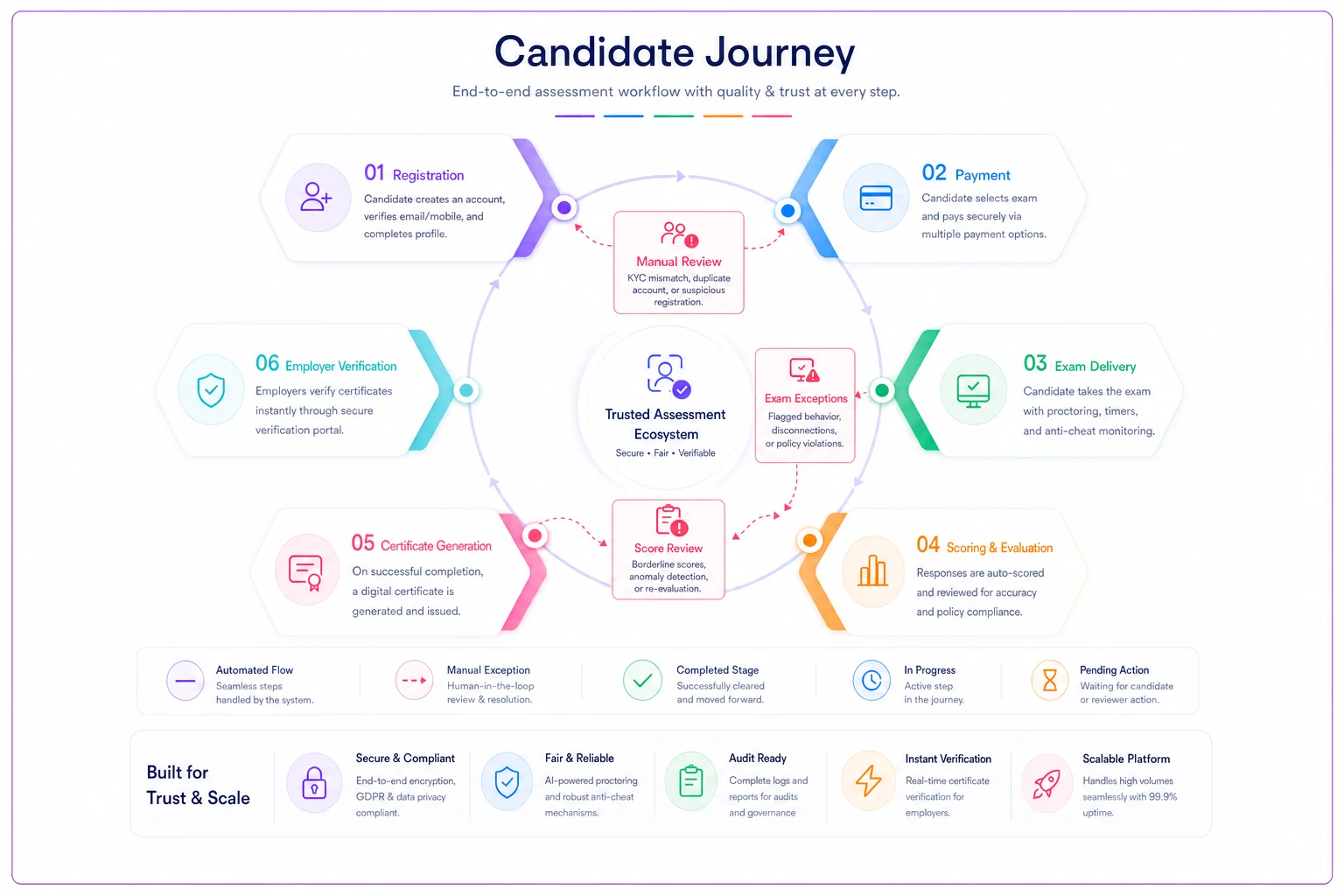
The pipeline that felt fine in a spreadsheet collapses under fan-out. Programs that scale cleanly treat this pipeline as a system from day one: consistent candidate records, standardized item and form metadata, and a data model that lets reporting and verification pull from a single source of truth. If your underlying assessment data model and taxonomy is a mess, every packaging tier inherits that mess and multiplies it.
Sample P&L Scenarios and a Break-Even View
Numbers make the model concrete. These are illustrative — your actual figures depend on stakes and delivery model — but the shape holds.
Scenario A — Medium-stakes employer certification, direct sales
-
Upfront development (content, psychometrics, platform setup)
roughly $60k–$90k
-
Annual maintenance (item refresh, re-equating, support)
around $30k–$40k
-
Price per attempt
$250
-
Delivery cost per attempt (platform, proctoring, support)
about $45
At those figures, contribution per attempt is roughly $205. To cover just the annual maintenance, you need somewhere near 175–200 attempts a year. To recover first-year development and maintenance in year one, you're looking at closer to 550–650 attempts — which is often unrealistic in year one and totally fine, because development is a multi-year investment.
Break-even template (plug your own numbers):
-
Fixed annual cost = maintenance + allocated development amortization
-
Contribution per unit = price − variable delivery cost
-
Break-even volume = fixed annual cost ÷ contribution per unit
-
Compare to realistic year-1, year-2, year-3 demand
-
If year-1 break-even requires demand you can't defend, the product is a multi-year play — fund it that way or don't start
The mistake here is treating development as a year-one expense that has to be recovered in year one. High-stakes and even medium-stakes certifications amortize over three to five years. Programs that panic about year-one break-even either overprice into irrelevance or cut the psychometric evidence that makes the product defensible in the first place.
Defensibility: The Checklist That Protects the Whole Model
Defensibility isn't only legal. It's competitive and operational too. A certification is defensible when it's hard to challenge in a dispute, hard to copy, and hard to game.
Run through this before you go to market:
-
[ ] Cut score set through a documented, repeatable method — not judgment alone
-
[ ] Reliability and item statistics documented and refreshed on a schedule
-
[ ] Fairness/subgroup analysis completed and revisited as volume grows
-
[ ] Item bank protected with exposure controls and rotation, so the exam can't be memorized and shared
-
[ ] Accessibility and accommodations policy in place and actually operationalized
-
[ ] Candidate data lifecycle documented — collection, retention, deletion, breach response
-
[ ] Verification infrastructure so credentials can be authenticated by third parties
-
[ ] A maintenance owner and budget line, not a "we'll get to it" plan
-
[ ] Clear contractual terms with employers/partners on how results may be used
The item-bank point deserves emphasis. A certification whose questions circulate freely online loses value fast, and its legal defensibility erodes with it. Exposure control isn't just security hygiene — it's protecting the asset you're monetizing.
Example Contract and Bundle Structures
Contracts encode your business model into enforceable terms. A few structures worth knowing:
-
Individual click-through agreement — covers candidate consent, data use, retake terms, and prohibited-conduct clauses. Automated, standardized, no negotiation.
-
Employer volume agreement — seat commitments, permitted uses (screening vs. legal decisions matters a lot here), reporting rights, data ownership, and liability boundaries around how they use results.
-
Channel partner agreement — co-branding rights, revenue share or wholesale pricing, exclusivity terms (regional or vertical), content update obligations, and quality control provisions so a partner can't damage your credential's reputation.
A practical bundle example: an employer contract that includes 100 exam seats at a discounted per-seat rate, cohort-level reporting, verified score reports, and a 12-month term — with recertification seats offered at renewal. That single structure combines several pricing levers (volume, verification add-on, renewal) into one clean sellable unit.
When This Makes Sense — and When It Doesn't
When commercializing makes sense:
-
Outside parties are already asking to use your assessment
-
Your content maps to competencies the market genuinely values
-
You have, or can fund, ongoing psychometric maintenance
-
You have the operational capacity to handle candidate volume and support
When it's a bad idea:
-
Your assessment was built for one narrow internal use and doesn't generalize
-
You can't fund maintenance, so evidence will decay and defensibility with it
-
You're chasing revenue that's smaller than the compliance and support cost to earn it
-
Your back-office processes are still manual and would collapse under external volume
Teams treating commercialization as a side project should probably stop here. A revenue product with real stakes needs an owner, a budget, and a maintenance commitment. Half-committing produces a fragile credential that's worse than not selling at all — because now your brand is attached to something you can't stand behind.
A Real Scenario
A mid-sized professional association had a member-training exam they'd refined internally for years. Members kept asking whether non-members could take it and get certified — clear demand, sitting untapped.
Before commercializing, they had no per-attempt pricing, no cut-score documentation beyond an old committee decision, and a manual certificate process handled by one staff member. Certification volume was roughly 120 people a year, all internal.
They spent about four months on the foundations first — documenting a defensible cut score, running a basic fairness review, building tiered pricing ($225 individual, discounted employer seats), and standardizing their candidate data and certificate pipeline so verification could be handled without manual lookups. They set a two-year recertification cycle tied to a genuinely updated competency set.
Within the first full year of selling externally, certification volume climbed to somewhere around 500–600 attempts, with a meaningful share coming from three employer contracts. Revenue that had been effectively zero as a product line became a real, recurring contribution. And because they funded maintenance from the start, the credential held its defensibility as volume grew rather than decaying under it.
The change that mattered wasn't the marketing. It was doing the stake-level, evidence, and operational work before pricing and packaging — in that order.
Pulling the System Together
Commercializing an assessment fails when teams treat it as a pricing exercise. It's a systems exercise. Stake level drives evidence requirements. Evidence requirements drive cost structure. Cost structure drives pricing. Pricing and segmentation drive packaging. Packaging makes promises your operations have to keep at volume. Defensibility runs underneath all of it, because a credential nobody trusts — or that can't survive a challenge — has no durable value no matter how well you priced it.
Get the sequence right and each piece reinforces the next. Get it backward — pricing first, evidence last — and you end up with a product that looks like revenue on a slide and feels like a liability in operations. The organizations that successfully commercialize a certification program aren't the ones with the fanciest assessments. They're the ones who built the whole business model, in order, before they ever sent an invoice.
Get the sequence right and each piece reinforces the next. Get it backward — pricing first, evidence last — and you end up with a product that looks like revenue on a slide and feels like a liability in operations.
Ready to revolutionize your evaluation process?
Join over 2,000 organizations using Evaloly to optimize assessments, improve learner outcomes, and make data-driven decisions.