
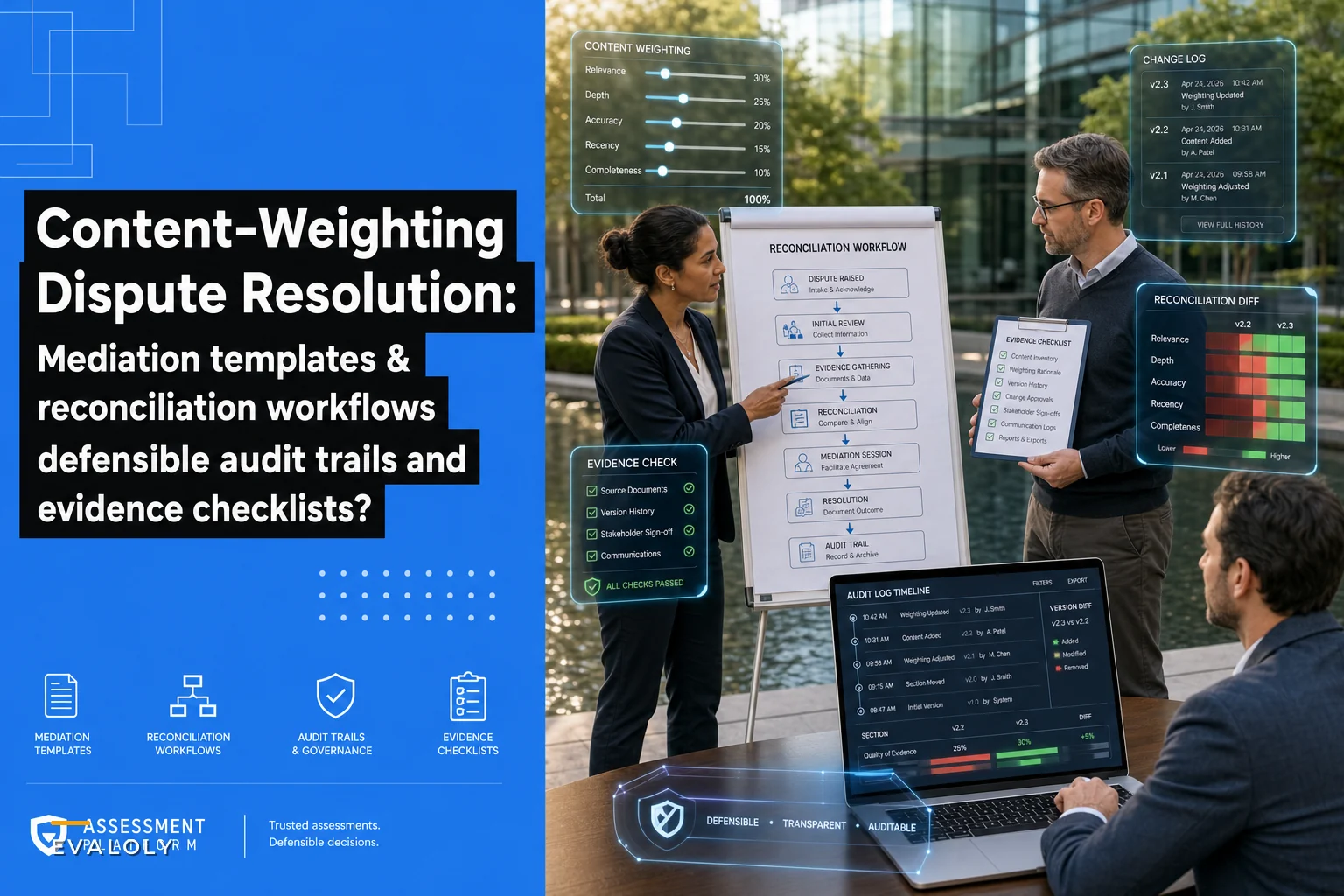

Content-weighting disputes are weird because they almost never start as disputes. They start as a quiet assumption. The hiring manager assumes the coding section is 60% of the score. The psychometrician assumes it's weighted by item count. The faculty committee assumes everyone agreed on the rubric back in March. Nobody wrote it down anywhere findable, and then a borderline candidate or a failing cohort forces the question into the open.
That's when everything gets ugly. Because once a real decision rides on the weighting — a promotion, a certification, a pass/fail line — people stop talking about measurement and start talking about who's to blame. Without a structured way to reconcile the dispute, you end up relitigating the same argument across three meetings with no record of what was decided or why.
This post is about the operational machinery that stops that spiral: mediation templates, a reconciliation workflow, change-logs that hold up, evidence checklists, and meeting scripts. Not theory. The actual documents and steps you run when two defensible positions collide and someone has to decide.
What a weighting dispute actually looks like in practice
"Weighting dispute" is too abstract to be useful, so let's be specific.
A corporate certification program has a five-domain exam. The published blueprint says each domain is weighted by its proportion of the body of knowledge — roughly 25/20/20/20/15. But the scoring engine was configured to weight by item count, and because Domain 1 has twice as many items as Domain 5, the effective weight lands closer to 32/18/18/18/14. Nobody notices until a candidate who aced the small-but-critical safety domain fails overall, files an appeal, and a sharp reviewer pulls the config.
Now you have a dispute where both parties are correct. The blueprint owner says "the published weight is the contract." The platform owner says "this is how it's been scored for three years, and changing it retroactively invalidates past results." The compliance lead just wants to know which version survives a challenge.
-
Intended vs. implemented weight — the blueprint says one thing, the engine does another.
-
Weighted vs. unweighted interpretation — stakeholders disagree on whether raw counts, time-on-task, or declared importance should drive the weight.
-
Silent drift — someone edited a rubric or reweighted a domain over time, and there's no record of who approved it.
Each needs a slightly different reconciliation, but all three need the same backbone: a documented process that produces a decision and the evidence trail behind it.
Why these disputes get so bad so fast
The core problem isn't disagreement. Disagreement is normal. The problem is that weighting disputes attack three things at once.
Eliminate assessment bottlenecks.
Evaloly simplifies every step from test design to results analysis, making assessments faster and more reliable.
- Customizable test creation
- Automated grading and analytics
- Secure distribution and proctoring
No credit card required
They're retroactive. A weighting fix usually affects people who already took the assessment. That turns a technical choice into a fairness question, which turns it into a legal question.
They expose that nobody owns the number. In a lot of programs, weighting is a decision that got made implicitly — during platform setup, during a rushed rubric revision, during a vendor migration. When you ask "who approved the current weights?" the answer is often silence. That silence is the real dispute.
They have no neutral ground. An appeal has a clear structure — candidate challenges, reviewer decides. A weighting dispute is often peer-to-peer: two subject experts, or a department vs. a platform team. No built-in referee, so it drags.
This is closely related to the chaos that shows up when programs scale without clear ownership — the same pattern we broke down in the governance model for fixing roles, workflows, and quality controls. Weighting disputes are often just governance gaps that waited until a high-stakes moment to announce themselves.
The mediation template (what to actually hand people)
Before you call a meeting, you fill out a one-page intake. The whole point is to force both sides to state their position in writing, in parallel, before they're in a room triggering each other. Verbal disputes escalate; written ones narrow.
Each party completes their own copy independently.
| Field | What goes here | Why it matters |
|---|---|---|
| Disputed element | The specific domain/section/item cluster in question | Stops scope creep into "the whole exam is wrong" |
| Position statement | One sentence: what weight you believe is correct | Forces clarity, exposes how far apart you really are |
| Basis | Blueprint, config, prior decision, SME judgment, standard | Reveals whether this is evidence vs. opinion |
| Supporting evidence | Document IDs, config exports, meeting minutes | This becomes the audit trail |
| Impact if your position loses | Affected candidates, cohorts, decisions | Surfaces the real stakes early |
| Acceptable compromise | What you could live with | Most disputes die here — people are closer than they think |
Have both parties name an acceptable compromise in their intake; it's often the fastest resolution.
That last row does more work than anything else. When both parties have to name an acceptable compromise in writing, you frequently find the "dispute" is a 4-point weighting gap that nobody would have gone to war over if they'd seen it side by side.
The reconciliation workflow
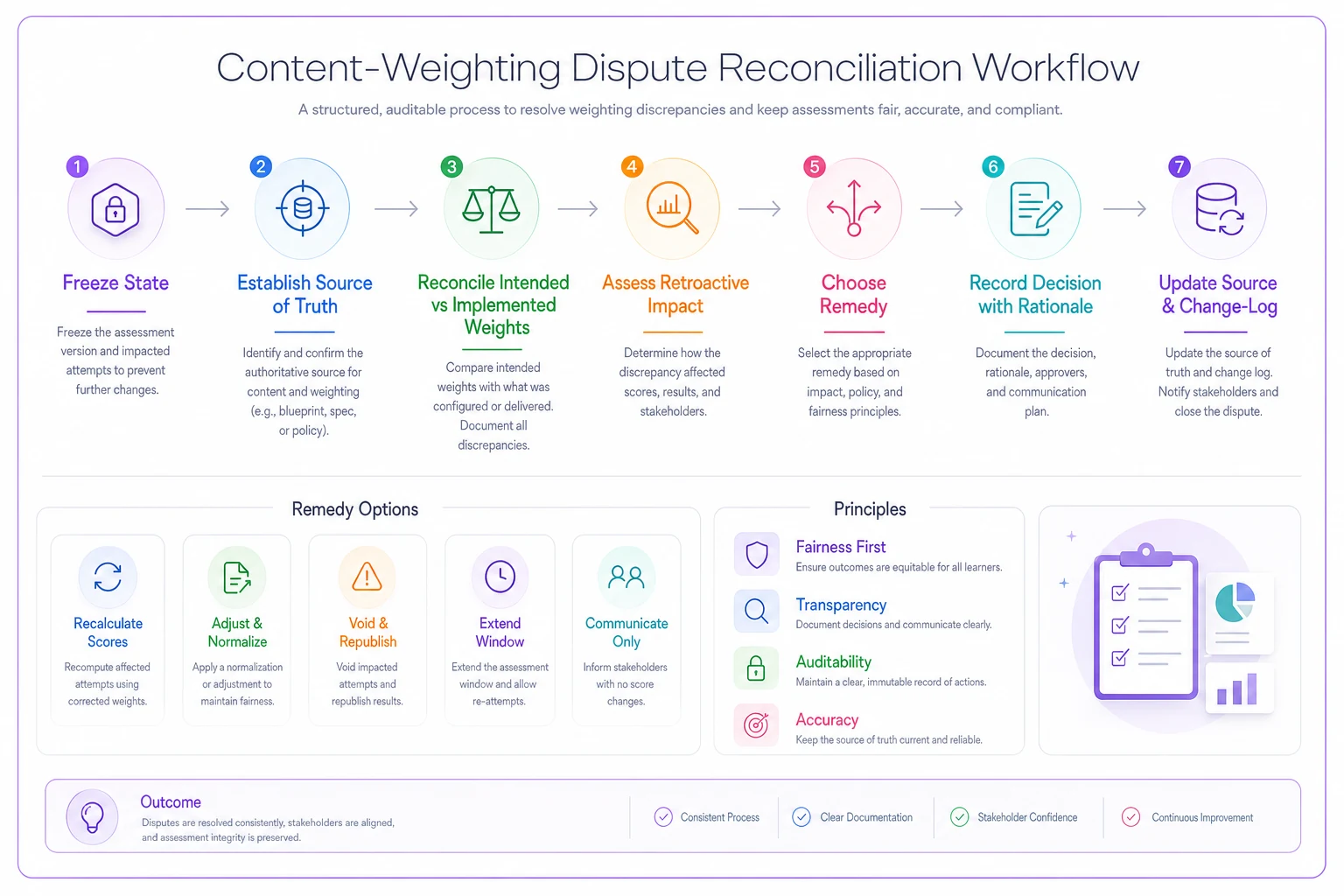
Once intakes are in, you run a fixed sequence. Don't improvise this — the sequence is the defensibility.
-
Freeze the state. Export the current weighting config and lock it. No edits until the dispute resolves. Record the export timestamp and who pulled it.
-
Establish the canonical source of truth. Decide which document is authoritative — the published blueprint, the standard-setting record, or the signed rubric. This single step resolves a surprising number of disputes, because often one party is citing a draft.
-
Reconcile intended vs. implemented. Lay the authoritative weight next to the actual effective weight. Quantify the gap per domain. This is the diagnostic moment.
-
Assess retroactive impact. Re-score affected records under both weighting schemes. Count how many pass/fail or band decisions actually flip. Often it's fewer than everyone fears.
-
Choose a remedy. Options
adopt the authoritative weight going forward only, re-score retroactively, or grandfather past results with a documented rationale.
-
Record the decision with rationale. Who decided, what they chose, why, what evidence they relied on, and who was consulted.
-
Update the source and the change-log. Make the authoritative document match the decision so you never re-fight this.
Step 4 is where disputes deflate. A weighting gap looks catastrophic on paper, but when you actually re-score the cohort, maybe 2–3% of candidates change outcome. That reframes the conversation from "the exam is broken" to "here are eleven people we need to handle carefully."
A quick workflow diagram helps keep the sequence orderly.
Step 4 is where disputes deflate. A weighting gap looks catastrophic on paper, but when you actually re-score the cohort, maybe 2–3% of candidates change outcome. That reframes the conversation from "the exam is broken" to "here are eleven people we need to handle carefully."
The change-log that survives scrutiny
A change-log is only defensible if it captures the why, not just the what. Most logs record "Domain 3 reweighted 20→22%" and nothing else. That's useless in an appeal.
-
Timestamp and editor — who made the change, when.
-
Before and after values — the actual numbers.
-
Trigger — dispute ID, standard-setting cycle, blueprint revision.
-
Approver — who signed off, distinct from who made the edit.
-
Affected scope — which forms, cohorts, or effective dates.
-
Linked evidence — the mediation record, the re-score analysis, the decision rationale.
The separation of editor and approver is non-negotiable. If the same person who changed the weight also approved it, the log doesn't demonstrate control — it demonstrates one person had unchecked power over scoring. In a formal challenge, that's exactly the gap opposing counsel probes.
Tagging and metadata discipline matters here too. If your item and domain structure is cleanly tagged — the kind of schema described in competency-based question banks for role-based skill mapping — your change-log can reference stable identifiers instead of fuzzy descriptions like "the safety questions." Fuzzy references are how drift sneaks back in.
Evidence checklist before you finalize anything
Don't close a weighting dispute until you can check every box. If one is missing, the decision isn't defensible yet — it's just an opinion that happened to win the meeting.
-
[ ] Authoritative source document identified and version-stamped
-
[ ] Current config exported and frozen
-
[ ] Intended vs. effective weights quantified per domain
-
[ ] Retroactive impact analysis completed (how many outcomes flip)
-
[ ] Both parties' mediation intakes on file
-
[ ] Remedy chosen with written rationale
-
[ ] Editor and approver recorded separately
-
[ ] Affected candidates/cohorts identified
-
[ ] Communication plan drafted for anyone impacted
-
[ ] Source document updated to match the decision
If one is missing, the decision isn't defensible yet — it's just an opinion that happened to win the meeting.
Meeting scripts (so the room doesn't go sideways)
The mediation meeting fails when it becomes a debate. Your job as facilitator is to keep it procedural. A few lines that actually work:
Opening: "We're not here to decide who was right. We're here to agree on the authoritative source, measure the gap, and choose a remedy we can document. I'll read both position statements as written."
When someone relitigates history: "Let's log that as context in the change record. Right now I need us on the source-of-truth question — which document governs?"
When it stalls on retroactivity: "Before we argue remedy, let's look at the re-score. How many actual decisions flip under each option?" Numbers cool the room faster than principle.
Closing: "Here's what I'm recording as the decision, the rationale, and who approved it. Speak now if that doesn't match what we agreed." Then read it back verbatim.
That last step — reading the recorded decision back in the room — prevents the single most common failure: everyone leaving with a slightly different memory of what was decided.
A real scenario
A mid-sized professional training organization ran a four-part competency assessment for an internal promotion track — roughly 600 candidates a year. The published blueprint weighted the "applied judgment" section at 30%, but the LMS had been configured to weight purely by item count, which pushed judgment down to around 22% because it had fewer, longer items.
A manager escalated after a strong candidate she'd championed just missed the cutoff. The initial reaction was panic — "we've been scoring wrong for two years, every result is invalid."
Running the reconciliation workflow changed the picture. They froze the config, confirmed the blueprint as the authoritative source, and re-scored the prior two cycles under both schemes. The number of candidates whose outcome actually flipped was small — somewhere around 15 across both years, out of well over a thousand attempts. The remedy became manageable: adopt the blueprint weight going forward, re-score and review only the flipped cases from the recent cycle, and document a clear rationale for grandfathering the older cohort.
The whole thing resolved in about two weeks instead of dragging across a quarter of meetings, and — more importantly — produced a change-log entry that held up when one grandfathered candidate later asked why her result wasn't revisited.
When this process makes sense — and when it's overkill
Run the full workflow when: the weighting affects pass/fail, certification, promotion, pay, or anything legally reviewable; when a gap between intended and effective weight is already discovered; or when two credible parties disagree and the decision has to stick.
Scale it down when: you're adjusting weights on a low-stakes formative quiz, or during an active revision cycle where nothing is live yet. A lightweight log entry is enough there — you don't need a mediation meeting to change a practice quiz.
Who should not improvise this: anyone running high-volume or regulated assessments without separation between the person who edits weights and the person who approves them. If that control doesn't exist, build it before the next dispute, not during it.
Keeping it defensible after the dust settles
The reconciliation isn't finished when the meeting ends. It's finished when the authoritative document, the scoring config, and the change-log all say the same thing. Programs that skip that final sync are the ones re-fighting the identical dispute a year later, because the "decision" lived in someone's inbox instead of in the source of truth.
Weighting disputes don't need to be dramatic. They need a frozen state, a named source of truth, a quantified gap, a re-score that tells you what actually changes, and a record showing who decided and why. Build those five pieces into a repeatable workflow and the next dispute stops being a crisis — it becomes a form you fill out, a short meeting you run, and a log entry you can point to when someone asks the hard question.
Weighting disputes don't need to be dramatic. They need a frozen state, a named source of truth, a quantified gap, a re-score that tells you what actually changes, and a record showing who decided and why. Build those five pieces into a repeatable workflow and the next dispute stops being a crisis — it becomes a form you fill out, a short meeting you run, and a log entry you can point to when someone asks the hard question.
Ready to revolutionize your evaluation process?
Join over 2,000 organizations using Evaloly to optimize assessments, improve learner outcomes, and make data-driven decisions.