


The moment an assessment program crosses a border, the rules stop being a single checklist and start being a web. A test that's perfectly compliant in Ohio becomes a minefield in Frankfurt. A proctoring setup that passes muster for a Texas hiring exam suddenly triggers biometric consent requirements in Illinois—and a completely different set of obligations in São Paulo. Most teams don't fail because they ignore privacy. They fail because they treat compliance as one rulebook when they're actually operating under twelve at once.
What makes this harder is that assessment programs generate unusual data. You're not just storing names and emails. You've got response-level behavioral data, proctoring video, accommodation records tied to disability status, score histories, appeal documentation, and item exposure logs. Each of those record types maps differently to different legal regimes. A generic GDPR explainer won't tell you how to handle an accommodation appeal in one country when the underlying medical record is subject to stricter local health-data rules than the assessment data itself.
This piece is about building the operating system for that mess—not memorizing statutes. The goal is a framework that lets your intake, scoring, proctoring, accommodations, and records teams make consistent decisions no matter where the candidate sits.
Why cross-border assessment compliance breaks differently than normal privacy work
Standard privacy programs are built around marketing data, customer accounts, and transactional records. Assessment programs don't fit that mold, and that mismatch is where most programs quietly accumulate risk.
The core problem: in a typical business, data flows one direction and gets used for a narrow purpose. In assessment operations, the same record gets reused across validity studies, appeals, accreditation audits, equating analyses, and sometimes legal defense of a hiring decision years later. That long tail of reuse is exactly what triggers cross-border complications, because retention obligations, purpose-limitation rules, and data-subject rights all behave differently once you leave the original jurisdiction.
-
The "one consent form" trap. A team writes one consent statement, translates it, and assumes it works everywhere. But consent that's valid in one regime may be legally insufficient—or outright invalid—where consent isn't the right lawful basis at all. In several European contexts, relying on consent for an employment assessment is actually weaker than relying on legitimate interest or legal obligation, because consent in an employer-candidate relationship is often considered not freely given.
-
Proctoring data getting classified wrong. Webcam footage and keystroke patterns get treated as "exam logs" internally, when in multiple jurisdictions they're biometric or special-category data with heightened requirements.
-
Accommodation records crossing borders by accident. A candidate requests an accommodation in one country, the record lands in a central system hosted in another, and now you've moved sensitive health-adjacent data across a boundary without a transfer mechanism in place.
The thread connecting all of these: assessment teams think in terms of workflows (intake → delivery → scoring → appeal → records) while regulators think in terms of record types and legal bases. The framework's job is to translate between those two languages.
The decision matrix: mapping legal regimes to record types
The backbone of a global assessment compliance framework is a decision matrix sitting between "what kind of record is this?" and "which rules apply to it, where?" Without this, every new country becomes a from-scratch research project, and every edge case gets escalated to legal—which doesn't scale past a handful of markets.
Eliminate assessment bottlenecks.
Evaloly simplifies every step from test design to results analysis, making assessments faster and more reliable.
- Customizable test creation
- Automated grading and analytics
- Secure distribution and proctoring
No credit card required
The matrix doesn't need to be exotic. It needs to be maintained and actually used by operations staff. A workable version looks like this:
| Record type | Sensitivity tier | Typical lawful basis (employment context) | Cross-border transfer concern | Default retention posture |
|---|---|---|---|---|
| Candidate identity & contact | Standard | Legitimate interest / contract | Moderate | Short, tied to program cycle |
| Item responses & scores | Standard-to-elevated | Legitimate interest / legal obligation | Moderate | Longer, for validity defense |
| Proctoring video & behavioral | Elevated / special-category in some regimes | Varies—often needs explicit justification | High | Shortest practical window |
| Accommodation requests | Sensitive (health-adjacent) | Legal obligation / explicit handling | Very high | Separate, restricted retention |
| Appeal & dispute records | Elevated | Legal obligation | High | Extended, tied to limitation periods |
| Accreditation evidence | Standard-to-elevated | Legitimate interest | Moderate | Long, audit-driven |
The insight most teams miss: these tiers shouldn't be global constants. The same proctoring video is "elevated" in one place and "special-category requiring explicit basis" in another. So the matrix needs a jurisdiction axis layered on top. In practice, the cleanest approach is a two-dimensional lookup—record type on one axis, jurisdiction on the other—where each cell tells your staff three things: the lawful basis to rely on, whether a transfer mechanism is required, and the retention clock.
If you've already built an internal data governance backbone, this matrix extends it rather than replacing it. The lifecycle thinking in an operational privacy and lifecycle playbook is the foundation here—the jurisdiction matrix is what you add when that single-region lifecycle has to survive contact with multiple legal systems at once.
Consent and transparency wording that actually holds up
A mistake that costs programs real money: writing transparency language that's legally defensible but operationally unusable, or operationally friendly but legally thin. You need wording that does both jobs, and you need variants because one lawful basis doesn't fit every market.
The practical move is maintaining a small library of pre-approved wording blocks rather than a single monolithic notice. Think of them as components:
-
A purpose block describing what the assessment data is used for (delivery, scoring, validity research, appeals).
-
A lawful basis block that swaps depending on jurisdiction—legitimate interest language for some, legal-obligation language for others, and genuine explicit-consent language only where consent is the correct and freely-given basis.
-
A proctoring disclosure block that's separate and explicit, because bundling it into general consent is where a lot of programs get burned.
-
A rights block describing how candidates exercise access, correction, and objection rights—worded to match the actual escalation path your team can deliver on.
One pattern worth internalizing: transparency wording fails most often not at the legal review stage but at the operational stage. A notice promises candidates they can request deletion within 30 days, but the records team has no workflow to actually locate and purge proctoring footage stored by a third-party vendor in that window. The wording wrote a check the operation couldn't cash. Every transparency promise needs a matching, tested internal procedure behind it—otherwise you've just documented your own non-compliance.
Accommodation and appeal crosswalks
Accommodations are where legal regimes, fairness obligations, and data sensitivity collide hardest. A candidate in one country may have a statutory right to a specific accommodation and a specific appeal timeline; a candidate in another has different rights and a different process entirely. If your team runs one global accommodation workflow, you'll either over-serve some markets (fine, if expensive) or under-serve others (a validity and legal problem).
A crosswalk solves this by mapping, side by side:
-
The accommodation request intake process per jurisdiction.
-
What documentation you're allowed to ask for (this varies a lot—some regimes restrict how much medical evidence you can request).
-
How accommodation records are stored and who can see them.
-
The appeal pathway, including statutory response windows.
-
The escalation route when an accommodation decision is contested across borders.
The non-obvious risk sits in steps 2 and 3 together. When you collect more medical documentation than a jurisdiction permits and then store it centrally, you've compounded two problems: an over-collection issue and a cross-border transfer of sensitive data. The crosswalk forces those decisions to be made deliberately rather than by default.
This is also where accommodation policy and measurement validity stop being separate concerns. An accommodation handled inconsistently across jurisdictions doesn't just create legal exposure—it creates comparability problems in your scores. The operational discipline described in an operational assessment accommodations policy with audit checklist is the per-program layer; the crosswalk is what keeps that discipline coherent when the same program runs in six countries with six different rulebooks.
Accreditation evidence bundles
If your program carries accreditation or certification weight, auditors will eventually ask you to prove the whole chain: that candidates were informed, that data was handled lawfully, that accommodations were processed fairly, that appeals were resolved within required windows, and that records were retained and disposed of correctly.
Teams that survive these audits cleanly are the ones who built evidence bundles as a byproduct of normal operations—not as a scramble three weeks before the audit. An evidence bundle is a predefined package that maps each accreditation requirement to the specific artifacts that satisfy it:
-
The transparency notice version shown to each cohort, with dates.
-
The lawful-basis determination for each record type in each market.
-
Accommodation logs with decision rationale and timing.
-
Appeal records with resolution timestamps.
-
Retention and deletion logs proving the lifecycle actually executed.
The pattern that distinguishes mature programs: they version their evidence. When a notice changes, when a lawful basis gets reassessed, when a retention window shifts, the old version doesn't vanish—it's archived with an effective-date range. Auditors don't just want to see your current posture; they want to see that you were compliant at the time each cohort was assessed. Programs that overwrite their documentation lose the ability to prove historical compliance, which is often the thing that actually matters.
Interoperability matters here too. When accreditation evidence has to pull from multiple platforms—your delivery system, your proctoring vendor, your records store—standardized data formats make bundle assembly possible instead of painful. The acceptance-test thinking in assessment interoperability standards mapped to procurement is what lets you demand, at procurement time, that your vendors can actually export the evidence you'll need later.
Escalation matrices for cross-border data subject requests
A data subject request that stays inside one jurisdiction is a workflow problem. One that crosses borders is a coordination problem—and coordination is where assessment programs bleed time and credibility.
Picture the realistic version: a candidate assessed in one country, whose proctoring data sits with a vendor in a second country, whose accommodation record lives in a central HR system in a third, submits an access request. Who owns the response? What's the legal deadline—and whose deadline, since response windows differ by regime? Which records get included, and which are exempt because they'd compromise exam security or another candidate's data?
-
Intake owner — who logs the request and classifies it.
-
Jurisdiction determination — which regime's timeline and rules govern.
-
Record-location map — where each relevant record type physically lives.
-
Decision authority — who decides on exemptions (e.g., withholding item content to protect exam integrity).
-
Response assembler — who compiles and delivers the final response.
-
Escalation trigger — the point at which legal must be looped in.
The mistake that quietly damages programs: treating every DSR as a legal emergency. When operations staff have no matrix, every request gets escalated, legal gets overwhelmed, and genuine deadlines get missed in the noise. A good matrix lets routine requests be handled routinely and reserves escalation for the genuinely ambiguous cases—which is usually a small fraction of the volume.
A short real scenario
A mid-sized certification body expanded from a single home market into four additional countries over about eighteen months. Volume grew from a few thousand candidates a year to somewhere north of twenty thousand. Early on, they ran everything off one consent form and one records process.
The cracks showed up in three places at once. Accommodation requests from two new markets were being handled with documentation demands that one of those markets didn't permit. Proctoring footage from all markets was pooling in a single regional data center with no transfer mechanism documented. And when the first cross-border access request came in, it took the team close to six weeks to assemble a response—well past the applicable deadline—because nobody could quickly say where all the records lived.
After building a jurisdiction-by-record-type matrix, splitting their consent wording into basis-specific variants, and standing up an escalation matrix for DSRs, the second cross-border access request was turned around in roughly nine days. The accommodation over-collection stopped because intake staff were now following a per-market crosswalk instead of one global form. None of this required new headcount—it required the decisions to be made once, centrally, and then pushed down into workflows people could actually follow.
When this level of framework makes sense—and when it doesn't
Not every program needs all of this on day one. Building the full apparatus for a single-country, low-volume assessment is over-engineering.
This framework makes sense when:
-
You operate in three or more jurisdictions, or you're actively planning to.
-
You handle proctoring, biometric, or accommodation data.
-
Your program carries accreditation or legal-defense weight.
-
Reuse of assessment data for validity, appeals, or audits spans years.
This is probably premature when:
-
You run a single-jurisdiction program with modest volume.
-
Your data is low-sensitivity and short-lived.
-
You have no proctoring and no formal accommodation pipeline.
Who should be cautious: small teams without any governance foundation at all. If you don't yet have a basic data lifecycle in place, build that first. The jurisdiction matrix is a layer on top of lifecycle discipline, not a substitute for it—bolting a multi-country framework onto a program that can't track its own records in one country just moves the chaos around.
Making it operational instead of theoretical
The difference between a compliance framework that works and one that lives in a slide deck comes down to whether operations staff can act on it without calling legal every time. That means the matrix, the wording library, the crosswalks, and the escalation paths all need to live where the work happens—in your intake forms, your records system, your DSR queue—not in a policy document nobody opens.
Programs that handle multi-jurisdiction assessment well treat compliance as a set of decisions encoded into workflow, reviewed on a regular cadence as laws shift and new markets open. They centralize the hard thinking (which basis, which retention clock, which transfer mechanism) and distribute the easy execution. And they version everything, because proving what you did two years ago is often harder than knowing what to do today.
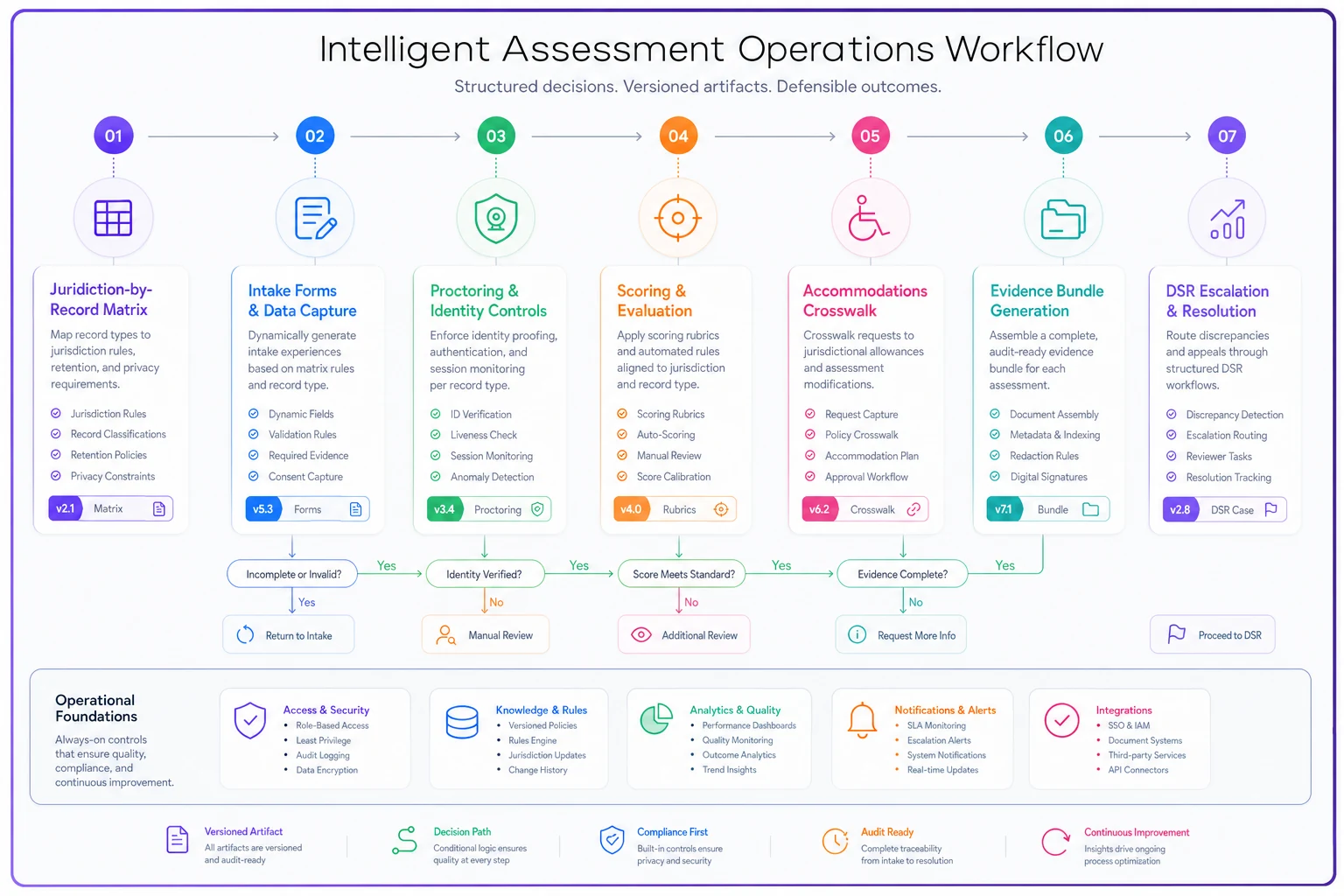
This diagram shows how the matrix and workflows connect to day-to-day systems and decision points.
Embed jurisdiction, lawful-basis, and retention fields into intake forms so staff see the exact rule to follow at the moment of data capture.
Cross-border assessment compliance isn't really a legal problem with an operational tail. It's an operational problem with a legal spine. Get the operating model right—the matrix, the crosswalks, the evidence bundles, the escalation paths—and the legal defensibility follows. Get it backwards, and you'll have beautiful policies that your actual operation quietly contradicts every single day.
Cross-border assessment compliance isn't really a legal problem with an operational tail. It's an operational problem with a legal spine. Get the operating model right—the matrix, the crosswalks, the evidence bundles, the escalation paths—and the legal defensibility follows. Get it backwards, and you'll have beautiful policies that your actual operation quietly contradicts every single day.
Ready to revolutionize your evaluation process?
Join over 2,000 organizations using Evaloly to optimize assessments, improve learner outcomes, and make data-driven decisions.