

Most assessment work inside organizations lives in the cracks. One person owns the item bank because they built it years ago. Another handles proctoring because they happened to figure out the platform. Someone in L&D writes rubrics on the side. HR runs hiring assessments off a completely separate tool nobody else can see. It works — until volume doubles, or leadership asks a question nobody can answer, like "how valid is the certification exam we've been running for three years?"
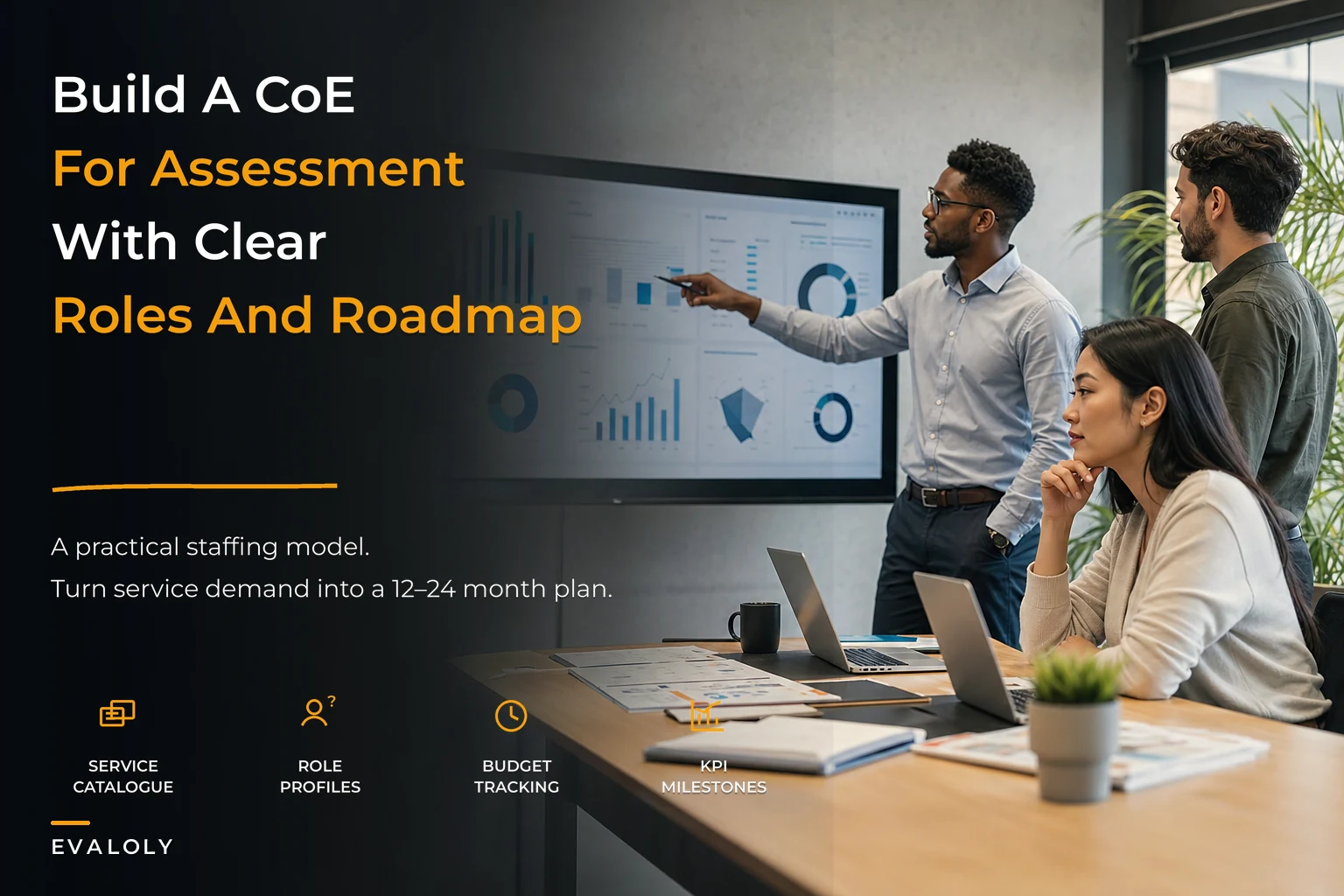
That's the moment people start googling "assessment center of excellence." Not because they want an org chart, but because the informal setup finally broke. This article walks through what an actual CoE looks like as a system — the roles, the service catalog, the budget, the tooling, and a phased rollout that doesn't collapse under its own ambition. The goal isn't to build a bureaucracy. It's to make assessment a repeatable, defensible capability instead of a collection of heroic individuals.
Why the Informal Model Breaks (and Why It Always Breaks the Same Way)
Before the roles and budgets, it's worth being honest about what fails, because the failure pattern tells you what the CoE actually needs to fix.
In the early stage, everything runs on tribal knowledge. That's fine at low volume. The problem is that assessment work has hidden dependencies most people don't notice until they collide. Item writing depends on competency definitions. Scoring depends on rubric consistency. Reporting depends on clean version control. Security depends on someone actually owning it. When these live in separate heads, coordination happens through hallway conversations and forwarded emails.
What breaks first is usually quality drift. Items get edited without review. Two versions of the same exam produce different pass rates and nobody notices for a semester. Then comes the audit problem — someone asks for evidence of fairness or validity and the answer is "we're pretty sure it's fine," which is not an answer. We covered a lot of this specific dysfunction in the piece on fixing roles, workflows, and quality controls when assessment scales, and a CoE is basically the organizational structure that makes that governance stick.
The deeper issue is that nobody owns the whole lifecycle. People own tasks. A Center of Excellence exists to own the connective tissue between tasks — the standards, the handoffs, and the measurement that proves the work is any good.
The Maturity Ladder: Know Which Rung You're Standing On
You can't build a CoE by copying someone else's org chart. You build it by figuring out your current maturity and designing the next rung, not the final one. Trying to jump from "chaotic" to "optimized" in one budget cycle is the single most common way these initiatives die.
Eliminate assessment bottlenecks.
Evaloly simplifies every step from test design to results analysis, making assessments faster and more reliable.
- Customizable test creation
- Automated grading and analytics
- Secure distribution and proctoring
No credit card required
Here's a realistic maturity ladder for assessment specifically:
| Level | What it looks like operationally | Typical failure mode |
|---|---|---|
| 1. Ad hoc | Individuals own assessments informally; no shared standards | Quality varies wildly; knowledge walks out the door when people leave |
| 2. Repeatable | Templates and rubrics exist; some shared item bank | Standards exist on paper but aren't enforced |
| 3. Defined | Documented workflows, review gates, version control, named roles | Process is followed but rarely measured or improved |
| 4. Managed | KPIs tracked (item quality, reliability, turnaround); regular psychometric review | Data exists but decisions still made on gut |
| 5. Optimized | Continuous improvement loop; assessment tied to business outcomes | Risk of over-engineering; complexity outpaces value |
Most organizations that think they're at Level 4 are actually at Level 2 with good intentions. The tell is simple: if you can't produce a reliability statistic or an item-difficulty distribution for your flagship assessment in under an hour, you're not "managed" yet.
The point of the ladder isn't to reach Level 5. Plenty of organizations should happily settle at Level 3 or 4 forever. A regional training company running a few certifications does not need the same maturity as a national credentialing body. Match the rung to the stakes.
The Service Catalog: What the CoE Actually Delivers
A CoE that can't explain what it provides becomes a vague "quality team" that everyone resents and nobody uses. The fix is a service catalog — a plain-language menu of what the function does for the rest of the organization. This also forces the uncomfortable but useful conversation about what the CoE will not do.
A workable catalog usually splits into four service lines:
-
1. Design and Development Services - Blueprinting and competency mapping for new assessments - Item writing, review, and calibration - Rubric design for constructed-response and mixed-format work
-
2. Quality and Psychometrics Services - Item-level and form-level analysis - Reliability and validity evidence collection - Fairness and accommodations review
-
3. Delivery and Operations Services - Platform administration and version control - Proctoring and security standards - Scoring workflows, including human-in-the-loop review for open-ended items
-
4. Insight and Advisory Services - Stakeholder reporting for HR, L&D, and executives - Consultation on whether a given decision even needs an assessment - Vendor and tooling evaluation
The advisory line is what earns the CoE its seat at the table — and most teams underinvest in it. If all you do is process items, you're a factory people route around when they're in a hurry. If you're the group people call before they've decided how to measure something, you're strategic. The measurement discipline behind that advisory role — grounding every recommendation in validity, reliability, and fairness — is what separates a real CoE from a rebranded admin team.
Role Profiles and How They Change as You Scale
CoE Lead / Assessment Manager. Owns the service catalog, the standards, and the relationships with stakeholders. This is your first hire or your first internal promotion. The mistake here is hiring a pure psychometrician for this role — it's a coordination and translation job first, a technical job second.
Assessment Specialist / Item Development Lead. Owns blueprinting, item quality, and rubric consistency. This person turns fuzzy requests ("we need to test onboarding knowledge") into a defensible blueprint.
Psychometrician or Measurement Analyst. At smaller scale this is a part-time contractor or a fractional resource. You don't need a full-time PhD psychometrician to run item analysis on 400 candidates a year. You do need one when high-stakes decisions and legal exposure enter the picture.
Assessment Operations Coordinator. Owns scheduling, platform admin, version control hygiene, and the boring-but-critical logistics. Underrated role. The absence of this person is why exam versions get mislabeled and cohorts become impossible to compare.
Data / Reporting Analyst. Emerges around Level 4. Turns raw results into stakeholder-specific narratives instead of exporting a spreadsheet and calling it a report.
Here's how staffing tends to evolve:
-
Stage one (Levels 1→2) One CoE Lead, plus a fractional psychometrician. Everyone else contributes part-time from existing teams.
-
Stage two (Level 3) Add a dedicated Item Development Lead and an Operations Coordinator. This is where the CoE stops being one person's side project.
-
Stage three (Level 4) Add a Reporting Analyst and convert the fractional psychometric support into a defined, ongoing engagement.
-
Stage four (Level 4→5) Specialize — separate roles for security, accessibility, and content by domain.
The pattern worth noting: coordination roles almost always get hired too late and specialist roles almost always get hired too early. Teams love to hire a shiny measurement expert and then wonder why exams are still late and mislabeled. The unglamorous coordinator would've solved more pain, sooner.
Hire and Train Checklist
When you're actually staffing, run each candidate — internal or external — through something like this:
-
- [ ] Can they write or critique an assessment blueprint from a vague business requirement?
-
- [ ] Do they understand the difference between an item being hard and an item being bad?
-
- [ ] Can they explain reliability to a non-technical executive without jargon?
-
- [ ] Have they worked with version control or, at minimum, understand why it matters for cohort comparisons?
-
- [ ] Can they handle a fairness or accommodations question without treating it as an afterthought?
-
- [ ] For the CoE Lead specifically
can they say "no, an assessment is the wrong tool here" to a senior stakeholder?
For training existing staff into these roles, prioritize in this order: measurement fundamentals first, tooling second, advanced psychometrics last. People try to reverse this constantly. Teaching someone advanced statistics before they understand what makes an item fair is like teaching someone to drive on a racetrack before they've learned what the pedals do.
Budget Templates: What This Realistically Costs
Budgets vary enormously by region and whether you build with internal staff or contractors, so treat these as shape-of-the-thing figures, not quotes.
A lean CoE (Levels 2→3) at a mid-sized training or HR function often lands somewhere around $120k–$180k annually all-in: one full-time lead's loaded cost, fractional psychometric support at maybe a few thousand a month, plus tooling. That's the version most mid-market organizations can actually justify.
A defined CoE (Level 4) with a small dedicated team tends to run $350k–$500k, once you're paying for two to three full-time roles plus platform and analytics tooling.
Tooling itself is usually the smallest line, which surprises people — often just 5–15% of the total. The expensive part is always people and their time. Budgets that assume software will replace the coordination work consistently underspend on staffing and then wonder why the initiative stalls.
Build the budget around the maturity rung you're targeting for the next 12 months, not the aspirational end state. Requesting Level 5 money in year one is how these proposals get rejected.
Tooling Stack
The stack should map to the service catalog, not the other way around. A reasonable Level 3–4 setup includes:
-
- Assessment platform with authoring, delivery, and version control — the backbone
-
- Item bank with metadata and tagging so you can actually query your content
-
- Psychometric / item-analysis tooling for reliability and item statistics
-
- Reporting layer for stakeholder-specific outputs
-
- Secure delivery / proctoring controls appropriate to your risk level, not maxed-out by default
-
- A shared documentation home for standards, blueprints, and the service catalog itself
The common mistake is buying a big platform first and figuring out the process later. It should go the other way. Define the workflow, then buy the tool that fits it. Otherwise you spend two years molding your process around a vendor's assumptions.
A note on AI-assisted tooling, since it's everywhere now: automation genuinely helps with the repetitive layers — flagging weak items from analysis data, drafting item variants for a specialist to review, routing scoring to human reviewers based on sampling rules, keeping version metadata consistent. Where it helps is in reducing the manual coordination load that eats a coordinator's week. Where it does not help is replacing measurement judgment. Treat automation as something that shortens the tedious parts of the workflow so your people can focus on the work that actually requires expertise — not as a substitute for the review gates themselves.
Define the workflow, then select tooling that fits it rather than retrofitting process to software.
Where it helps is in reducing the manual coordination load that eats a coordinator's week. Where it does not help is replacing measurement judgment. Treat automation as something that shortens the tedious parts of the workflow so your people can focus on the work that actually requires expertise — not as a substitute for the review gates themselves.
A 12–24 Month Phased Rollout Tied to KPIs
Here's the part where most CoE plans fall apart: they list activities but no measurable checkpoints, so nobody knows if it's working until the annual review.
Months 0–3: Foundation. Publish the service catalog and standards. Appoint the CoE Lead. Baseline your current state — pull reliability and item stats on your top three assessments even if the numbers are embarrassing. That embarrassment is the baseline. KPI: baseline metrics documented for flagship assessments; standards published.
Months 3–9: Standardize. Roll out review gates, version control, and blueprint templates. Bring assessments through the new process one at a time, worst-offender first. KPI: % of active assessments migrated to the standard workflow; turnaround time per new assessment.
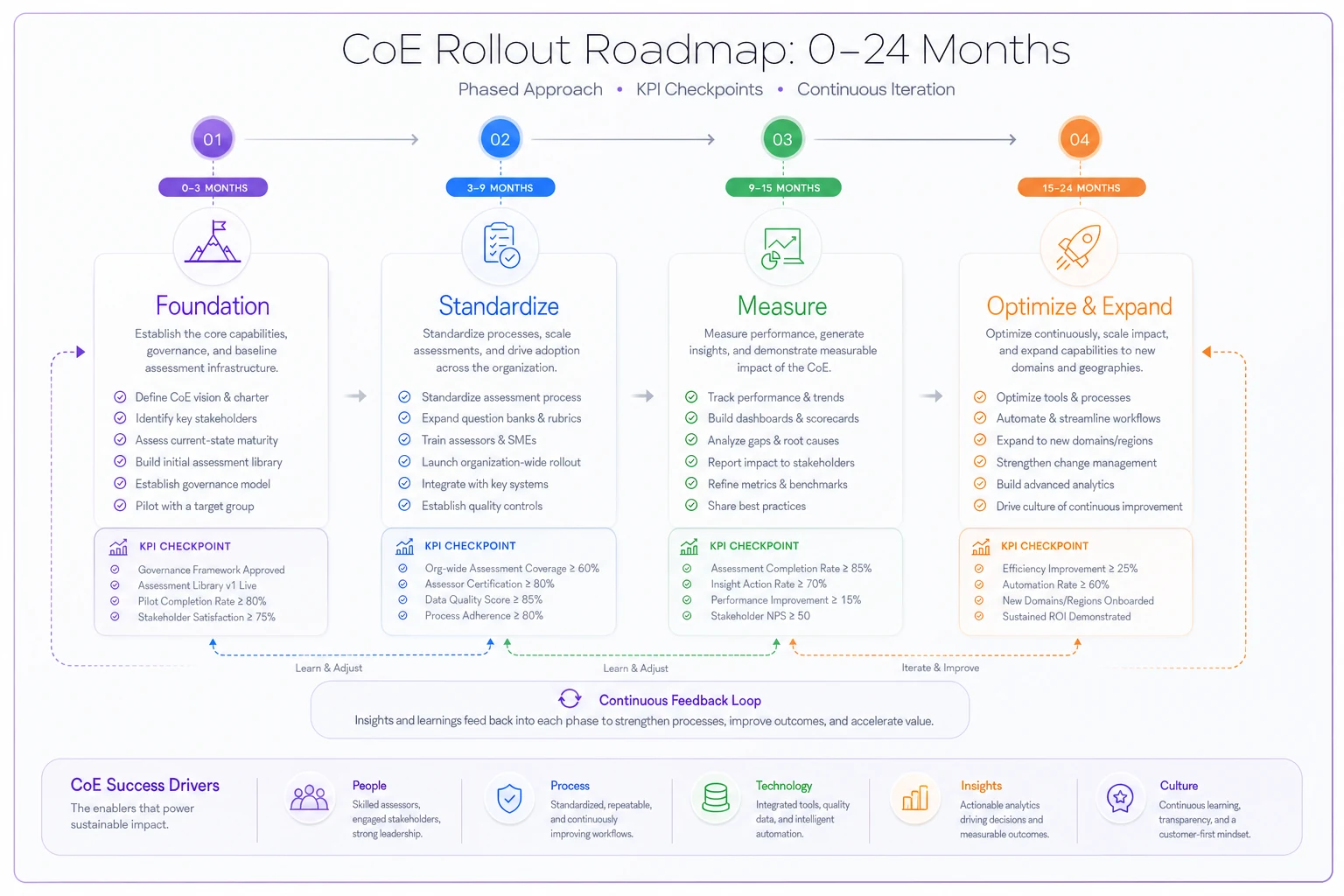
The diagram shows phases with clear checkpoints to review KPIs and iterate on process, helping teams keep progress visible and measurable.
Months 9–15: Measure. Establish regular item analysis and reliability review. Start producing stakeholder reports on a schedule, not on request. KPI: average reliability across flagship assessments trending up; item flag-and-fix cycle time; reporting delivered on cadence.
Months 15–24: Optimize and Expand. Tie assessment outcomes to downstream results — hiring quality, training effectiveness, certification defensibility. Specialize roles where volume justifies it. KPI: reduction in mislabeled or duplicated items; stakeholder satisfaction; measurable link between at least one assessment and a business outcome.
Pick KPIs you'll actually track. Three real metrics reviewed monthly beat fifteen that live in a slide nobody opens.
A Real Scenario
A mid-sized professional training provider ran certification exams for roughly 1,800 candidates a year across four programs. No CoE — one senior trainer quietly owned everything. When she went on extended leave, two exam versions got confused, and about 120 candidates sat a form with a broken answer key that went unnoticed for weeks. The cleanup cost them credibility with a corporate client and a stretch of unpaid rescoring work.
They stood up a lean CoE: one lead promoted internally, a fractional psychometrician about two days a month, and roughly a quarter of an existing admin's time formalized into a coordinator role. Total incremental spend was in the neighborhood of $90k–$110k for the first year, most of it the lead's reallocated salary.
Within about eight months, exam version errors dropped to effectively zero because version control finally had an owner. Turnaround on building a new exam went from "whenever we get to it" to a predictable few weeks. And when that same corporate client asked for validity evidence during a contract renewal, the team produced it in a couple of days instead of scrambling. The renewal closed. Nobody could put an exact revenue figure on that, but losing it would have hurt a lot more than the CoE cost.
When This Makes Sense — and When It Doesn't
Build a CoE when: assessment volume is growing, decisions carry real stakes (hiring, certification, promotion), you've had a quality or version incident, or leadership is asking questions you can't answer with evidence.
Hold off when: your assessment volume is genuinely low and stable, the stakes are informal, and one competent person can hold the whole thing in their head without risk. Building governance around a handful of low-stakes quizzes just creates overhead nobody thanked you for.
Who should not do this: organizations trying to use a CoE as a political maneuver to centralize control without actually improving quality. If the goal is turf rather than measurement, it'll be resented and routed around, and you'll have spent a budget cycle building a bottleneck.
A Center of Excellence isn't an org chart or a software purchase — it's the decision to treat assessment as a real capability with owners, standards, and evidence behind it. Start with the rung you're on, fix the coordination gaps before chasing sophistication, and measure enough to prove the thing is working. Do that, and the next time someone asks how valid your flagship exam is, you'll have an answer instead of a hopeful shrug.
Ready to revolutionize your evaluation process?
Join over 2,000 organizations using Evaloly to optimize assessments, improve learner outcomes, and make data-driven decisions.