

Most assessment programs don't have a real item pilot process. They have a habit. Someone writes new items, drops them into a live form as unscored "trial" questions, waits until the data looks "big enough," eyeballs a p-value and a point-biserial, and either keeps or kills them. That works fine until someone asks a hard question — how many responses did you actually need? What was your stop rule? Would you have made the same call with 40 fewer people? — and nobody has an answer that holds up.
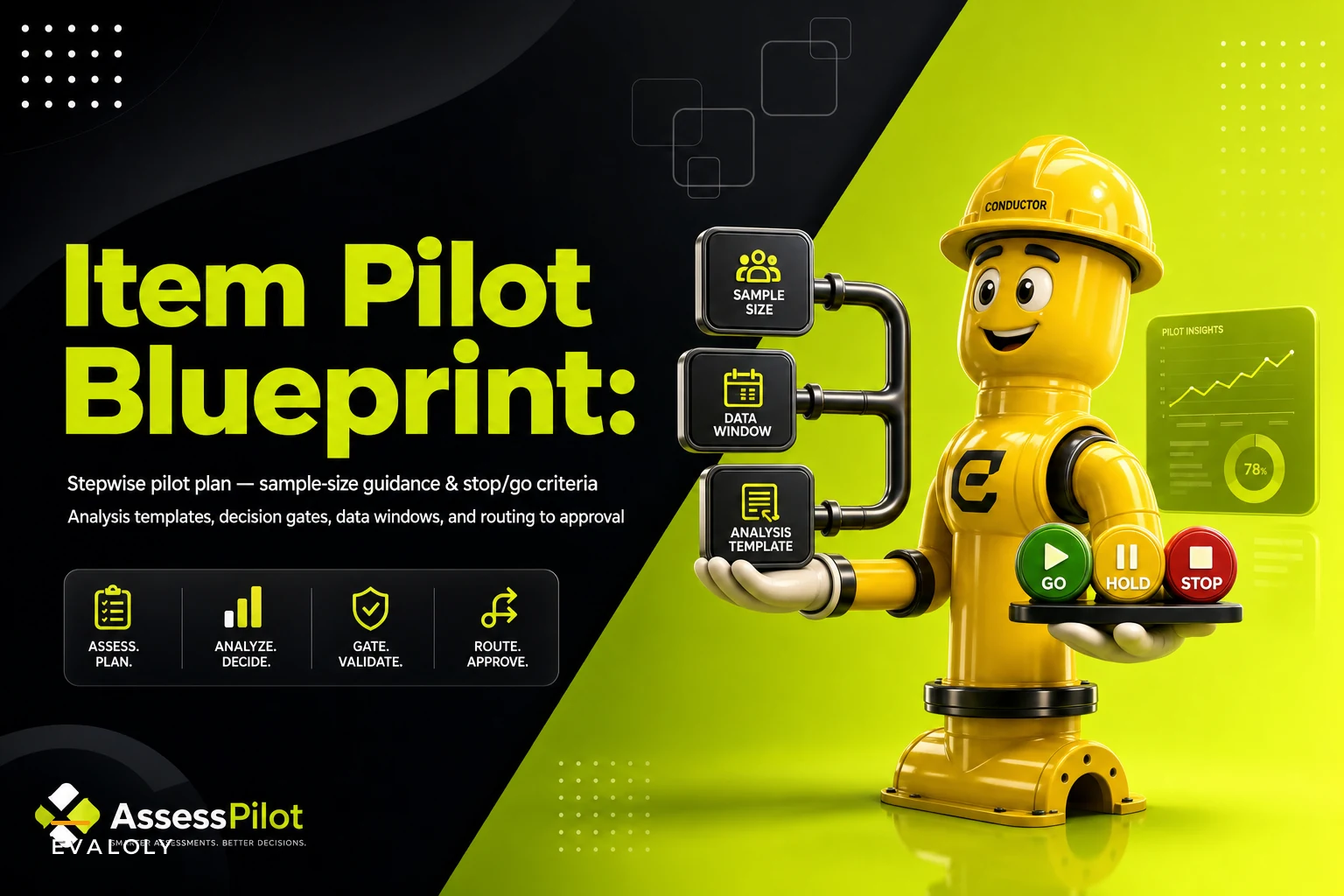
This article is about fixing that specific gap: turning ad hoc item tryouts into a standardized field-test with defined sample-size windows, explicit stop/go criteria, and analysis templates that produce the same decision no matter who runs the numbers. Not a measurement lecture. Just the pilot-to-approval pipeline for getting items into your operational bank.
Where the ad hoc approach quietly breaks
The failure isn't usually a bad item slipping through. It's inconsistency. Two reviewers look at the same trial data and reach different conclusions because there's no agreed threshold. One approves a question with a discrimination of 0.14 because "the content is important." Another rejects a 0.19 because it "felt easy." Both are guessing, and neither decision is auditable six months later.
A second, sneakier problem: peeking. Programs tend to check item stats as data trickles in, and they approve the moment numbers look acceptable. If you test significance every time 10 more people respond, you will eventually cross an arbitrary line by chance. That's how a weak item gets locked into a bank on a lucky data window, then underperforms the second it goes operational.
The third issue is silent under-powering. A program pilots an item on 45 people, sees a point-biserial of 0.28, and calls it good. At n=45, the confidence interval around that estimate is wide enough that the true value could be anywhere from about 0.05 to 0.50. You approved a coin flip and called it evidence. The small-sample item statistics playbook covers the statistical side of this in more depth — the point here is that without a defined minimum window, people approve items long before the estimate is stable.
Sample-size guidance: pick your window before you look at data
The single most important rule: decide your sample-size window before the pilot opens, and don't approve inside it. This kills the peeking problem instantly. If your minimum is 150 completed responses, then response #83 looking great is irrelevant. You wait.
Eliminate assessment bottlenecks.
Evaloly simplifies every step from test design to results analysis, making assessments faster and more reliable.
- Customizable test creation
- Automated grading and analytics
- Secure distribution and proctoring
No credit card required
What window do you actually need? It depends on what decision the statistic has to support and how you're scoring. Below is a practical starting table for classical item analysis on a dichotomous (right/wrong) item. These are working minimums, not academic ideals.
| Decision you're making | Practical minimum n | Comfortable n | Why |
|---|---|---|---|
| Screen for broken items (miskey, ambiguous) | 60–80 | 100+ | You only need to catch gross failures; distractor patterns show up fast |
| Confirm difficulty (p-value) for form assembly | 100–150 | 200+ | p is stable earlier than discrimination |
| Confirm discrimination (point-biserial) for bank approval | 150–200 | 300+ | Discrimination estimates are noisy; wide CIs at low n |
| Approve into a high-stakes bank | 200+ | 350–500 | You're committing to reuse; you want tight intervals |
| Any subgroup fairness flag (DIF screening) | 200+ per group | 300+ per group | Small subgroup cells produce garbage flags |
The DIF row is where most small programs get burned. You cannot screen for differential item functioning with 22 people in the focal group. You'll either miss real problems or chase noise. If you can't hit the per-group minimum, don't run the DIF analysis and pretend the item is clean — flag it as "fairness not evaluated" and handle it through content review instead.
One more thing on windows: completed responses, not started. If your pilot embeds trial items near the end of a long form, fatigue and dropout will thin your effective sample. Count only respondents who actually reached and answered the item.
Stop/go criteria: the thresholds you commit to in advance
Stop/go criteria are the whole point of a blueprint. They convert "does this feel okay" into "does this clear the bar." Write them down, get them approved by whoever owns the bank, and apply them mechanically.
GO (approve into bank):
-
Difficulty (p) between roughly 0.30 and 0.90
-
Point-biserial discrimination ≥ 0.20
-
Keyed answer has the highest point-biserial of all options
-
No distractor chosen by more than the key (unless intentionally hard)
-
No DIF flag at your screening threshold (if evaluated)
HOLD (revise and re-pilot):
-
Discrimination between 0.10 and 0.19 with sound content
-
One dead distractor (chosen by <5%) but item otherwise functions
-
A distractor pulling high scorers, suggesting ambiguity
-
Difficulty just outside range but content-critical
STOP (reject):
-
Negative or near-zero discrimination (< 0.10)
-
A non-keyed option outperforming the key on point-biserial (possible miskey)
-
p below ~0.15 or above ~0.95 with no defensible reason
-
Confirmed DIF against a subgroup
The pattern that trips people up: a HOLD is not a soft GO. Items sitting in the 0.10–0.19 discrimination band are the ones programs keep approving "because we need the coverage." That's how bank quality erodes one marginal item at a time. HOLD means it goes back to the writer, not into the form.
The analysis template: what every pilot report contains
Standardization dies when every analyst formats results differently. Force a single template so decisions are comparable across pilots, reviewers, and quarters. At minimum, each item's pilot record should carry:
-
Item ID and version — tied to your version-control scheme so you never confuse a revised item with its predecessor
-
Pilot window dates and final completed n
-
Difficulty (p) with the count answering each option
-
Point-biserial for the key and every distractor
-
Distractor analysis — % choosing each option, split by high/low scorers
-
DIF result or explicit "not evaluated"
-
Stop/go decision and which criterion drove it
-
Reviewer name and date
The distractor split is the most under-used piece here. A distractor chosen more often by high scorers than low scorers is a red flag — it usually means the option is defensibly correct or the stem is ambiguous. That single row catches more real problems than the headline p-value ever will. For the underlying metrics and triage logic, the item-level analysis playbook breaks down how to read these numbers without over-interpreting them.
Version tagging matters more than it looks. If you revise a HOLD item and re-pilot it, the two pilots must be linked but distinct — otherwise you'll pool data across versions and produce a meaningless blended statistic. This is the same discipline that keeps cohort comparisons from breaking; the branching and metadata model for version control covers how to structure those links so a revised item never contaminates its parent's data.
Data windows: when to open, when to close, when to pause
A pilot window has three moments that need rules.
Opening. Don't open a pilot until you know the target n and the expected response rate. If you seed trial items into a form taken by around 50 people a week and you need 200, you're committing to at least a four-week window. Plan for it. Half-finished pilots that get "close enough" and approved early are the number one source of unstable items.
Closing. Close at your target n, not at a calendar date, unless the calendar forces it. If you must close early for a form-release deadline, the item doesn't get a GO — it gets a "pilot incomplete, do not approve" tag and rolls into the next cycle.
Pausing. Sometimes you pause mid-window because something looks broken — a distractor pulling 60% of responses, for example, suggesting a miskey. Pause, investigate, but don't approve or reject on partial data. Fix the miskey, restart the window as a new version. A miskeyed item caught at n=40 is not a failed item; it's a fixed item that needs a clean pilot.
A real scenario: certification program tightening its pilots
A mid-sized professional certification group was pushing roughly 120–150 new items into their bank each year. Their process was informal — trial items in live forms, quick review, approve. About a year in, they noticed operational forms were running slightly hot on difficulty and a handful of newer items had near-zero discrimination in live use. Post-hoc cleanup was eating real analyst time, and two items had to be pulled after candidates flagged them.
They put in a blueprint. Nothing elaborate: a fixed 200-response minimum for bank approval, the stop/go table above, a mandatory distractor split in every pilot record, and a hard "no approval inside the window" rule. Analysts stopped peeking and stopped approving on gut.
Over the next couple of cycles the share of newly approved items landing in the weak-discrimination band dropped noticeably, and post-approval pulls went to essentially zero for piloted items. The less visible win was faster reviews — because the criteria were fixed, a reviewer could clear a clean item in a few minutes instead of debating it. The trade-off was real though: their pilot timeline stretched, because 200 completed responses takes longer than 80. They accepted slower intake for a cleaner bank, which was the right call for a certification body.
When a rigid blueprint is the wrong tool
When it makes sense: any item that will be reused, scored, and reported on — certification banks, placement tests, anything with stakes or longevity. If an item lives past a single administration, it deserves a real pilot.
When it's overkill: low-stakes formative quizzes you rewrite every term, one-off classroom checks, or content you'll never bank. Forcing a 200-response window on a quiz you're going to discard is wasted effort. Screen for gross failures at n=60 and move on.
Who should not do this: programs that genuinely can't hit minimum sample sizes. If your entire candidate pool is 40 people a year, classical stop/go thresholds will mislead you more than they help. You're in small-sample territory, and the honest move is conservative content review plus flagging estimates as provisional — not pretending a point-biserial from 30 responses is trustworthy.
Putting it into a running process
Here's the loop, start to finish, that a working team can actually follow:
-
Writer submits item with content tags and intended difficulty.
-
Define the window — set target n and stop/go thresholds before the item goes live.
-
Seed into a pilot slot as unscored, tied to a version ID.
-
Collect to target n — no peeking, no early approval.
-
Run the standard template — p, point-biserials, distractor splits, DIF if the sample allows.
-
Apply stop/go mechanically — GO, HOLD, or STOP based on the criteria, not the discussion.
-
Route the outcome — GO to bank, HOLD back to writer for revision and re-pilot, STOP to archive with a reason.
-
Log the decision with reviewer and date for the audit trail.
The rule that makes the whole thing hold together is separating the when-to-decide from the what-to-decide. The window controls when. The criteria control what. As long as those two are fixed before data collection starts, you've removed the two biggest sources of bad item approvals — peeking and shifting standards.
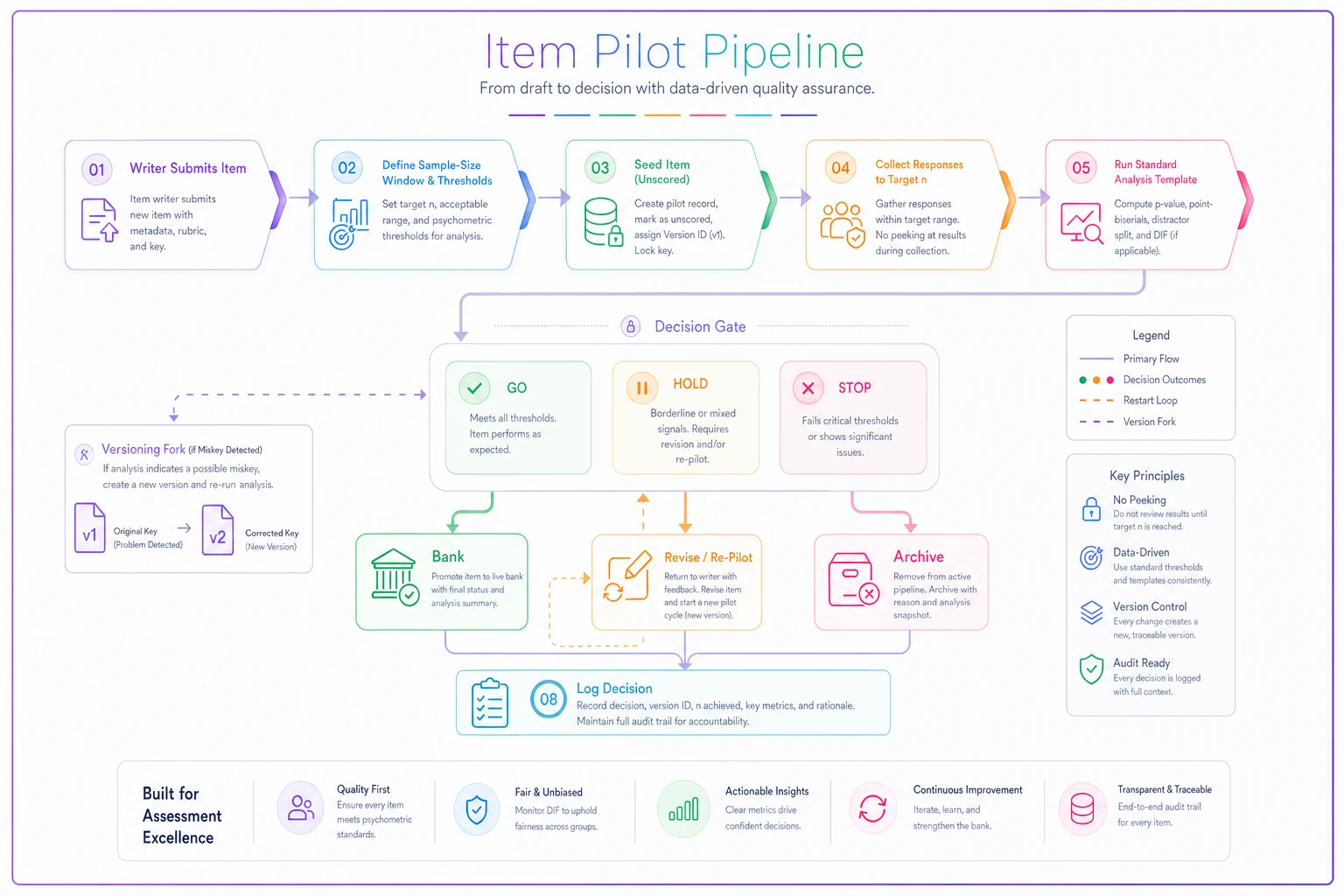
Diagram showing the loop and decision gates for the pilot workflow.
A field-test blueprint isn't about running fancier statistics. It's about making the same decision every time, on enough data, against a bar you set in advance. Most programs already have the metrics. What they're missing is the discipline to decide before they look — and that's the part worth building first.
Ready to revolutionize your evaluation process?
Join over 2,000 organizations using Evaloly to optimize assessments, improve learner outcomes, and make data-driven decisions.