


The fastest way to wreck an item bank isn't a bad vendor or a weak platform. It's hiring three new item writers in a quarter and letting them "learn by doing." Six weeks later you're staring at 400 new items, half of which have two defensible correct answers, distractors that don't distract, and stems written for a reading level nobody in the target population actually has.
This is the part of scaling assessment content that almost nobody documents properly. Everyone talks about item quality metrics after the fact. Very few teams talk about the onboarding machinery that determines whether a new writer produces usable items in week two or week ten. That gap is what an item-writer onboarding SOP is supposed to close, and most orgs are running one held together with a shared Google Doc and tribal knowledge.
Here's how the breakdown actually happens — and the templates, checkpoints, and SLAs that keep quality flat while volume goes up.
Where new item writers actually go wrong
New writers rarely fail at the obvious stuff. They fail at the invisible conventions that experienced writers apply without thinking.
A typical example: a subject-matter expert joins as a contract item writer. Brilliant on content. Their first batch of 30 multiple-choice items comes back and the reviewer finds that 22 of them have the longest option as the correct answer. Classic test-wiseness leak. The SME never learned that pattern is a problem because nobody told them — they were just writing "good questions."
Another one shows up constantly with cognitive level. You ask for application-level items and get recall items dressed up in longer sentences. The stem says "A nurse is caring for a patient who..." and then the actual task is just "define the term." The writer thinks they've written a scenario item. They've written a vocabulary item with extra words.
The pattern across most onboarding failures looks like this:
-
Writers don't know the house style rules because the rules live in senior people's heads
-
Feedback comes too late — after a full batch, not after the first two items
-
There's no shared definition of "done," so every reviewer enforces something slightly different
-
Volume expectations get set before quality is stable, so writers optimize for throughput
That last one is the quiet killer. If you tell someone they need 40 items a week in month one, they will hit 40 items a week and the review queue will absorb the damage. If you're already dealing with broader coordination problems, the governance model for fixing roles and workflows when assessment scaling gets chaotic is worth reading alongside this, because onboarding sits inside that larger structure.
The onboarding flow that actually works
The core idea: don't let a new writer touch production items until they've cleared calibration on a small, controlled set. Front-load the correction, and the batch reviews get dramatically cheaper.
Eliminate assessment bottlenecks.
Evaloly simplifies every step from test design to results analysis, making assessments faster and more reliable.
- Customizable test creation
- Automated grading and analytics
- Secure distribution and proctoring
No credit card required
Here's the sequence that works across teams scaling from 2 to 8+ writers:
-
Read-and-mark day (Day 1). Before writing anything, the new writer reviews 15 existing items — 10 good ones, 5 with deliberately seeded flaws. They flag what's wrong. This tells you their diagnostic eye before you trust their pen. Someone who can't spot a clued distractor won't avoid writing one.
-
First 5 items, single-topic (Days 2–3). Narrow scope on purpose. One content area, one item type. You're testing whether they can apply the style guide, not whether they know the domain.
-
Calibration review (Day 4). Two reviewers score the same 5 items independently using the QA checklist. If they disagree with each other, your checklist is the problem, not the writer. Fix the checklist.
-
Feedback + rewrite (Day 5). Writer revises based on annotated feedback. You want them to see their own items with the flaws marked, not just a score.
-
Second batch, 10 items, expanded scope (Week 2). Now you introduce a second item type or a harder cognitive level.
-
Certification gate (end of Week 2). If the second batch clears QA at your target pass rate on first submission — say 80% of items need no substantive rework — they're cleared for normal production volume. If not, one more calibration loop.
The number that matters here is first-pass acceptance rate, not raw output. A writer producing 15 solid items a week that need almost no rework is worth more than one producing 35 that each need a 20-minute fix.
A visual of the calibration sequence can help new teams align quickly.
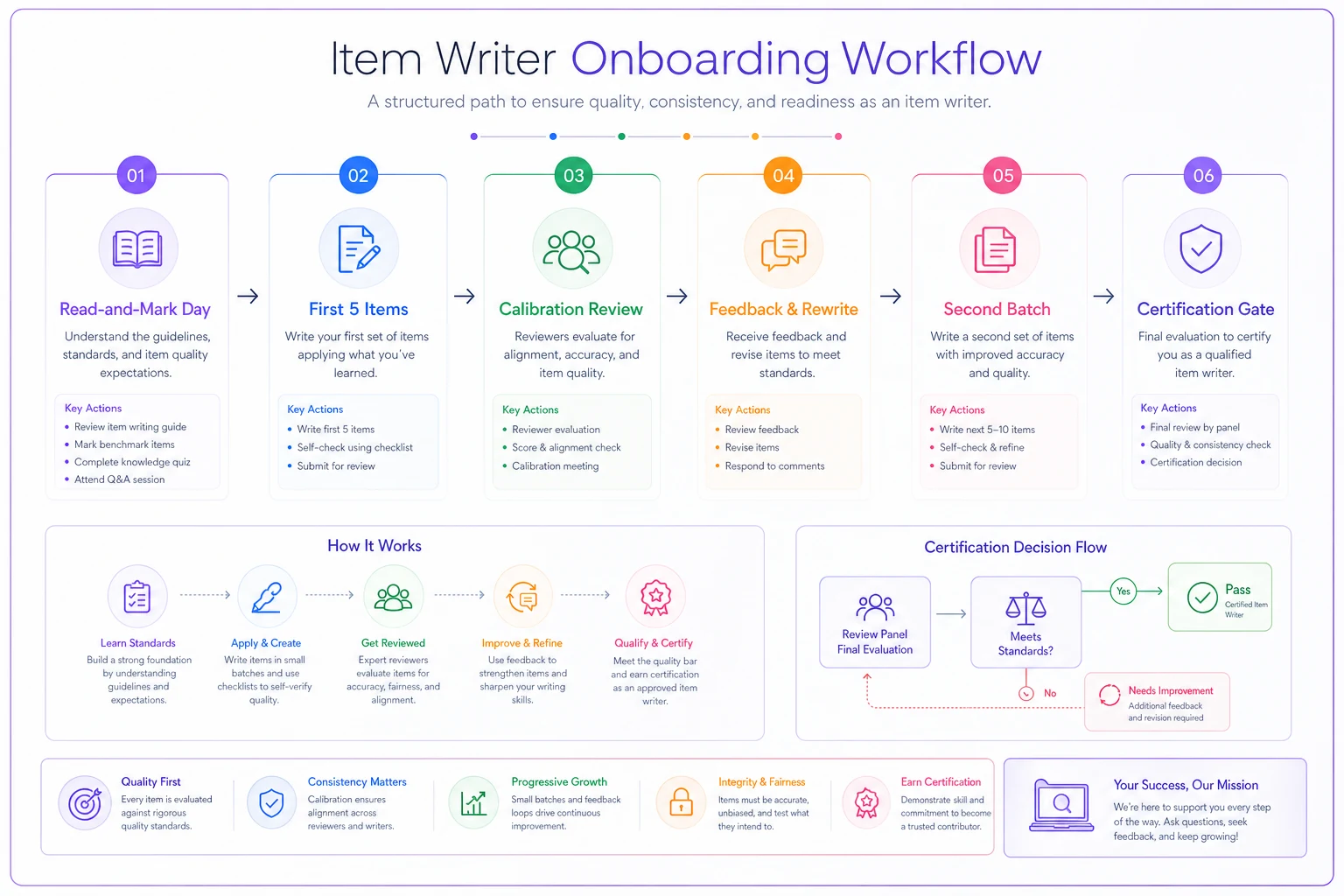
The calibration loop above reduces rework and makes first-pass acceptance the main metric.
Test-writing templates that prevent the common defects
Templates aren't about creativity control. They're about making the invisible rules visible so the writer doesn't have to remember 40 conventions at once.
A workable multiple-choice template forces the writer to fill in specific fields rather than just typing a question. Something like:
-
Learning objective / competency tag (mapped, not free-text — see notes on tagging schemas for competency-based question banks)
-
Cognitive level (recall / application / analysis) — and the writer must justify it in one line
-
Stem (must be a complete question or problem, testable without reading options)
-
Key + a one-sentence rationale for why it's correct
-
Distractors — each with a note on why a plausible test-taker would pick it (based on a real misconception, not random)
-
Reading level check (target grade band)
That distractor field is the highest-leverage part. When you force a writer to explain why someone would choose a wrong answer, they stop writing throwaway options like "none of the above" and start writing distractors tied to actual errors. The rationale field also becomes useful later during item-level analysis, because you already have the writer's intent documented.
For constructed-response and scenario items, the template needs a scoring-note field: what the ideal response contains, what partial credit looks like, and one example of a common wrong-but-tempting answer. Writers who skip this produce items that are impossible to grade consistently, which becomes someone else's problem three months later.
QA checkpoints: where to inspect, and how often
The mistake most teams make is doing one big review at the end of a batch. By then, a systematic error is already baked into 30 items. Checkpoints should get further apart as trust builds, not stay fixed.
The sampling stage is where a lot of teams get nervous — "won't errors slip through if we don't check everything?" Some will. But a writer who's cleared certification and two clean batches has a low enough defect rate that 100% review is a waste of a senior reviewer's time. The far bigger risk is reviewer fatigue: someone checking 200 items in a sitting stops catching subtle problems around item 60. Sampling keeps reviewers sharp on the items that matter.
| Stage | Review depth | What you're checking | Who reviews |
|---|---|---|---|
| Onboarding (weeks 1–2) | Every item, 2 reviewers | Style compliance, key accuracy, cognitive level | Lead + peer |
| Ramp (weeks 3–6) | Every item, 1 reviewer | Key accuracy, distractor quality, tagging | Lead |
| Established | Sample 20–30% + all flagged | Drift, edge cases, fairness/bias scan | Rotating reviewer |
| Post-pilot (any writer) | Data-driven | Statistical flags from response data | Psychometric review |
One checkpoint people forget: a fairness and bias scan as a distinct pass, not something folded into general review. Reviewers checking for a correct key are in a different mental mode than reviewers checking whether a scenario assumes cultural or regional knowledge unrelated to the competency. Separate the passes.
Role-level checklists
Different roles in the pipeline need different checklists. Handing the same checklist to a writer, a reviewer, and a content lead just guarantees everyone half-does everyone else's job.
Writer self-check (before submission):
-
Stem is answerable without reading the options
-
Only one defensibly correct answer
-
No "all/none of the above" unless justified
-
Distractors map to real misconceptions
-
No grammatical clues linking stem to key
-
Longest option is not systematically the answer
-
Competency tag and cognitive level filled and justified
-
Reading level within target band
Reviewer check (per item):
-
Key verified independently (reviewer answers cold before seeing the marked key)
-
Rationale holds up
-
Cognitive level matches the actual task, not the stem length
-
No overlapping or absurd distractors
-
Tagging accurate against the schema
Content lead check (per batch):
-
Coverage balance across the blueprint
-
No accidental clustering of difficulty
-
Duplicate or near-duplicate detection
-
Sign-off on writer's first-pass acceptance rate trend
The independent-key rule for reviewers is small but powerful. When a reviewer answers the item cold before looking at the marked answer, you catch "two correct answers" problems that a reviewer skimming toward a pre-known key will glide right past.
SLA suggestions that keep the pipeline from clogging
Onboarding falls apart when feedback is slow. A new writer sitting for six days waiting on their first batch review loses momentum and, worse, keeps producing items using the same flawed assumptions because nobody's corrected them yet.
Reasonable internal SLAs during onboarding:
-
First-batch review turnaround 2 business days max. Faster during weeks 1–2.
-
Feedback specificity annotated at item level, not a batch-level score. A number tells a writer nothing about what to fix.
-
Rewrite window writer returns revisions within 2 days of receiving feedback.
-
Certification decision within 1 day of second clean batch — don't leave people in limbo.
For established writers, the SLA shifts toward volume and drift:
-
Sample review turnaround 3–5 business days
-
Statistical flag response any item flagged by response data gets triaged within a week
Set these as ranges and revisit them monthly. If your review turnaround keeps slipping, that's usually a signal your reviewer capacity hasn't scaled with your writer headcount — a very common failure when teams add writers faster than reviewers.
Sample training exercises that transfer
Reading a style guide doesn't teach anyone to write good items. Deliberate exercises do. A few that consistently work:
The flaw hunt. Give the trainee 10 real items with seeded defects — a clued distractor, a double-key, a recall item mislabeled as application. Ask them to find and name the flaw. This builds the diagnostic muscle before they write anything.
The distractor rewrite. Hand them a solid stem and key with three weak distractors. Their job is to replace the distractors with ones tied to actual misconceptions. This is the single most useful drill — most item quality lives in the distractors.
Cognitive-level sorting. Give 15 items, ask them to classify each by cognitive level and justify it. Then show the "official" classifications. The gaps reveal exactly where the writer's mental model is off.
The reverse-engineer. Give them item-response data (a distractor almost nobody chose, a key that low performers got but high performers missed) and ask them to explain what's wrong with the item. This connects writing to the downstream analytics reality and tends to make writers far more careful.
When a heavy onboarding SOP is overkill
This whole apparatus makes sense when you're producing item volume at scale with multiple writers and real stakes on the assessments — certification, hiring, licensure. If you're a two-person team writing 20 items a quarter for a low-stakes internal course, this is too much process. You'll spend more time running the SOP than writing items.
It's also a bad fit when your writers are all long-tenured experts who've calibrated together for years. You still want the checklists and the statistical checkpoints, but the intensive week-one-and-two calibration loop is built for new people. Forcing veterans through it burns goodwill fast.
Where it becomes non-negotiable: any time you're adding contract writers seasonally, spinning up a new content area, or scaling from a couple of writers to a team. That's precisely when quality drift is invisible until it's expensive.
A quick real scenario
A mid-sized credentialing body was scaling from 3 to 7 item writers ahead of a new exam form. Before formalizing onboarding, their first-pass acceptance rate on new writers' items sat around 55–60% — meaning nearly half of every new batch bounced back for rework. Review queues stretched past two weeks, and two reviewers were effectively doing full-time cleanup.
They put in a calibration-based onboarding flow: read-and-mark day, controlled 5-item first batch, independent-key reviews, and a certification gate at 80% first-pass acceptance. New writers took a bit longer to reach full volume — roughly an extra week and a half before they were writing at pace. But first-pass acceptance on their fourth-week items climbed into the low 80s, and the rework backlog dropped enough that one reviewer shifted back to actual item development.
Nothing dramatic happened overnight. The win was that the next three writers they onboarded followed the same path and hit similar numbers, which is the whole point. Repeatability, not heroics.
Where tooling helps, honestly
You can run all of this in spreadsheets and documents, and plenty of teams do at first. It works until it doesn't. The pain shows up when you can't tell which items came from which writer, when feedback lives in email threads, and when nobody can pull a writer's first-pass acceptance trend without an afternoon of manual counting.
Assessment platforms with built-in authoring workflows, versioning, and review-stage tracking make the SOP enforceable instead of aspirational — templates become required fields, checkpoints become gated steps, and acceptance rates get tracked automatically instead of tallied by hand. AI-assisted checks can also pre-screen submissions for the mechanical stuff (longest-answer patterns, reading level, duplicate stems) so human reviewers spend their attention on judgment calls like distractor quality and fairness. That's the right division of labor: automate the pattern-catching, keep humans on the reasoning.
The tooling only matters if the underlying SOP is sound. A platform won't fix an onboarding process that has no calibration step and no shared definition of done. Get the flow, the templates, and the checkpoints right first. The software just keeps them from decaying back into a shared doc six months later.
Scaling item production without quality loss isn't really about hiring better writers. It's about how quickly and precisely you correct the writers you have — before the flaws compound across hundreds of items. Front-load the calibration, make your review checkpoints tighter early and looser later, hold your feedback SLAs, and measure first-pass acceptance instead of raw throughput. Do that, and the fifth writer you onboard ramps as cleanly as the first.
Ready to revolutionize your evaluation process?
Join over 2,000 organizations using Evaloly to optimize assessments, improve learner outcomes, and make data-driven decisions.