

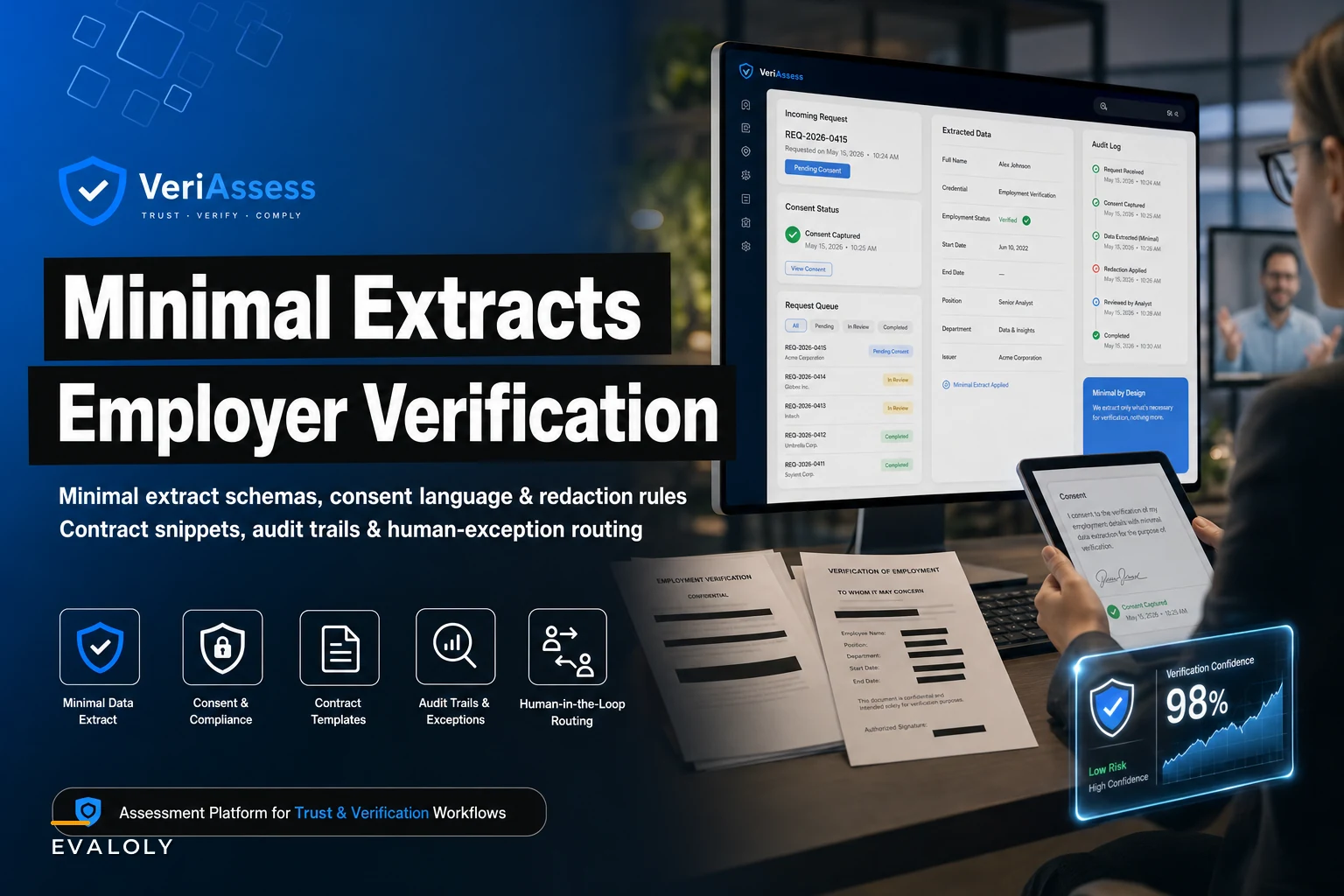

Most verification problems don't come from the verification itself. They come from the extract — the slice of assessment data an employer or background-check vendor asks for, and what your team actually hands over.
A hiring manager emails: "Can you confirm this candidate passed your certification?" Simple question. But by the time your team responds, they've forwarded a full score report PDF with raw item responses, demographic fields, accommodation notes, and the candidate's attempt history — because that's what the platform spits out by default. None of that was needed. All of it is now sitting in someone's inbox outside your control.
That gap — between what's asked and what's sent — is where the real risk lives. This post is about fixing it: the minimal extract schema, the consent and contract language that governs it, and the redaction and auditability rules that keep the whole thing defensible.
Where verification extracts quietly go wrong
The failure almost never looks dramatic. It looks like a helpful person being too generous with data.
A few patterns come up repeatedly:
-
The "just send the report" reflex. Someone asks to confirm a credential. Your coordinator exports the native score report, which bundles pass/fail with scaled scores, subscores, timestamps, and sometimes proctoring flags. The employer only needed a yes/no.
-
Consent that doesn't cover the actual disclosure. The candidate signed something during registration about "program administration." Nobody checked whether that language actually authorizes disclosure to a third-party employer or a background screening company.
-
No field-level control. The platform can export everything or nothing. There's no middle setting that says "release credential status and issue date, redact everything else."
-
No trail. Three months later, someone asks what was sent to that vendor and who approved it, and the honest answer is a shrug.
What ties all of this together: verification gets treated as a customer-service task, not a data-release task. The person answering wants to be helpful and fast. The system gives them a blunt export button. So they use it.
The core issue is that the default export is almost always wrong for verification. A full assessment record is built for internal analysis and appeals, not external disclosure. If your verification extract looks anything like your internal record, you're over-disclosing by design.
The minimal extract principle
Start from the question, not the record. An employer verification almost always boils down to one of three things:
Eliminate assessment bottlenecks.
Evaloly simplifies every step from test design to results analysis, making assessments faster and more reliable.
- Customizable test creation
- Automated grading and analytics
- Secure distribution and proctoring
No credit card required
-
Did this person earn this credential? (yes/no + issue date)
-
Is the credential still valid right now? (status + expiry)
-
What was the credential, specifically? (title, version, issuing body)
That covers the vast majority of requests. Everything beyond those fields should require a specific, separately justified reason.
Here's a practical contrast between a bloated native export and a minimal verification extract:
| Field | Native score report | Minimal verification extract |
|---|---|---|
| Candidate full name | ✓ | ✓ (match field only) |
| Credential title + version | ✓ | ✓ |
| Pass/fail or credential status | ✓ | ✓ |
| Issue date / expiry | ✓ | ✓ |
| Issuing authority | sometimes | ✓ |
| Scaled score / percentile | ✓ | ✗ |
| Subscores / domain breakdown | ✓ | ✗ |
| Raw item responses | ✓ | ✗ |
| Attempt history | ✓ | ✗ |
| Accommodation flags | ✓ | ✗ |
| Proctoring notes / flags | ✓ | ✗ |
| Demographic fields | ✓ | ✗ |
| Internal item IDs | ✓ | ✗ |
The right-hand column is boring. That's the point. A verification extract should be small enough that handing it over feels low-stakes, because it is.
One thing worth flagging: employers often ask for the score out of habit, not need. A recruiter requesting a percentile usually can't do anything meaningful with it — they can't interpret it properly, and it exposes you to disparate-impact arguments you don't want anywhere near a hiring decision. Default to status, not score, and make the employer justify in writing if they genuinely need more.
Consent language that actually authorizes the disclosure
A verification extract is only clean if the candidate agreed to it. Vague registration-time consent — "we may use your data to administer the program" — does not cover sending credential data to a prospective employer. You need layered, specific language.
Three consent moments to separate clearly:
-
Registration consent — covers delivery, scoring, and internal program operations. This is not your disclosure authority.
-
Standing verification consent — an opt-in where the candidate authorizes the issuing body to confirm credential status to third parties who present a valid request. This is what makes routine employer confirmations possible.
-
Per-request consent — for anything beyond minimal status (e.g., an employer wants subscores for a specialized role), a fresh, specific authorization naming the recipient and the fields.
Sample minimal-disclosure clause you can adapt (have counsel review for your jurisdiction):
> "I authorize [Issuing Body] to confirm the existence, status, title, and issue/expiry date of credentials I have earned to third parties who submit a verification request including my name and the credential in question. This authorization does not extend to scores, subscores, item-level responses, accommodation records, or proctoring data, which require my separate written consent for each disclosure."
Notice what that clause does: it pre-authorizes the routine stuff and explicitly walls off the sensitive stuff. That separation is what lets your team answer standard requests quickly without a privacy review every time, while still forcing a stop-and-check on anything unusual.
This consent layering should sit inside your broader data lifecycle rules. If you haven't mapped retention, access tiers, and disclosure pathways end to end, the consent language will have gaps — worth reading alongside an operational privacy and lifecycle playbook for assessment data so your verification consent isn't floating disconnected from the rest of your governance.
Contract clauses for third-party verification vendors
When a background-screening company or employer platform sits between you and the hiring decision, a one-off email approval isn't enough. You need a few clauses in the data-sharing agreement or MSA that constrain what happens after you hand data over.
The clauses that matter most in practice:
-
Purpose limitation. The vendor may use the extract only to confirm the specific credential for the specific candidate — no secondary purpose, no profile-building, no resale, no model training.
-
Field restriction. The agreement names the exact fields they're entitled to receive. Anything outside that list requires a separate request.
-
No-onward-transfer clause. The vendor cannot forward the extract to any further party without your written approval.
-
Retention cap. The vendor must delete the extract within a defined window after the verification is complete — 30 to 90 days is common — and certify deletion on request.
-
Redaction-respect clause. The vendor agrees not to attempt to re-identify, reconstruct, or infer redacted fields.
-
Audit-cooperation clause. You retain the right to request logs of what they received and when, and they agree to provide them.
A quick operational note: vendors will often push back on the retention cap because their systems default to indefinite storage. Hold the line. A verification is a point-in-time event; there's no legitimate reason to keep a candidate's credential data for years afterward.
If you're running verification as a revenue line — some certification bodies charge employers for confirmations — these clauses interact with your pricing and liability model. The economics of running verification at scale are worth thinking through alongside the business model for commercializing assessment and certification programs, because the cheaper and more automated your verification becomes, the more disciplined your contracts need to be.
Redaction rules: redact by default, release by exception
The safest system is one where redaction is the default state and releasing a field is the deliberate action — not the other way around.
A redaction rule set that holds up:
-
Default-deny every field except the minimal verification set (name match, credential title, status, dates, issuer).
-
Mask partial identifiers. If a full identifier isn't needed for matching, show a partial — last four of an ID, not the whole thing.
-
Strip free-text fields entirely. Comments, accommodation notes, and proctor remarks never go into a verification extract. High-risk and almost never relevant.
-
Collapse scores to status. Convert any numeric score into pass/fail or valid/expired before the extract is generated, unless a per-request consent explicitly unlocks the number.
-
Redact at generation, not at send. Sensitive data should never reach the extract file in the first place. Redacting after export means the raw data existed somewhere redactable — which means it existed somewhere leakable.
That last rule is the one teams get wrong most often. They generate the full report, try to black out fields before emailing it, and the original unredacted file lingers in a downloads folder or email draft. Redaction has to happen upstream, at the point the extract is built, so the sensitive version never gets created for external use.
Redaction has to happen upstream, at the point the extract is built, so the sensitive version never gets created for external use.
Redaction has to happen upstream, at the point the extract is built, so the sensitive version never gets created for external use.
Auditability: the part everyone skips until an incident
When a dispute, complaint, or regulator question lands, you need to answer three things precisely:
-
What was disclosed?
-
To whom, and under what authorization?
-
Who approved it, and when?
If your verification process can't answer those from a log, you're reconstructing events from memory and inbox searches. That's where defensibility falls apart.
A minimal audit record per verification should capture:
-
Timestamp of the request and the response
-
Requesting party (employer/vendor identity)
-
Candidate and credential referenced
-
The exact field set released (the schema version, ideally)
-
The consent basis relied on (standing verification consent vs. per-request)
-
The staff member or automated rule that approved release
-
Any redactions applied
The useful discipline here is logging the schema version, not just "sent data." If your minimal extract schema is versioned — v1 releases status and dates, v2 adds issuer — your log can record "released extract schema v2" and you can reconstruct exactly which fields went out without storing the sensitive payload in the log itself.
Where automation helps — and where it shouldn't
Routine status confirmations are a reasonable fit for automation. A request comes in, the system checks the candidate's standing verification consent, pulls only the schema-defined minimal fields, logs the disclosure, and responds. Fast, consistent, auditable — and no human improvising an export.
The important boundary: automation should handle the default path and refuse the exceptions. Any request for scores, subscores, accommodation data, or anything outside the minimal schema should drop out of the automated flow and route to a human, with the per-request consent requirement attached. The system's job is to make the safe path effortless and the risky path impossible to do by accident.
A typical automated flow looks like this:
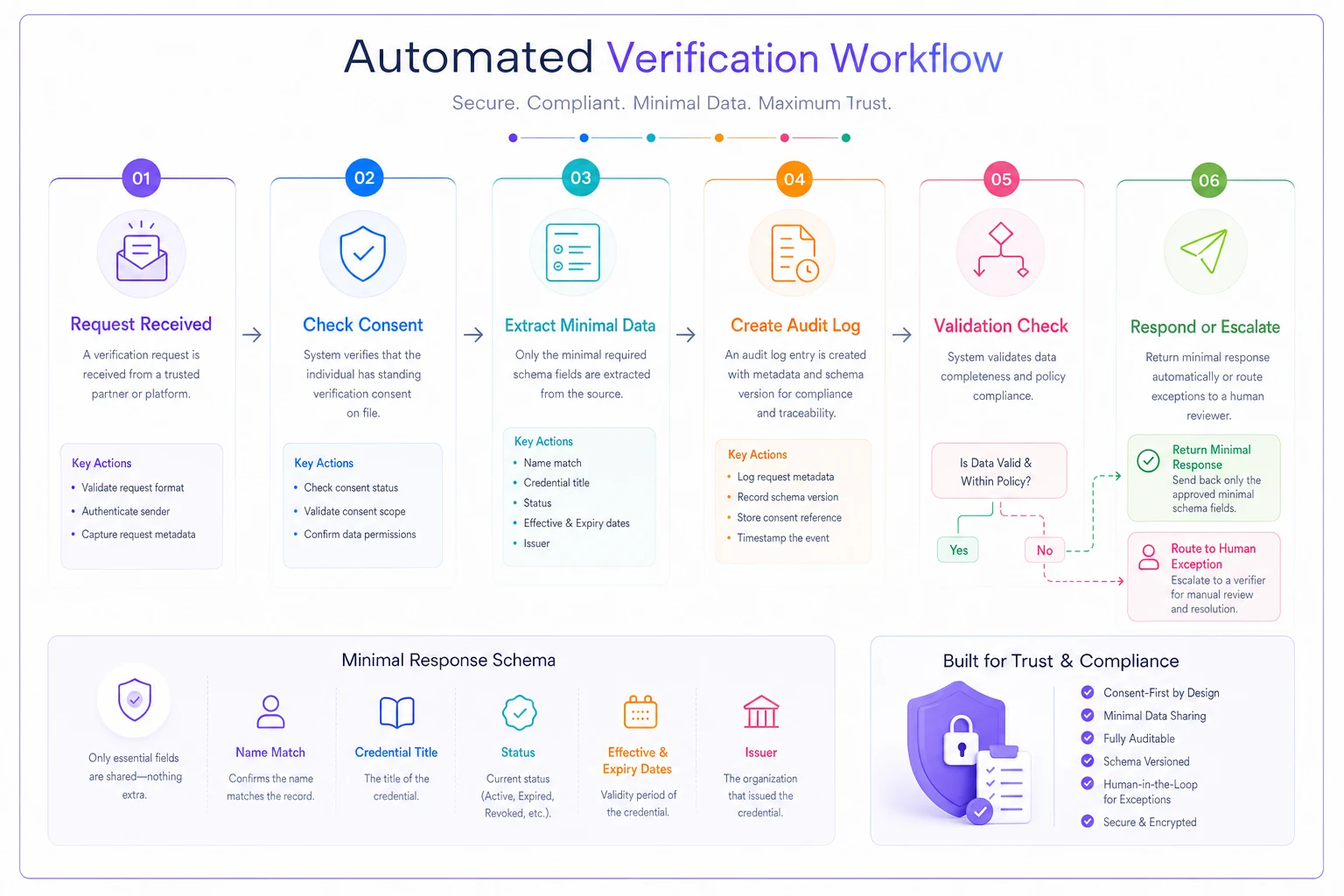
What you don't want is automation that mirrors the old problem at higher speed — auto-exporting full reports because that's the available function. The value isn't speed for its own sake. It's enforcing the minimal schema and the audit trail every single time, without relying on a busy coordinator to remember the rules.
When a minimal extract is the wrong call
A few situations where the stripped-down extract genuinely isn't appropriate:
-
Regulated credential audits. When an accrediting body or regulator formally audits a credential, they may legitimately need the full record — but that's a defined legal process with its own authorization, not a routine employer check.
-
The candidate requests their own full record. They have a right to their complete data. Minimal-extract logic is for third parties, not the subject.
-
Genuine role-specific score needs. Rare, but real — some safety-critical roles may justify a subscore disclosure. That's a per-request consent and contract clause situation, not a reason to loosen the default.
Outside those cases, if someone is pushing for more than status and dates, treat it as a reason to slow down, not expand the default.
A short real scenario
A mid-sized professional certification body — issuing around 4,000 credentials a year — was fielding somewhere between 60 and 80 employer verification emails a month. Each one was handled by whoever picked up the inbox, and the standard move was exporting the full score report and forwarding it. Scores, attempt history, proctoring flags, all of it.
After a candidate complaint about an employer seeing a failed first attempt, they rebuilt the process around a minimal extract: status, credential title, issue and expiry dates, nothing else. They added standing verification consent at registration, purpose-limitation and deletion clauses for their two main screening-vendor partners, and started logging every disclosure with the schema version and consent basis.
Same volume of requests each month. But the content of each disclosure shrank to a handful of fields, the complaint stopped recurring, and when one vendor later asked for data they weren't contractually entitled to, the request dropped out of the routine flow instead of being quietly fulfilled. The next time legal asked what was sent and who approved it, the answer took about two minutes to pull.
The one thing to fix first
If you do nothing else from this post, separate your verification extract from your internal score report. Build one small, versioned schema that releases credential status and dates and nothing more, make it the default, and force everything beyond it through explicit consent and contract clauses.
Over-disclosure in verification is rarely a decision anyone made on purpose — it's the by-product of a blunt export button and a helpful employee. Fix the extract, and most of the risk disappears before it starts.
Over-disclosure in verification is rarely a decision anyone made on purpose — it's the by-product of a blunt export button and a helpful employee. Fix the extract, and most of the risk disappears before it starts.
Ready to revolutionize your evaluation process?
Join over 2,000 organizations using Evaloly to optimize assessments, improve learner outcomes, and make data-driven decisions.