


Most small programs that want adaptive testing assume they need what the big certification boards have: a calibrated item bank of 2,000+ items, a full IRT model, and a psychometrician on staff. So they either overbuild something they can't maintain, or they give up and stick with fixed forms that everyone eventually memorizes.
There's a middle path that almost nobody lays out clearly. You can get adaptive-style efficiency and better security from a bank of a few hundred items using semi-adaptive routing and pool partitioning. It's lighter, it's auditable, and it doesn't require you to bet your program on a model you can't explain to a skeptical HR director.
This post is about that middle path — the pragmatic version. Where it actually helps, where it quietly hurts you, and how to run a pilot that tells you whether to keep going or pull the plug.
Why full CAT is usually the wrong tool for a 300-item bank
Full computer-adaptive testing selects the next item based on the candidate's running ability estimate, pulling from a large calibrated pool. It's elegant when it works. But the machinery has real requirements: stable item parameters, enough responses per item to trust those parameters, and ongoing recalibration as items drift.
A program running 400–1,500 candidates a year across a couple hundred items rarely has the response volume to keep parameters stable. What happens in practice is the parameters get estimated once, nobody re-estimates them, and within 18 months the "adaptive" engine is routing on numbers that no longer describe the items. You've inherited all the complexity and lost the accuracy that justified it.
The other failure mode is exposure. Full CAT concentrates administration on high-information items near the ability cut. That means your best 30 or 40 items carry a huge share of exposure, and in a small program those items leak fast. The math gets ugly when a handful of items do most of the work.
So the goal isn't to mimic CAT. It's to borrow two ideas from it — routing based on early performance, and partitioning to control what gets seen — while keeping the footprint small enough to actually run.
Two low-footprint strategies worth knowing
Semi-adaptive routing (multistage, but simple)
Eliminate assessment bottlenecks.
Evaloly simplifies every step from test design to results analysis, making assessments faster and more reliable.
- Customizable test creation
- Automated grading and analytics
- Secure distribution and proctoring
No credit card required
Instead of selecting item-by-item, you build a short routing block — say 8 to 12 items covering a spread of difficulty — and use performance on that block to send the candidate down one of two or three pre-assembled paths.
-
Routing stage 10 items, mixed difficulty
-
Path A (easier) 20 items, if routing score is low
-
Path B (harder) 20 items, if routing score is high
-
Optionally a middle path for the ambiguous band
You're not recalculating ability continuously. You make one branching decision, maybe two. This is essentially a stripped-down multistage design, and the beauty is you can assemble and QA each stage by hand. Nothing routes on a black box.
The insight most people miss: the routing block is where all your measurement quality lives. If those 10 items don't reliably separate stronger from weaker candidates, the whole thing collapses into random assignment. Spend your item-analysis effort there first. Our item-level analysis playbook covers the discrimination metrics that matter for exactly this kind of decision.
Pool partitioning
Partitioning splits your bank into interchangeable, roughly parallel pools, and you rotate which pool is live. Each pool is built to the same blueprint — same content coverage, similar difficulty spread — so scores stay comparable across pools.
With three partitioned pools of 100 items each, any single candidate sees one pool, and no pool is exposed on every administration. You're spreading exposure structurally instead of relying on an algorithm to manage it for you.
The common mistake here is building pools that look balanced by topic count but drift apart in difficulty. Pool 1 ends up noticeably easier than Pool 3, and now cohort comparisons are quietly broken. Partitioning only works if the pools are genuinely parallel, which means checking difficulty distribution, not just topic tags.
Comparing the approaches
The two middle rows are where small programs live.
| Approach | Bank size needed | Setup effort | Exposure control | Explainability | Good fit for |
|---|---|---|---|---|---|
| Fixed single form | Small | Low | Poor | High | Very low stakes, tiny programs |
| Pool partitioning | Medium (250+) | Medium | Good | High | Ongoing programs with repeat sittings |
| Semi-adaptive routing | Medium (200+) | Medium-High | Good | Medium-High | Wide ability spread, efficiency matters |
| Full CAT | Large (1,000+) | Very High | Needs tuning | Low | High volume, dedicated psychometric support |
And you can combine them — partition the bank, then apply semi-adaptive routing within each pool. That's usually the sweet spot for a program that's serious about security but staffed by two people who also have other jobs.
Exposure controls that don't need a model
You don't need item-response theory to manage exposure. A few operational rules do most of the work:
-
Cap per-item administration. Retire or rest any item once it's been seen by a set number of candidates (many small programs use a threshold in the low hundreds).
-
Rest, don't just retire. Pull high-exposure items into a cooldown pool for a cycle, then reintroduce after the content is stale to memorizers.
-
Randomize within constraints. Within a path or pool, shuffle item order and pull from small equivalent clusters so two candidates rarely see the identical sequence.
-
Watch the routing block hardest. Because everyone sees it, the routing stage is your highest-exposure real estate. Give it the largest set of interchangeable variants you can maintain.
-
Track exposure per pool, not just per item. A pool that goes live three cycles in a row is a leak waiting to happen.
Programs tend to obsess over item-level exposure but never track pool-level or stage-level exposure — and that's where the actual leakage concentrates.
Running the pilot: metrics and stop/go criteria
A simple pilot process
Before you set up any routing logic, freeze your baseline. You need something to compare against, otherwise the whole pilot is just vibes.
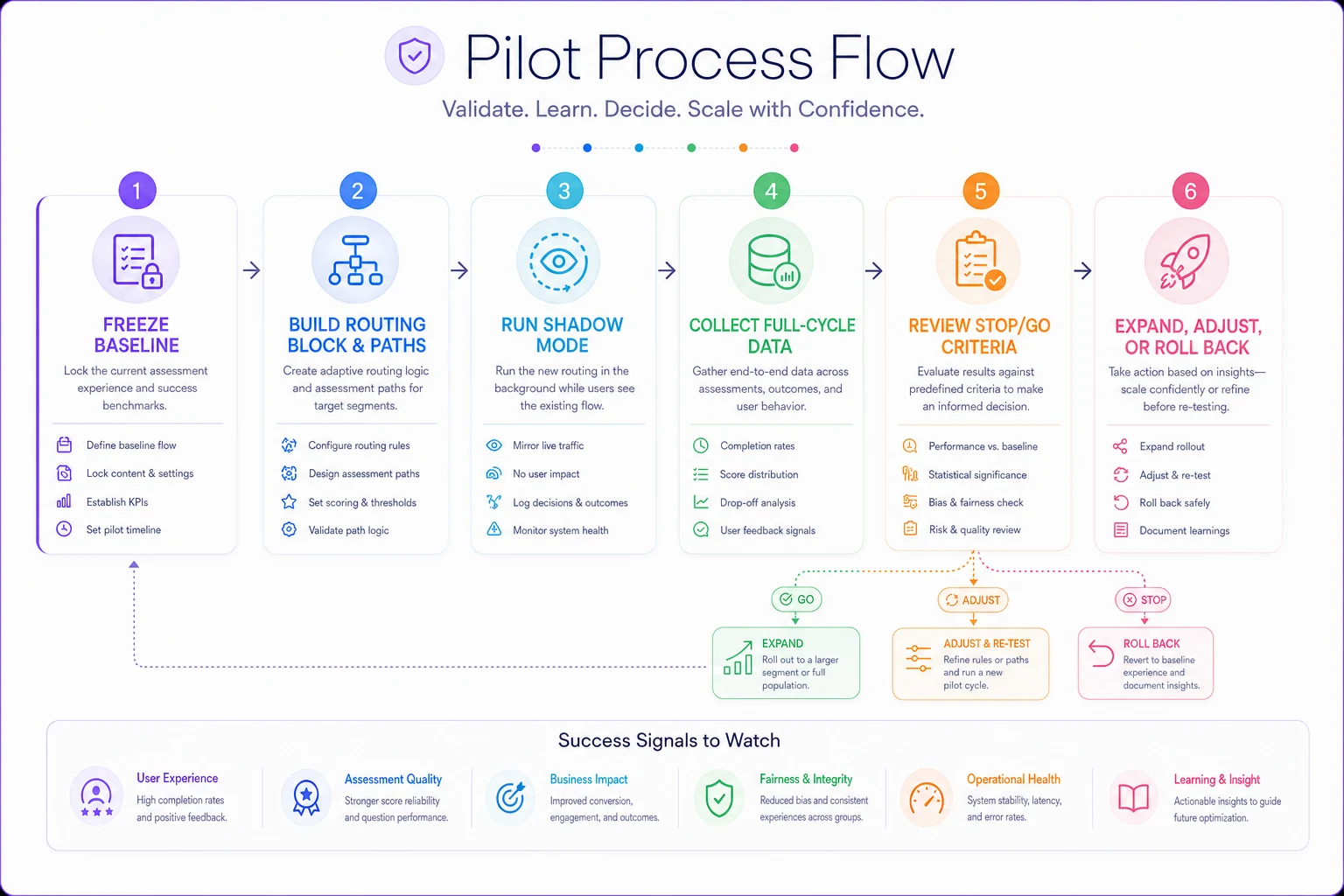
[GRAPH: Pilot process flow — Freeze Baseline → Build Routing Block & Paths → Run Shadow Mode → Collect Full-Cycle Data → Review Stop/Go Criteria → Expand, Adjust, or Roll Back]
-
Freeze a baseline. Pull reliability and pass-rate data from your current fixed-form administrations. This is your comparison point.
-
Build the routing block and paths (or pools). QA each stage against blueprint before anyone sees it.
-
Run in parallel or shadow mode. If you can, route a portion of candidates through the new design while the rest stay on the old form. Shadow mode — scoring both ways without acting on the new one — is even safer for the first cycle.
-
Set the pilot size. Aim for enough candidates per path that your reliability estimates aren't noise. For small programs this often means a full cycle, not a two-week snapshot.
-
Review against pre-set stop/go criteria.
-
Decide
expand, adjust, or roll back.
Shadow mode tends to make stakeholders nervous because it feels slow. Run it anyway. The cost of a bad rollout is much higher than the cost of one extra cautious cycle.
Metrics that actually matter for a small pilot
You don't need a dashboard of 40 numbers. Watch these:
-
Reliability of the total score compared to baseline. If it drops, the routing is hurting you.
-
Routing accuracy — do candidates who route "high" actually outperform on the harder path? If routing decisions don't predict path performance, your routing block is weak.
-
Path/pool difficulty parity — are scores comparable across paths after adjustment, or is one path systematically easier?
-
Exposure distribution — did partitioning actually flatten per-item exposure, or did it concentrate somewhere unexpected?
-
Test length / time saved — the whole point of routing is efficiency; measure whether candidates finished faster without losing accuracy.
-
Flag rate for edge cases — how many candidates landed right on a routing boundary and got assigned somewhat arbitrarily?
Stop/go criteria — decide these first
Write these down before the pilot starts. It protects you from the most human failure of all: seeing a slightly better average score and declaring victory while reliability quietly slipped.
| Signal | Go (expand) | Adjust | Stop (roll back) |
|---|---|---|---|
| Total-score reliability vs baseline | Equal or better | Slightly lower, fixable | Meaningfully lower |
| Routing accuracy | Clear separation between paths | Weak but improvable | No predictive value |
| Difficulty parity across paths | Comparable | Minor, correctable gap | Large, persistent gap |
| Exposure spread | Flatter than before | Uneven but manageable | Worse than fixed form |
Committing to these thresholds in advance is the whole discipline. Without them, you'll rationalize whatever you see.
A real scenario
A regional professional-training group ran a recertification exam for roughly 600–700 candidates a year. Single fixed form, 45 items, reused for years. Pass rates had crept upward in a way that looked less like improving competence and more like the form circulating in study groups.
They didn't build CAT. They partitioned their working bank of about 260 items into three parallel pools and added a small semi-adaptive routing block within each — a 9-item router feeding two 18-item paths. They piloted it in shadow mode for one cycle, then live for the next.
Results were unglamorous and exactly what you'd want. Total-score reliability held steady — not better, but not worse. Average test length dropped by around a quarter for candidates routed to the shorter appropriate path, which cut seat time noticeably. The suspicious pass-rate creep flattened, because no single set of items was carrying every administration anymore. The gain wasn't a dramatic accuracy jump. It was security and efficiency at roughly the same measurement quality, which for a recert program is the whole ballgame.
When this actually makes sense
You have repeat sittings or a program that runs for years, so memorization and leakage are real threats.
-
You have repeat sittings or a program that runs for years, so memorization and leakage are real threats.
-
Your candidate ability spread is wide enough that a one-size form wastes everyone's time.
-
You have at least ~200 usable items with some existing item statistics, or can retrofit your legacy bank to get there.
-
Someone can own the maintenance — resting items, rotating pools, checking parity each cycle.
Someone can own the maintenance — resting items, rotating pools, checking parity each cycle.
When it's a bad idea
Your bank is under ~150 items with no realistic path to grow it. Partitioning three ways just gives you three weak pools.
-
Your bank is under ~150 items with no realistic path to grow it. Partitioning three ways just gives you three weak pools.
-
The exam runs once and never repeats. Exposure isn't your problem, so you're adding complexity for nothing.
-
Nobody will maintain it. Adaptive designs that aren't maintained degrade worse than a plain fixed form, because they hide the rot behind machinery.
Nobody will maintain it. Adaptive designs that aren't maintained degrade worse than a plain fixed form, because they hide the rot behind machinery.
Who should NOT do this
If you don't yet have basic item-level statistics — discrimination, difficulty, distractor behavior — routing is premature.
Routing is only as good as the items in the routing block, and you can't build a good router from items you haven't analyzed. Get the item analysis fundamentals solid first, then come back to routing. Building adaptive logic on top of unvetted items just automates your existing measurement problems and makes them harder to see.
Where the operational work lives
The strategies here are simple to describe and genuinely tedious to run by hand — tracking per-pool exposure across cycles, checking difficulty parity every time you rebuild a pool, flagging items that cross their administration cap, keeping routing paths aligned to blueprint. That maintenance load is what quietly kills small adaptive programs.
Assessment platforms with automated exposure tracking and pool-management tooling can carry the recurring bookkeeping, so a two-person team can actually sustain the design instead of abandoning it after the first cycle. The strategy is yours; the repetitive tracking is worth handing off.
The real takeaway is narrower than the usual "go adaptive" advice: for a small program, the win isn't sophistication — it's controlled exposure and less wasted testing time at the same measurement quality you already had. Run the pilot, commit to your stop/go criteria before you peek at results, and be willing to roll back. A slightly boring fixed form you trust beats a clever adaptive engine nobody can maintain or explain.
Ready to revolutionize your evaluation process?
Join over 2,000 organizations using Evaloly to optimize assessments, improve learner outcomes, and make data-driven decisions.