



Most assessment teams don't fail their alignment work because they lack standards knowledge. They fail because the mapping lives in one person's head, the acceptance criteria are vague ("we follow ISO 17024-ish practices"), and nobody wrote down what "aligned" actually proves. Then an auditor, a procurement officer, or a new compliance lead shows up and asks the one question the whole thing can't survive: show me the evidence that your internal procedure meets this external clause.
That gap—between the way you actually run assessments and the way an external standard describes "good"—is where crosswalks live. And assessment standards alignment, done properly, isn't a document. It's a system that connects your internal SOPs, your acceptance tests, your remediation backlog, and your audit evidence into something that survives personnel changes and real scrutiny.
A crosswalk isn't a translation exercise you finish once. It breaks the moment your procedures drift, your standards get revised, or your program grows past the size where one coordinator can keep it all straight. So here's how the whole system works—and the specific places it tends to collapse.
Why crosswalks exist, and why they rot
A crosswalk is a structured mapping: internal procedure → external clause → evidence that satisfies it → acceptance test → remediation owner if it fails. On paper, simple. In practice, every one of those arrows is a place where things break.
Teams adopt an external framework—ISO/IEC 17024 for certification bodies, ISO 10667 for assessment in work settings, AERA/APA/NCME Standards for Educational and Psychological Testing, or a regulator's requirements—and start by reading the clauses and nodding. "Yes, we do validity studies. Yes, we have an appeals process. Yes, impartiality is covered." That nodding is the failure point. Nobody traces the clause down to the specific procedure, the specific artifact, and the specific test that would prove it.
Across a lot of assessment programs, the crosswalk gets built once—usually under deadline pressure before an accreditation visit—and then it's never touched again. Procedures change. The item-writing SOP gets updated. A new proctoring vendor comes in. The appeals workflow moves to a different tool. None of that flows back into the crosswalk. Eighteen months later the document describes a program that no longer exists.
The second rot pattern is subtler. The crosswalk maps clauses to claims instead of clauses to evidence. "Clause 9.4 – Impartiality: covered by our impartiality policy." Fine, but where's the policy, when was it last reviewed, who attested to conflicts this cycle, and what happens when someone fails the test? A claim is not evidence. An auditor can't accept "we have a policy." They need the artifact, the date, the owner, and the acceptance result.
The anatomy of a crosswalk that actually holds
A crosswalk that survives has five columns, not two. Most teams build two (clause and "yes/no") and wonder why it falls apart. Here's the structure that connects the pieces:
Eliminate assessment bottlenecks.
Evaloly simplifies every step from test design to results analysis, making assessments faster and more reliable.
- Customizable test creation
- Automated grading and analytics
- Secure distribution and proctoring
No credit card required
| Crosswalk element | What it captures | Where it breaks if missing |
|---|---|---|
| Internal procedure reference | The exact SOP, version, and section you're claiming satisfies the clause | You can't tell which procedure changed when the clause fails |
| External clause | The specific standard, clause number, and intent (not just the number) | Reviewers argue about interpretation forever |
| Evidence artifact | The actual file, record, or log that proves conformance—with location and date | "We have a policy" with nothing attached |
| Acceptance test | A pass/fail check someone can run to confirm the evidence is current and real | Alignment becomes opinion, not verification |
| Remediation owner + timeline | Who fixes a failed test and by when | Gaps sit open for months with no accountability |
The jump from a two-column spreadsheet to this five-column map is the single biggest quality difference between programs that pass audits cleanly and programs that scramble for weeks every cycle.
Notice what the acceptance-test column does. It converts "are we aligned?" from a judgment call into a repeatable check. That's the whole game. If two different people can run the same test and get the same pass/fail result, your alignment is defensible. If alignment depends on who you ask, it isn't.
A simple workflow diagram shows the flow from clause to remediation.
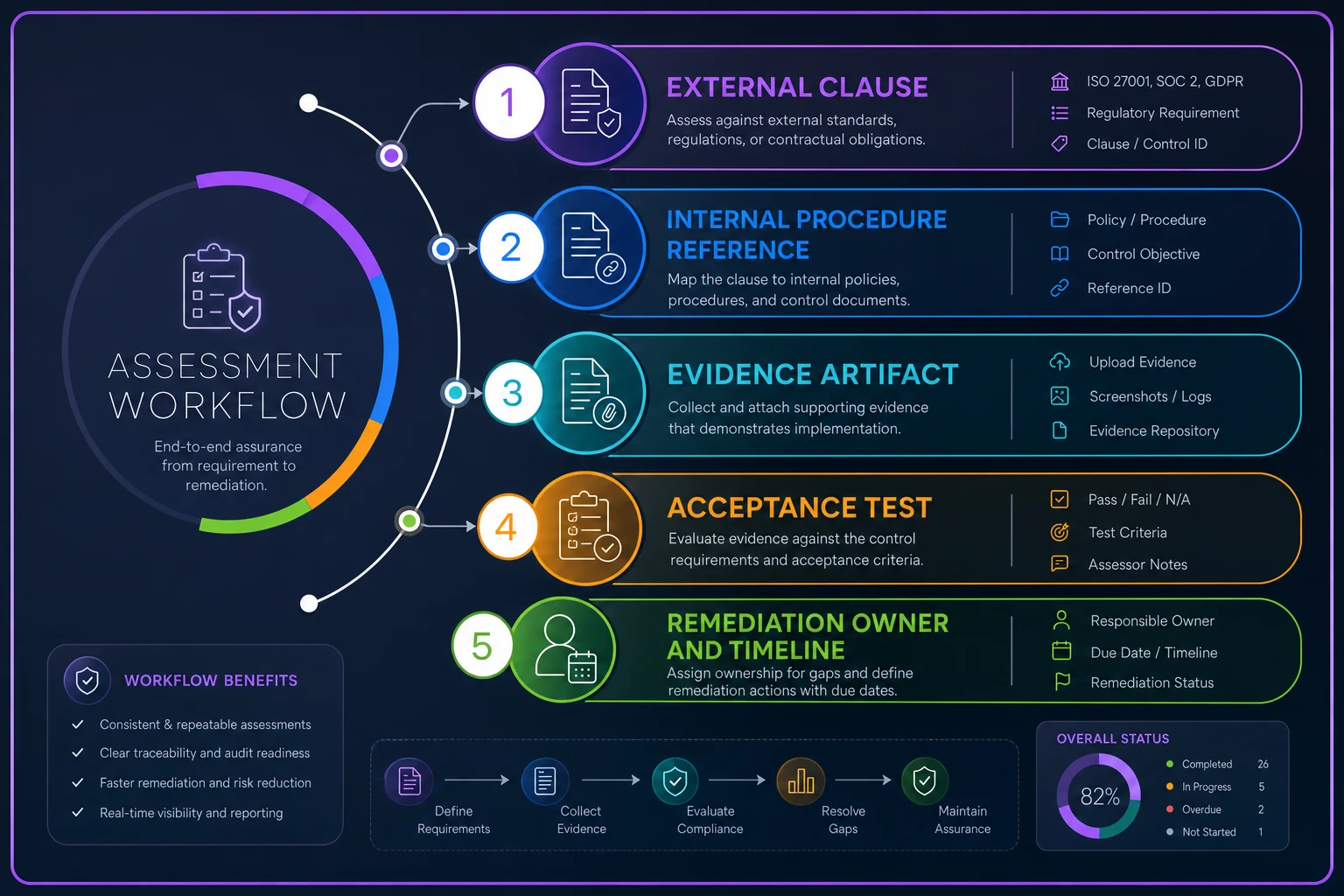
This diagram highlights the handoffs from clause to remediation.
Writing acceptance tests that mean something
An acceptance test for a crosswalk entry has to be specific enough that a reasonably trained person—not the author—can execute it and reach the same conclusion. Vague tests ("confirm we have adequate documentation") are worse than no test, because they create the illusion of verification.
A good acceptance test names the artifact, the condition, and the threshold. Compare these:
-
Weak "Verify item review process is documented."
-
Strong "Confirm the item-review SOP (v3.2 or later) exists, was reviewed within the last 12 months, and that the most recent three item batches each have a completed review record with at least two reviewer sign-offs."
The strong version can fail. That's the point. A test you can't fail isn't testing anything.
Here's a practical acceptance-test checklist you can adapt for a crosswalk covering certification-body-style requirements. Each item should resolve to pass or fail, with a date and an owner:
-
Impartiality and conflict management — A signed conflict-of-interest attestation exists for every person involved in item development and scoring decisions this cycle, dated within the current review period.
-
Validity evidence — For each operational form, a validity argument document exists that ties content coverage to the published blueprint, with a review date inside your stated validity-review interval.
-
Reliability reporting — Current-cycle reliability statistics (internal consistency or equivalent) are calculated, documented, and sit above your pre-declared minimum threshold.
-
Accommodations and fairness — Accommodation decisions have an audit trail: request, decision, rationale, and delivery confirmation, with no undocumented denials in the sample pulled.
-
Appeals and score review — The appeals SOP matches the actual tool workflow, and a sample of closed appeals shows responses within your published SLA.
-
Data lifecycle and retention — Candidate records follow the documented retention schedule, with disposal logs for anything past the retention window.
-
Security and exposure — Exposure-control rules are documented and the actual form-rotation records match the policy for the current cycle.
-
Version control — Every operational form maps to a specific blueprint version, and no form references a retired blueprint.
The failure most teams make here is treating the checklist as a one-time pass. An acceptance test only means something if it runs on a cadence—quarterly for high-risk items, annually for stable ones. A test that passed fourteen months ago tells you nothing about today.
Where this breaks as the program scales
At small scale—one program, one coordinator, a few hundred candidates a year—a crosswalk can survive on heroics. One person knows every procedure, remembers which SOP changed, and can reconstruct evidence from memory during an audit. Fragile, but it works until it doesn't.
Three things break it as you grow:
Volume of procedures. A single certification program might map against 40–60 clauses. Add a second credential, a different jurisdiction, and an internal skills-assessment line, and you're suddenly maintaining three or four crosswalks against overlapping-but-not-identical standards. The same impartiality procedure now has to satisfy slightly different clauses in each. Keeping them in sync by hand stops being realistic somewhere around the third framework.
Drift between the document and reality. As more people touch the system, procedures change without anyone updating the crosswalk. The item-writer onboarding changes, the proctoring vendor swaps, the appeals tool migrates. Each change silently invalidates one or more acceptance tests, but nobody re-runs them until audit season. By then the gap is months deep.
Standards revisions. External standards get updated. A revised clause can invalidate a mapping you thought was solid. If you don't have a mechanism to re-map against the new version and flag which internal procedures are now out of conformance, you'll discover it the hard way—during a surveillance audit, when a reviewer cites the current clause and your evidence references the old one.
This is also where multi-jurisdiction complexity compounds. If you're running assessments across regions with different regulatory expectations, your crosswalks multiply and your remediation timelines have to account for conflicting requirements. The operational thinking behind that is covered in our global assessment compliance framework for multi-jurisdiction assessment programs, which connects directly to how you structure crosswalks when one internal procedure has to answer to several external authorities at once.
Remediation timelines: the part everyone skips
A crosswalk that only identifies gaps is a worry list. One that assigns owners and deadlines to those gaps is a management system. That difference is remediation discipline, and it's where most alignment work quietly dies.
When an acceptance test fails, three things need to happen immediately: the gap gets a severity rating, an owner, and a deadline tied to that severity. Without severity rating, everything feels urgent and nothing gets done. Here's a workable remediation tiering:
-
Critical (fix within 2–4 weeks). The failure directly threatens validity, fairness, or a candidate's standing—missing validity evidence for an operational form, undocumented accommodation denials, appeals SLA breaches. These block the program's defensibility right now.
-
Major (fix within 30–60 days). Conformance exists but documentation is stale or incomplete—a reliability study that's overdue, a conflict attestation cycle that lapsed, version-control records that don't fully reconcile. The practice is probably sound; the evidence isn't current.
-
Minor (fix within the cycle, up to 90 days). Housekeeping—an SOP that references an old tool name, a retention log that's behind on routine disposal. Real, but not threatening.
Critical and major remediation items should have named owners and calendar dates before the review meeting ends, not after. What kills remediation is the gap between identifying a problem and assigning it. A failed test with no owner is just a note. A failed test with a name and a date is a task that gets done.
One more thing on timelines. Retention and data-lifecycle failures deserve special attention because they compound silently and they're favorites for regulators. If records are being kept past their window or disposed of before it, that's not a documentation problem—it's a live exposure. The operational mechanics of getting this right are covered in our assessment data governance playbook, and a mature crosswalk should treat every data-lifecycle clause as a recurring acceptance test, not a one-time check.
A real scenario: when the crosswalk met the auditor
A mid-sized professional certification body—roughly 4,000 candidates a year across two credentials—had what they thought was a solid alignment story. They'd mapped against ISO/IEC 17024 before their initial accreditation and kept a spreadsheet. Two columns: clause number and "compliant (Y)."
When the surveillance audit came around about two years later, the reviewer asked for evidence on about a dozen clauses. For roughly half, the evidence either didn't exist in the form the spreadsheet implied or had gone stale. The impartiality attestations covered the original staff, not the three people who'd joined since. The validity documentation referenced a blueprint version that had been revised. The appeals SOP described a manual process they'd migrated off a year earlier.
Nothing was fundamentally broken about how they ran assessments—the actual practices were fine. The alignment system was broken. They spent close to three weeks reconstructing evidence, re-running procedures just to generate current records, and writing corrective-action responses. The findings were resolvable, but it cost them the better part of a month of senior staff time and a round of nonconformities they could have avoided entirely.
After that cycle they rebuilt the crosswalk as a five-column live map with quarterly acceptance tests on the critical clauses and annual tests on the stable ones. The next surveillance audit, the same evidence requests took hours rather than weeks—because every clause already pointed to a current artifact with a recent pass date and a named owner. The difference wasn't better assessment practice. It was treating alignment as an operating system instead of a document.
When this level of rigor makes sense—and when it doesn't
Full five-column crosswalks with scheduled acceptance tests and tiered remediation are worth it when you're accountable to an external authority: accreditation, regulatory oversight, high-stakes certification, or enterprise procurement that audits vendors. In those contexts, the cost of a failed audit or a lost contract dwarfs the overhead of maintaining the map.
When it's overkill: a small internal skills check used for low-stakes development decisions, with no external accountability and no consequential outcomes for candidates, doesn't need a formal ISO crosswalk. Building one anyway just creates maintenance burden with no defensibility payoff. Match the rigor to the stakes.
Who should not do this half-heartedly: if you're going to build a crosswalk, build the acceptance-test and remediation columns too. A clause-to-claim mapping with no tests and no owners is arguably worse than nothing, because it creates false confidence. You'll walk into the audit feeling covered and discover the evidence was never real. Either commit to the testable version or don't claim alignment at all.
Making the system maintainable
The maintenance problem is the real problem. Any team can build a good crosswalk in a focused week. Keeping it accurate for two or three years across staff turnover and standards revisions is what separates programs that pass cleanly from programs that scramble.
A few habits make the difference. Tie crosswalk updates to procedure changes—when an SOP gets revised, part of closing that change is checking which acceptance tests it affects. Put the recurring tests on a calendar with real owners, not a vague "annual review." Keep the evidence close to the test, so running a check means opening the artifact, not hunting for it across four systems.
This is also where the platform layer earns its place. When your crosswalk entries, acceptance tests, evidence artifacts, and remediation tasks live inside the same operational system—rather than scattered across spreadsheets, shared drives, and someone's memory—the map stays connected to reality. AI-assisted workflows can flag when an SOP change touches a mapped clause, surface acceptance tests coming due, and route a failed test to the right owner with a deadline attached, so gaps don't sit open until audit season. The point isn't automation for its own sake. It's that the parts of the system that break—drift, stale evidence, orphaned remediation items—are exactly the parts that benefit from being connected and monitored rather than maintained by hand.
Put the recurring tests on a calendar with real owners, not a vague "annual review".
The teams that handle alignment well aren't the ones with the most standards expertise. They're the ones who stopped treating the crosswalk as a document you produce and started treating it as a system you run—with tests that can fail, owners who are named, and timelines that hold. That shift is what turns alignment from an audit-season fire drill into something boring, repeatable, and defensible. Boring, in this case, is exactly what you want.
The teams that handle alignment well aren't the ones with the most standards expertise. They're the ones who stopped treating the crosswalk as a document you produce and started treating it as a system you run—with tests that can fail, owners who are named, and timelines that hold. That shift is what turns alignment from an audit-season fire drill into something boring, repeatable, and defensible. Boring, in this case, is exactly what you want.
Ready to revolutionize your evaluation process?
Join over 2,000 organizations using Evaloly to optimize assessments, improve learner outcomes, and make data-driven decisions.