

The worst part about a content leak isn't usually the leak itself. It's the scramble that happens afterward — the panicked Slack threads, the "should we cancel?" arguments, the compliance person asking whether you documented anything, and the nagging fear that whatever you decide will get challenged later by a candidate who failed.
Most teams don't have a runbook for this. They have instincts, and instincts under pressure tend to produce inconsistent, hard-to-defend decisions. Someone cancels a whole administration when a note-to-file would've done. Someone else quietly ignores a Reddit thread with 40 leaked items because acknowledging it feels worse than pretending it isn't there.
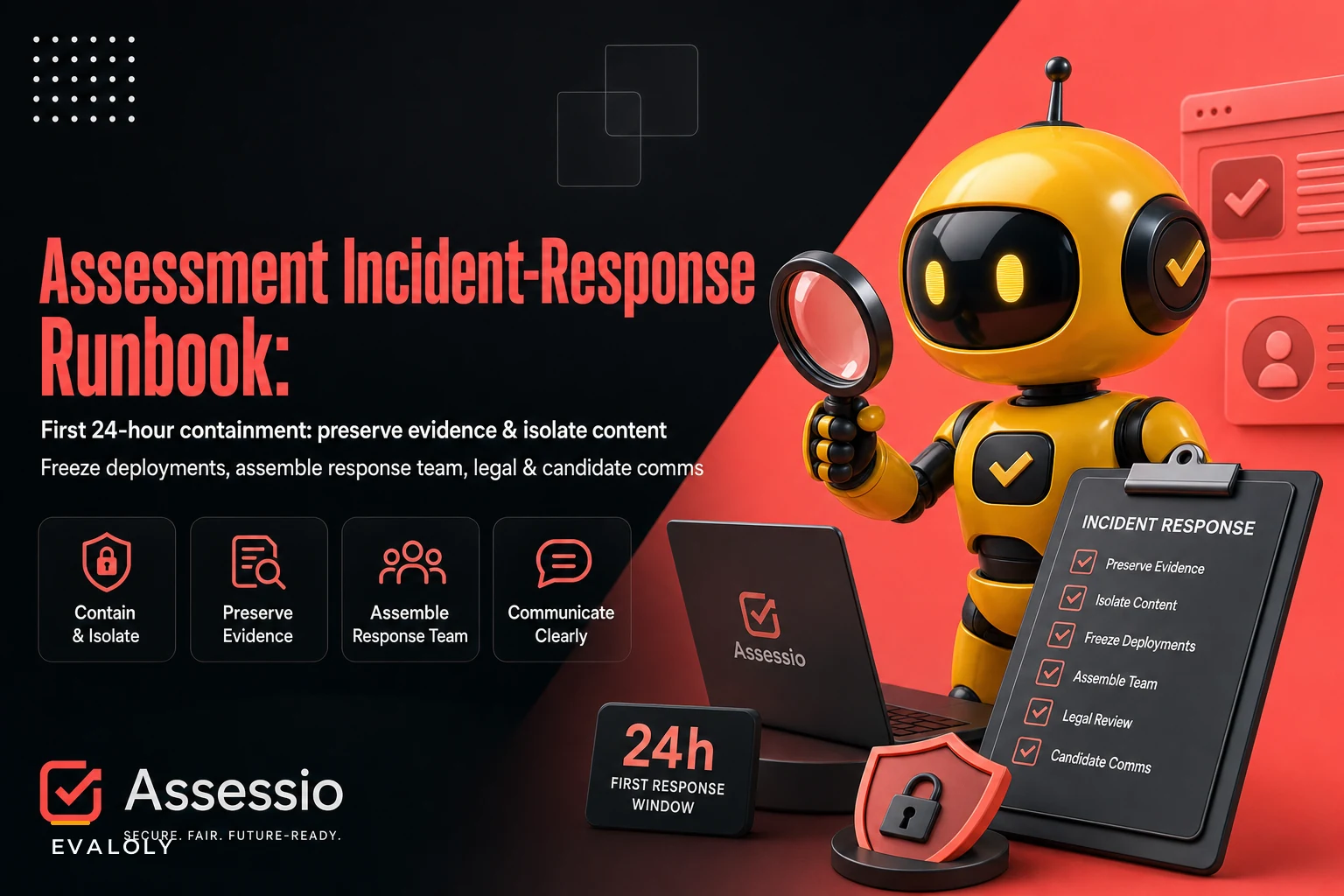
This post is the runbook most teams wish they'd had before the leak, not after. It's scoped to one thing: what to do when assessment content actually gets out. Detection triggers, containment, the cancel-vs-note-to-file decision, candidate messaging, and a forensics trail that holds up if someone lawyers up.
First, know what a "leak" actually looks like in the wild
Before you can respond, you have to recognize what you're dealing with — and content leaks rarely announce themselves cleanly.
-
A candidate posts three "hard questions they saw" in a study Discord, more or less verbatim
-
A tutoring company starts advertising that they have "recent exam material" for your certification
-
Two candidates in the same testing window give suspiciously identical wrong answers to your newest, hardest items
-
Someone emails your support inbox to "helpfully" tell you their competitor is selling your test
Each of these is a leak, but they carry wildly different exposure levels. A partial leak of five retired items is an annoyance. A leak of your live, high-stakes form the week before a national administration is a five-alarm fire. The response has to scale to the exposure, and that's exactly where teams get it wrong — they either overreact to a small leak or underreact to a large one because the trigger didn't feel dramatic enough to act on.
Detection triggers: what should actually kick off the runbook
You want a small set of clearly defined triggers so that anyone on the team — not just the security lead — can say "this counts, start the process." Ambiguity here costs you hours you don't have.
Eliminate assessment bottlenecks.
Evaloly simplifies every step from test design to results analysis, making assessments faster and more reliable.
- Customizable test creation
- Automated grading and analytics
- Secure distribution and proctoring
No credit card required
Here's a workable trigger set:
| Trigger | Signal | Default severity |
|---|---|---|
| Verbatim item match found online | Exact or near-exact wording of a live item on a public/semi-public site | High |
| Braindump / paraphrase cluster | Multiple paraphrased items appear together, clearly sourced from your test | Medium–High |
| Statistical anomaly | Sudden difficulty drop on new items, or improbable answer-pattern similarity | Medium |
| Insider report | Staff, proctor, or vendor reports unauthorized access or sharing | High |
| Commercial offering | A third party is selling or advertising your content | High |
| Candidate self-report | A test-taker reports they were shown material beforehand | Medium |
The statistical anomaly row is the one people miss. In practice, the earliest signal of a leak is often psychometric, not visual. You notice a brand-new item that should have a p-value around 0.55 suddenly performing at 0.85 for a specific testing window or a specific geography. That's not candidates getting smarter overnight. Building simple monitoring on your newest items — the ones most likely to be freshly harvested — often catches a leak weeks before it surfaces publicly.
One practical rule: every trigger, even a "medium," gets logged and time-stamped the moment it's spotted. You are building a timeline whether you realize it or not, and the clock starts at first awareness, not at first decision.
The first 24 hours: containment before analysis
The instinct to immediately investigate "how bad is it" is understandable, and mostly wrong as a first move. Containment comes first, because the exposure grows while you're still analyzing.
Here's the sequence that works:
-
Preserve the evidence before it disappears. Screenshot the leaked content with visible URLs and timestamps, save the page (full HTML, not just an image), and record who found it and when. Leaked posts get deleted. If you investigate first and preserve later, you often end up with nothing to show.
-
Isolate the affected content. Identify every item involved and every form those items appear on. This is where good version control earns its keep — if you can't quickly answer "which live forms contain item 4471," you're going to burn hours.
-
Freeze deployment of compromised forms. Pull the affected form from the active rotation, or at minimum flag it so no new administrations use it until a decision is made.
-
Assemble the response group. Keep it small
assessment lead, a psychometrician or data person, someone from legal/compliance, and one communications owner. Big groups make slow decisions.
-
Establish a single source of truth. One document, one timeline, one owner. Every finding, decision, and rationale goes here. This becomes your defensibility record later.
Candidate communication is not step one. Communicating before you understand scope leads to walk-backs, and a retracted statement is worse than a slightly delayed one. Contain, confirm scope, then communicate.
A simple containment workflow:
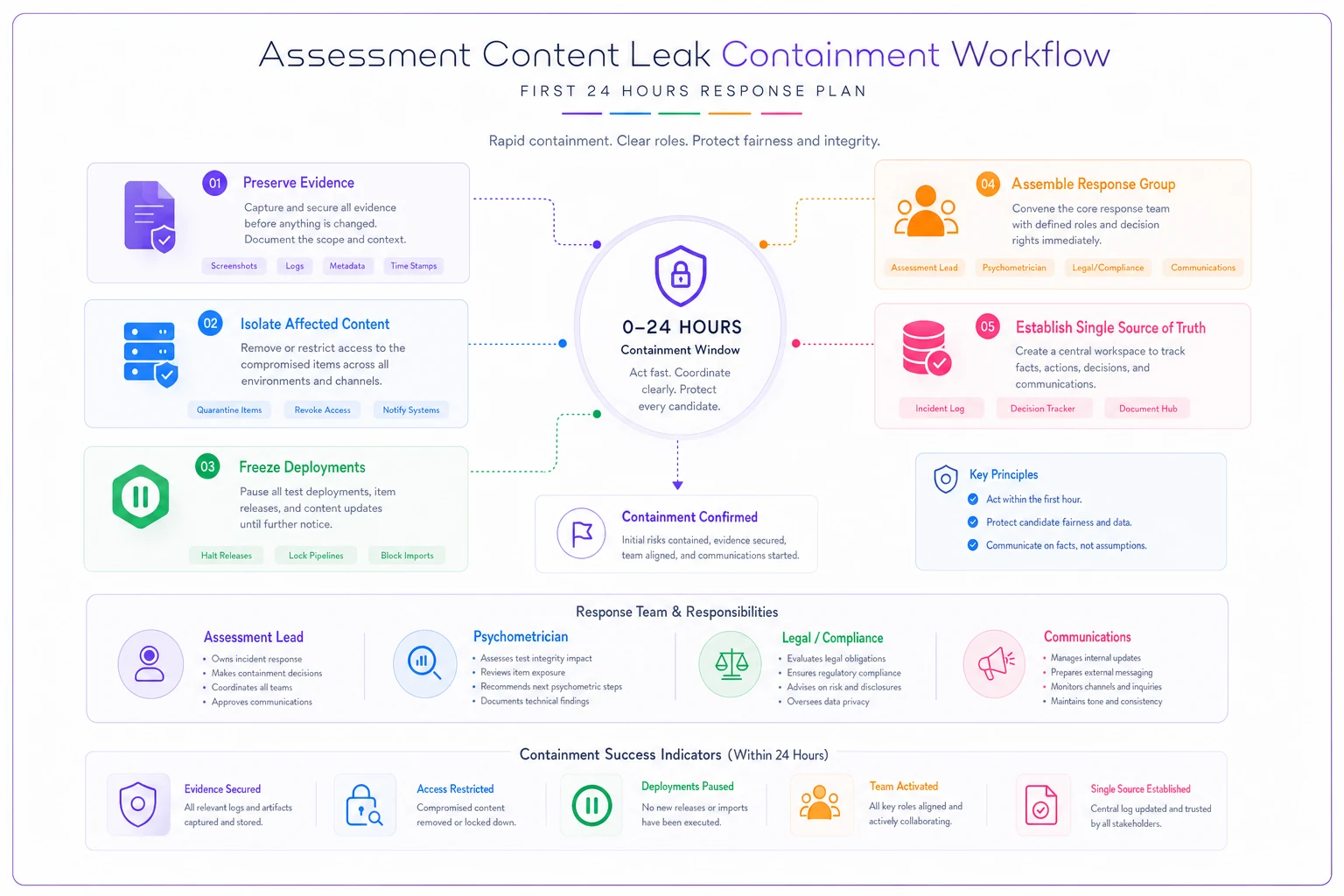
This diagram shows the containment steps and responsible roles.
The decision that everyone gets stuck on: cancel vs. note-to-file
This is the heart of the runbook, and it's where most teams freeze. Cancelling scores is drastic, expensive, and generates candidate fury. Doing nothing risks the validity — and defensibility — of every affected result. The answer is almost never "cancel everything" or "do nothing." It's a threshold decision.
Think about it across three axes:
-
Exposure breadth — how many live items leaked, and were they concentrated on one form or spread thin?
-
Access reach — how many candidates could plausibly have seen the material before or during their attempt?
-
Score impact — did the leaked items actually move outcomes, or are they low-weight items unlikely to change pass/fail?
Here's a rough decision framework based on how these combine:
| Situation | Typical response |
|---|---|
| A handful of low-weight items, no evidence of candidate access before test | Note-to-file, monitor, replace items in next cycle |
| Several items leaked but caught before the affected window opened | Retire and substitute items, no cancellation needed |
| Meaningful cluster of items with confirmed pre-test access for a subgroup | Invalidate affected candidates' results, offer re-test |
| Broad leak of a live form with confirmed circulation before administration | Cancel the affected administration, re-form, re-administer |
The nuance most people miss: you can invalidate at the candidate level, not just the administration level. If you've confirmed that only candidates from one testing center or one referral source had access, cancelling everyone's scores is both unfair to the untouched majority and legally riskier than a targeted invalidation. Blanket cancellations get challenged precisely because they sweep up people with no connection to the breach.
A note-to-file is the right call more often than teams expect. It's a documented decision that says: we identified this exposure, we assessed the impact, we determined it did not materially threaten score validity, and here's our reasoning. That document is gold if the leak resurfaces later. Silence is not.
When cancellation actually makes sense
Cancel when you can honestly say: the leaked content was live, it circulated before or during the administration, and enough candidates plausibly saw it that you can't defend the resulting scores as a fair measure. High-stakes credentialing exams with legal or licensure consequences lean toward cancellation faster, because the cost of a defensible-but-wrong pass is enormous.
When cancellation is a mistake
Don't cancel to look decisive. Don't cancel because the leak feels embarrassing. And don't cancel a whole cohort to punish a few bad actors — that's using invalidation as discipline, and it won't survive scrutiny. If the leaked items are retired, low-weight, or demonstrably didn't move outcomes, a note-to-file with item replacement protects fairness without torching the experience for hundreds of honest candidates.
Forensics: build the trail while it's fresh
Forensics here isn't CSI. It's disciplined documentation and a handful of data pulls that let you answer, later, exactly what happened and why you responded the way you did.
-
Source capture — preserved screenshots, saved pages, URLs, and timestamps of the leaked material
-
Item inventory — every affected item ID, its status (live/pilot/retired), weight, and every form it appears on
-
Access logs — who accessed the item bank, when, and from where in the relevant window; export before anyone assumes logs are permanent
-
Candidate correlation — response and timing data for candidates plausibly connected to the leak (answer-pattern similarity, unusual speed on leaked items)
-
Attribution notes — any evidence pointing to source (a specific center, referral, staff account) with the caveat that attribution is often uncertain
-
Decision log — each decision, who made it, when, and the reasoning, tied back to your threshold framework
-
Vendor/proctor records — session data, flags, or reports from your delivery platform
Pull and preserve access logs and delivery data immediately; retention limits can delete vital evidence.
Worth flagging: access logs and delivery data have retention limits, and people discover this at the worst possible moment. Pull and preserve them early, even before you're sure you'll need them. A leak you decide to note-to-file today can become a formal challenge in six months, and by then your platform may have rolled off the logs you needed.
If your delivery relied heavily on invasive monitoring, this is also a moment to be honest about how much that actually protected you — the forensic value of heavy proctoring is often lower than assumed, and there are privacy-preserving controls that hold up better under scrutiny without generating a mountain of intrusive data you now have to defend collecting.
Candidate communication: templates that don't make things worse
Communication is where a manageable incident becomes a reputational one. The two failure modes are opposite and equally damaging: saying too much too soon (which you then have to walk back), or going silent and letting candidates learn about the leak from Reddit.
Template 1 — Note-to-file, no candidate action needed (usually no proactive outreach)
> We're aware that a small number of questions circulated outside our secure environment. We reviewed the situation and confirmed it did not affect the fairness or validity of scores. We've replaced the affected content as part of our normal security practices. Your results stand.
Template 2 — Targeted invalidation and re-test offer
> During a routine security review, we identified that some exam content may have been improperly accessed in connection with your testing session. To protect the fairness of the credential for everyone, we've invalidated the affected results and are offering a no-cost re-test on [dates]. We understand this is frustrating, and we're committed to making the re-test process as smooth as possible. Here's exactly what happens next: [steps].
Template 3 — Administration cancellation
> We've determined that exam content for the [date] administration was compromised before testing. To maintain the integrity and fairness of the [credential], we've cancelled the affected administration. All affected candidates will be re-registered at no cost for [new dates], and any fees paid will [be applied / be refunded]. We know this disrupts your plans, and we take that seriously. Full details and your specific next steps are below.
A few principles that separate messages that calm people from messages that inflame them:
-
Lead with fairness, not with your embarrassment. Candidates accept disruption far better when they understand it's protecting the value of their credential.
-
Never blame candidates as a group. Even in a leak involving cheating, the honest majority will read a scolding tone as being accused.
-
Always give concrete next steps. "We'll be in touch" generates ten times the support volume of "here are the three things that happen next."
-
Say the same thing everywhere. Your email, your website notice, and your support team's script must match word-for-word on the key facts. Inconsistency reads as cover-up.
Match the message to the decision you made. Three templates cover most situations.
Preserving fairness and defensibility throughout
Everything above comes down to two things you'll be judged on later: was the response fair to candidates, and is it defensible if challenged.
Fairness means the response is proportionate and doesn't punish uninvolved people. A targeted invalidation with a free re-test is fair. A blanket cancellation that voids honest candidates' months of prep because a few people cheated is not — and it's the kind of decision that turns a security incident into a legal one.
Defensibility means you can produce, on demand, a coherent story: here's when we learned of it, here's what we found, here's the threshold framework we applied, here's the decision, here's who made it and why. If you can't reconstruct that timeline, even a technically correct decision looks arbitrary. And arbitrary is what challenges are built on.
Consistency across incidents matters too. If you cancelled one administration for a leak of ten items but noted-to-file another leak of thirty, someone will eventually notice and ask why. Applying the same threshold framework every time is itself a form of defensibility — it shows your decisions follow a process, not a mood. Teams that have already sorted out clear roles and escalation paths through a real governance model for their assessment operations handle leaks far more calmly, because the decision authority is settled before the crisis rather than argued out during it.
A real scenario: mid-size certification body, partial live-form leak
A professional certification body running quarterly exams for roughly 1,800 candidates a cycle noticed something off in their item stats: four brand-new items on their spring form were performing far easier than their pilot data predicted — a difficulty drop that only showed up among candidates who'd registered through one particular training provider.
They ran the runbook. Preserved the anomaly data, pulled access and referral records, and found that all the outlier candidates traced back to that one provider, which had apparently reconstructed and shared several items. The leaked content touched about 60 candidates out of the cycle.
The instinct in the room was to cancel the whole administration. Instead, they applied the threshold framework. Exposure was real but contained; access reach was limited to an identifiable group; the honest 1,700-plus had no connection to the breach. They invalidated the roughly 60 affected results, offered a free re-test on a freshly assembled form, retired the compromised items, and documented every step in a single decision log.
The difference in outcome was significant. A blanket cancellation would have meant re-testing everyone, a re-administration cost estimated in the tens of thousands, and a wave of complaints from candidates who'd done nothing wrong. The targeted response cost a fraction of that, held up when the training provider tried to dispute it, and — because the decision log was clean — closed out without escalating into a formal legal challenge. The whole thing resolved in a matter of weeks rather than dragging across the next cycle.
Who should not improvise this
If you run genuinely high-stakes assessments — licensure, credentialing with legal consequences, hiring decisions that affect livelihoods — do not treat leak response as something you'll figure out in the moment. The teams that improvise are the ones that end up with inconsistent decisions, missing evidence, and challenges they can't defend.
If your program is small and low-stakes, you still need the detection triggers and a lightweight decision framework, even if you never expect to cancel anything. The cost of the runbook is a couple of documents and some clarity on who decides what. The cost of not having one shows up all at once, on the worst possible day, when the questions are already out and everyone's looking at each other.
Bringing it together
A good assessment content leak response isn't about reacting fast. It's about reacting proportionately and documentably. Contain before you analyze. Preserve evidence before it vanishes. Decide cancel-vs-note-to-file against a real threshold instead of gut feel. Communicate to protect fairness, not to protect your reputation. Keep a clean trail the whole way through, because the leak you handle quietly today is the challenge you might have to defend a year from now.
The teams that survive leaks without lasting damage aren't the ones with unbreakable content — no content is unbreakable. They're the ones who decided, in advance, exactly how they'd respond when it broke.
A good assessment content leak response isn't about reacting fast. It's about reacting proportionately and documentably. Contain before you analyze. Preserve evidence before it vanishes. Decide cancel-vs-note-to-file against a real threshold instead of gut feel. Communicate to protect fairness, not to protect your reputation. Keep a clean trail the whole way through, because the leak you handle quietly today is the challenge you might have to defend a year from now.
The teams that survive leaks without lasting damage aren't the ones with unbreakable content — no content is unbreakable. They're the ones who decided, in advance, exactly how they'd respond when it broke.
Ready to revolutionize your evaluation process?
Join over 2,000 organizations using Evaloly to optimize assessments, improve learner outcomes, and make data-driven decisions.