

Most assessment programs don't fail because the instrument is bad. They fail on the last mile — the gap between a report landing in someone's inbox and an actual hiring, promotion, or development decision changing because of it. You can have clean psychometrics, defensible fairness data, and beautifully designed score reports, and still watch managers quietly ignore all of it while they hire on gut feel like they always have.
That gap is where an assessment adoption playbook earns its keep. Not a slide deck about "change management" — an operational system that routes the right output to the right person, at the right moment in their decision workflow, with instructions specific enough that they don't have to think about the assessment. They just act on it.
This is the part almost nobody documents. So let's build it.
Why adoption breaks even when the data is good
Adoption is a coordination problem disguised as a data problem. The report is fine. What's broken is everything around it.
Here's a pattern that shows up constantly. A talent team spends months standing up a competency-based assessment. Reports flow. Then three separate failures happen in parallel:
-
Managers get a report but have no idea which score band should actually change their behavior, so they treat it as "one more input" and default back to interview vibes.
-
HR receives results but has no cadence for following up — the report exists, but nothing gets triggered by it.
-
L&D sees development gaps in aggregate but can't connect them to any actual learning assignment, so the insight dies in a dashboard.
Each group is waiting for someone else to define what "using the assessment" even means. Nobody owns the translation layer between output and action. And because no single owner exists, the assessment becomes decorative — technically present in the process, functionally absent from the decision.
The deeper issue is that assessment teams tend to optimize what they control — the instrument, the report — and assume the decision layer will sort itself out. It never does. Decision workflows have their own gravity: existing habits, existing meetings, pressure to fill the req fast. If your assessment output doesn't slot into that gravity, it loses.
The three things a real adoption system has to do
Strip away the jargon and adoption comes down to three jobs:
Eliminate assessment bottlenecks.
Evaloly simplifies every step from test design to results analysis, making assessments faster and more reliable.
- Customizable test creation
- Automated grading and analytics
- Secure distribution and proctoring
No credit card required
-
Translate each report into stakeholder-specific meaning — what does this mean for me and my decision?
-
Route the right output to the right person at the moment they're deciding.
-
Tie usage to something that matters — an incentive, a KPI, a required step — so it doesn't decay the second launch enthusiasm fades.
Get all three working and adoption sticks. Miss one and it slowly rots. Most programs nail translation (they build nice reports), stumble on routing, and completely skip the incentive layer. Then they're confused when usage drops off after quarter one.
If your reporting layer isn't stakeholder-specific yet, that's the prerequisite. The work on turning assessment data into decisions with role-specific reporting and narrative packs is where the raw material for this playbook comes from. This article assumes you already have those outputs and need people to actually act on them.
Stakeholder-specific value messaging (the part everyone gets wrong)
The single biggest adoption mistake: sending the same message about the assessment to everyone. Managers, HR, and L&D don't care about the same things, and a value message that resonates with one will actively annoy the others.
Managers don't want to hear about construct validity. They want to know the assessment will help them avoid a bad hire that eats six months of their time. HR cares about defensibility and consistency across reqs. L&D cares about closing skill gaps they can actually build programs around. Same instrument, three completely different reasons to care.
| Stakeholder | What they actually fear | Message that lands | Message that fails |
|---|---|---|---|
| Hiring managers | Slow reqs, bad hires, wasted onboarding time | "This flags the two competencies most likely to cause a mis-hire for this role — before you spend interview slots on them." | "This assessment has strong predictive validity across constructs." |
| HR / TA leads | Inconsistency, legal exposure, messy audits | "Every candidate gets scored the same way, and the record defends the decision if it's ever challenged." | "Managers will love the new insights." |
| L&D | Training that isn't tied to real gaps | "You'll see exact competency gaps by cohort so programs target something real." | "The reports include lots of rich data." |
The messages that land are all about reducing a specific pain in that person's workflow — not about the quality of the assessment. Quality is table stakes and invisible to stakeholders. Pain reduction is what changes behavior.
One thing worth flagging: managers respond far better to "this saves you time and prevents a costly mistake" than to any accuracy claim. An accuracy claim reads as "the tool is trying to replace my judgment," which triggers resistance. Frame it as sharpening their judgment, and the wall comes down.
Nested playbooks: embedding reports into real decision workflows
The word "playbook" gets thrown around loosely. What actually works is a set of nested playbooks — one per decision type — each small enough to fit inside an existing workflow rather than sit beside it.
You need at minimum three.
Hiring decision playbook
The assessment output has to arrive before the debrief, not after the offer is already forming in the manager's head. The trigger is candidate completion; the output is a one-page summary with a recommended action band, not a raw score dump.
The rule that makes this work: define score bands with pre-agreed actions attached.
-
Green band → proceed to standard interview loop.
-
Yellow band → proceed, but probe these two specific competencies in the interview (suggested questions attached).
-
Red band → requires a documented override reason to advance.
That override requirement is quietly the most important line in the whole playbook. It doesn't force anyone to reject a candidate — it just makes ignoring the assessment a visible, logged choice. Visibility alone changes behavior more than any mandate.
Promotion decision playbook
Promotions are where assessments get ignored most, because internal candidates come with relationships and politics. The playbook here routes the report into the calibration meeting, not the manager's private prep. The report becomes a shared artifact the panel reacts to together — which neutralizes the "but I've worked with them for years" gut argument by putting a common reference on the table.
L&D assignment playbook
This one is almost pure logic: a competency gap below threshold triggers a recommended learning path. The manager approves rather than builds from scratch. The failure mode to avoid is dumping gap data on L&D and expecting them to manually map each person to content — that never scales past a couple dozen people.
Adoption KPIs tied to incentives
If adoption isn't measured and tied to something people care about, it will not survive contact with a busy quarter. Enthusiasm is not a strategy.
Metrics that actually predict whether adoption is real:
-
Report-open rate by role — are managers even looking?
-
Decision-linkage rate — what percentage of hiring and promotion decisions have a documented reference to the assessment output?
-
Override rate and override quality — how often is the recommendation overridden, and are the reasons substantive?
-
Time-to-decision — a good adoption system should speed up decisions, not slow them down; if it's slowing things down, the routing is wrong.
-
L&D assignment follow-through — percentage of triggered learning paths started within 30 days.
The trap is tracking open-rate only. Opens feel like adoption but aren't. A manager can open every report and change zero decisions. Decision-linkage is the metric that separates theater from real usage.
On incentives — you don't need to attach this to comp. Lighter mechanisms work better and cause less resentment:
-
Make decision-linkage a required field in the ATS or HRIS so a req can't close without it.
-
Surface adoption metrics in existing manager scorecards next to time-to-fill.
-
Have HRBPs review override quality during normal check-ins, not a separate audit.
The principle: attach adoption to workflows and reviews people already have, rather than creating a new obligation that competes for their attention.
Handoff artifacts: the stuff that makes it repeatable
The difference between a playbook that scales and one that dies with its champion is the handoff artifacts — the small, boring documents that let someone new run the process without a two-hour training session.
Three you can't skip.
1. The meeting script. A literal script for how a manager introduces assessment output in a debrief or calibration. Something like: "We got the assessment back — it flags [competency] as a risk area. Let's specifically dig into that with examples before we decide." Sounds trivial. Isn't. The script prevents the report from being either ignored or over-weighted.
2. The report-to-action checklist. A single page that turns a report into a sequence of steps. This is where score-reporting literacy pays off — the groundwork in building score-reporting literacy for stakeholders with one-sheets and decision checklists is exactly what makes these checklists usable instead of ignored.
Keep the meeting script under 30 seconds so managers actually use it.
3. The routing map. Who gets what report, when, and what triggers the next step. This is usually the first artifact to disappear in most organizations because it lives in one person's head.
A workflow that actually holds together
The individual parts sound obvious. The failure is always in the seams.
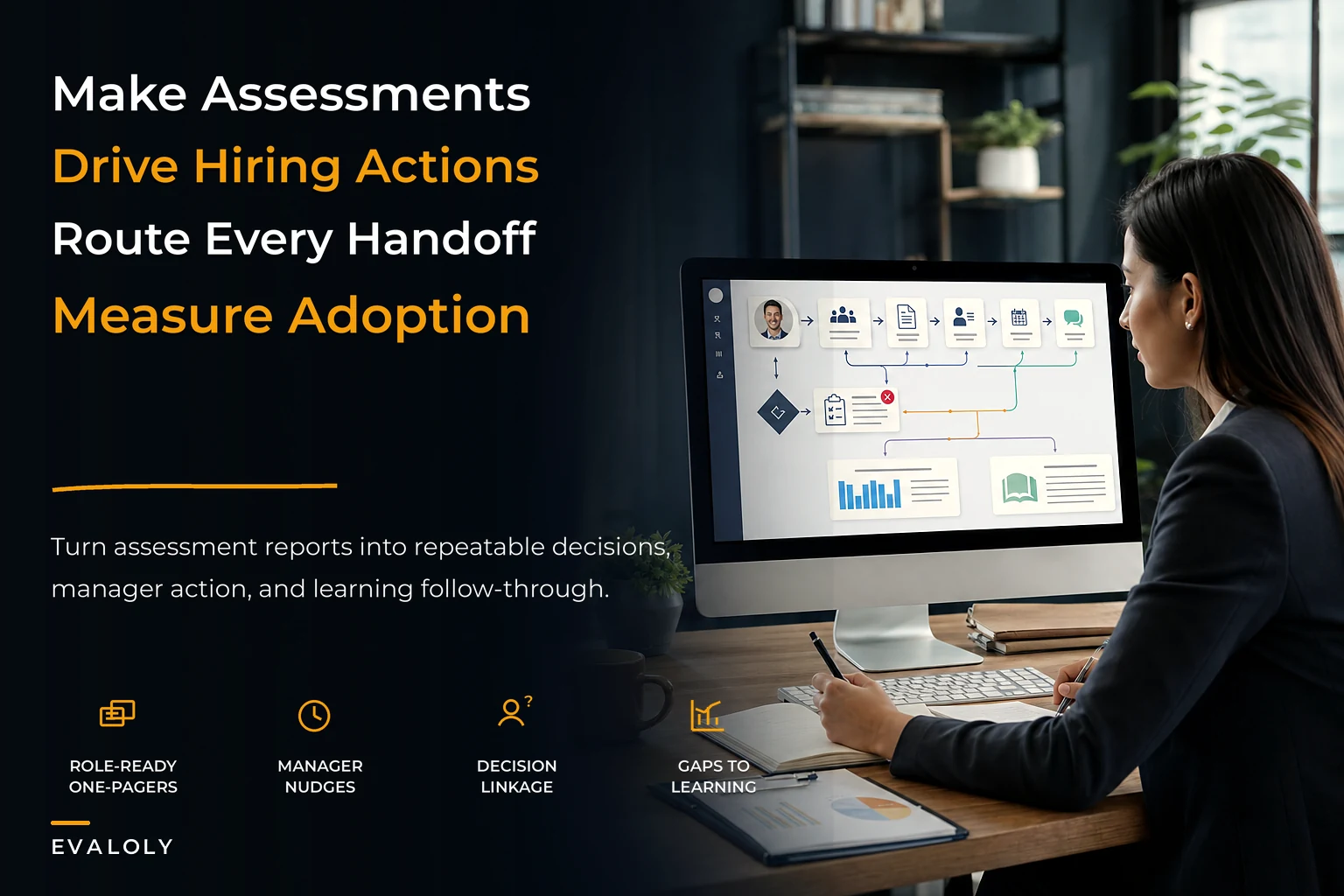
A candidate completes the assessment. That completion is the trigger — not a person remembering to check. The system generates a role-specific one-pager and routes it to the hiring manager and the HRBP simultaneously. The manager sees a recommended action band; the HRBP sees the same band plus a defensibility flag.
Before the interview loop, the manager gets a nudge with the two competencies to probe. During the debrief, they use the meeting script. When they enter a decision, the ATS requires a linkage field — reference to the assessment, and if it's an override, a reason.
That override reason flows to the HRBP's regular cadence. HR isn't auditing everything — they're spot-checking override quality during check-ins they already run. Meanwhile, aggregated gap data flows to L&D weekly, where below-threshold competencies auto-suggest learning paths that managers approve.
Here's a simple diagram of that workflow.
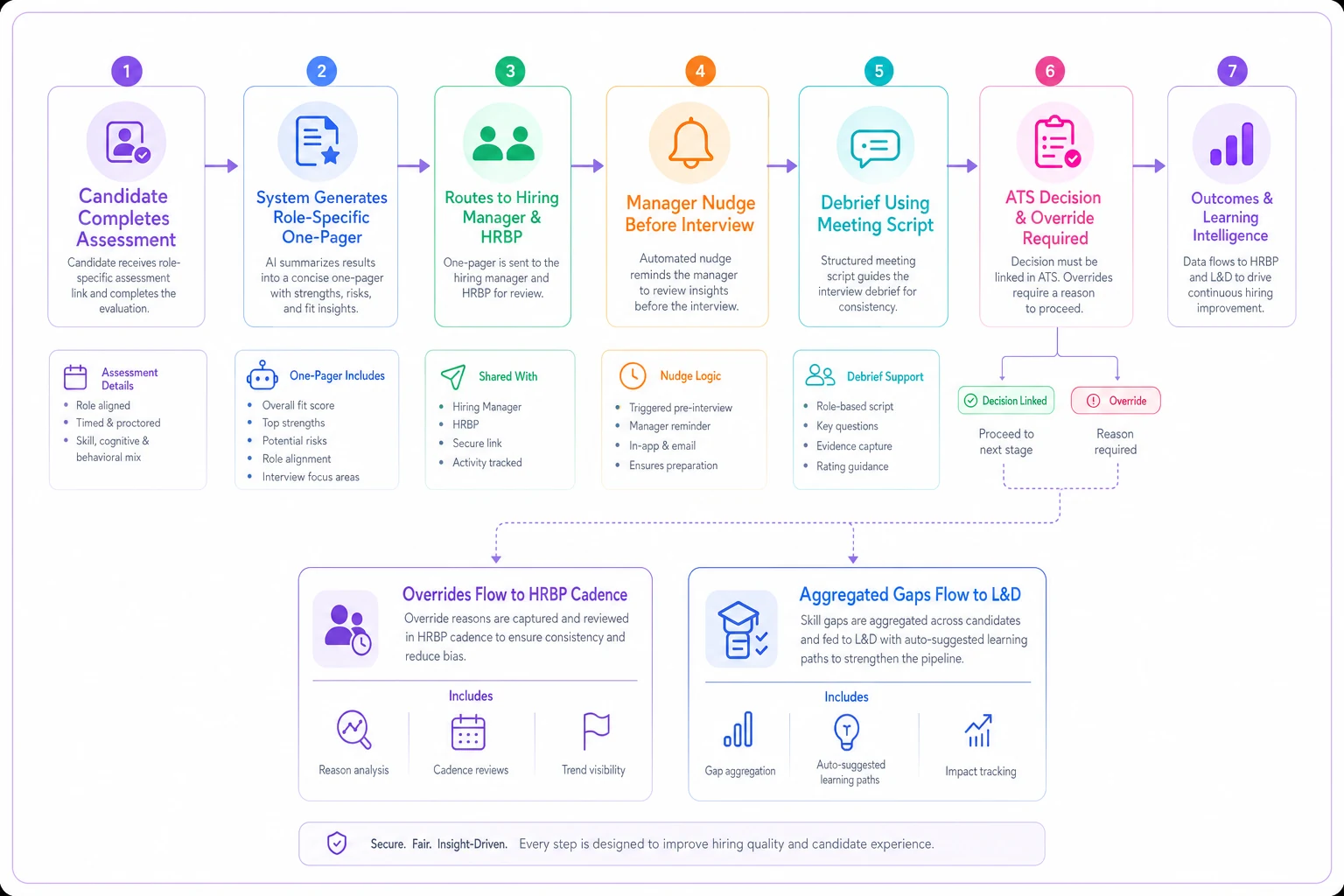
Every step has a clear owner and a clear trigger. Nothing waits on someone remembering. That's the whole game — remove the moments where a human has to decide to use the assessment, and replace them with moments where using it is the path of least resistance.
Real scenario: a mid-sized services firm
A professional services firm, roughly 400 employees, rolled out a competency assessment for senior analyst hires. First quarter: reports flowed, managers largely ignored them. Decision-linkage was around 20% — most hires closed with no documented reference to the assessment. Time-to-fill hadn't moved. Leadership was starting to ask why they'd paid for it.
The fix wasn't a better assessment. It was the adoption layer. They added the required linkage field in their ATS, built the three-band action model with the documented-override rule, and gave managers the debrief script. HRBPs started reviewing override reasons in their existing biweekly syncs.
Within two quarters, decision-linkage climbed above 80%. More telling: override rate settled around 15% — meaning managers weren't rubber-stamping, they were genuinely using the tool and occasionally, defensibly, disagreeing with it. A handful of red-band candidates who would've sailed through before got a harder second look. Two didn't get offers. The managers involved later said those were saves.
No dramatic ROI number, because honestly the real value was qualitative — the assessment went from decorative to load-bearing. That's the outcome you're actually chasing.
When this makes sense — and when it doesn't
When it's worth building the full system: you're running assessments across enough decisions that inconsistency is a real risk, you have multiple stakeholder groups with different needs, and you're scaling to the point where informal coordination is breaking down. If you're already feeling the pain described in the work on fixing assessment chaos when scaling with a governance model for roles and workflows, this playbook is the decision-side counterpart to that governance work.
When it's overkill: you're running a handful of assessments a quarter, one team owns the whole process, and everyone's in the same room. Building formal routing maps and KPI dashboards for that scale is bureaucracy for its own sake.
Who should not do this yet: anyone whose underlying reports aren't stakeholder-specific. If you're still shipping raw score dumps to everyone, fix the reporting layer first. An adoption system built on confusing reports just distributes confusion faster.
The part that actually determines success
Adoption isn't a launch event — it's a maintained system. Programs that stick treat the playbook as living infrastructure. Routing maps get updated when the org changes, scripts get revised when they stop landing, KPIs get reviewed so open-rate theater doesn't quietly replace real decision-linkage.
The single mistake to avoid above all others: assuming that because the report is good, people will use it. They won't. Not out of laziness — out of the simple reality that their workflow has its own momentum and your report is a stranger to it. The job is to make the report a native part of how they already decide, complete with small scripts and triggers and required fields that make using it easier than ignoring it.
Do that, and the assessment stops being something people are asked to consider. It becomes something the workflow just does. That's what adoption actually looks like when it works.
Ready to revolutionize your evaluation process?
Join over 2,000 organizations using Evaloly to optimize assessments, improve learner outcomes, and make data-driven decisions.