


Most assessment ethics committees die one of two deaths. Either they become a rubber stamp—a monthly meeting where someone reads a slide deck, nobody asks hard questions, and the minutes say "no concerns raised." Or they become the bottleneck everyone routes around, where a simple question about a new item type sits in a queue for six weeks while product teams quietly ship anyway and ask forgiveness later.
Both failures come from the same root cause: the committee was set up as an event instead of a system. Someone drafted a charter, named a chair, scheduled recurring meetings, and assumed governance would happen. It doesn't. What actually determines whether an ethics committee works is a set of boring operational mechanics—decision authorities, evidence thresholds, escalation paths, and what artifacts each meeting produces—that almost nobody writes down.
This is the part that gets skipped. So let's build the operational layer properly, from the charter down to what a meeting actually leaves behind.
Why the charter is the least important document you'll write (and still necessary)
The charter gets all the attention because it's the thing legal and leadership want to see. It names the committee, states its purpose, lists membership, and declares its authority. Fine. You need it. But the charter is where governance programs get stuck pretending they've done the work.
A typical charter says the committee exists "to ensure assessments are fair, valid, and ethically administered." That sentence is true and completely useless operationally. It doesn't tell anyone what crosses the committee's desk, what the committee can actually decide, or what happens when someone disagrees with a ruling.
-
What triggers a review? Not "concerns about fairness"—specific events. A new scoring model. A demographic subgroup pass-rate gap above a defined threshold. A proctoring vendor change. An item flagged in three or more appeals.
-
What can this committee decide on its own, and what must it escalate? A committee that can only "advise" will be ignored. A committee that can veto anything will be feared and routed around.
-
Who sits on it, and more importantly, who doesn't? If the people who build and sell the assessments outnumber everyone else, you don't have oversight—you have a self-review panel.
-
What is the committee NOT responsible for? Scope creep kills these groups. If the ethics committee becomes the place every ambiguous question lands, it drowns.
The charters behind programs that actually function are maybe two pages. The decision-authority matrix behind them is where the real design lives.
Decision authorities: the matrix that keeps the committee from becoming a bottleneck
Here's the pattern that breaks most committees: every decision gets treated as equally weighty. A minor wording change to an item intro and a decision to deploy an AI-assisted essay scorer both go through "the committee." One of those needs twenty minutes. The other needs a structured review with evidence packages. Treat them the same and you either over-scrutinize trivia or under-scrutinize the things that actually matter.
Eliminate assessment bottlenecks.
Evaloly simplifies every step from test design to results analysis, making assessments faster and more reliable.
- Customizable test creation
- Automated grading and analytics
- Secure distribution and proctoring
No credit card required
The fix is a tiered authority matrix. Decisions get sorted by reversibility and impact, and each tier gets a different path.
| Decision tier | Example | Who decides | Evidence required | Cadence |
|---|---|---|---|---|
| Tier 0 – Operational | Item wording fix, typo, timing tweak | Assessment owner, logged | Change note only | Continuous, no meeting |
| Tier 1 – Reviewable | New item type, rubric revision, minor weighting change | Owner decides, committee reviews after the fact | Summary + rationale | Monthly batch review |
| Tier 2 – Pre-approval | New scoring model, subgroup gap above threshold, proctoring vendor change | Committee approves before deployment | Full evidence package | Scheduled review, 2-week SLA |
| Tier 3 – Escalated | Legal exposure, systemic bias finding, adverse-impact pattern | Committee recommends, executive sponsor decides | Full package + external input | Called meeting, documented |
The point of this table isn't the specific tiers—yours will differ. The point is that reversibility should drive how much process you spend. A decision you can undo next week doesn't need the same scrutiny as one that affects a hiring cohort you can't recall.
The most common mistake is putting too much in Tier 2 and Tier 3. A committee that pre-approves everything becomes the queue everyone hates. In functioning programs, most changes flow through Tier 0 and Tier 1, with only genuinely consequential decisions—the ones touching scoring logic, demographic impact, or candidate rights—requiring pre-approval. If more than a handful of things hit the pre-approval desk each month, your thresholds are miscalibrated.
Evidence thresholds: the part that separates oversight from theater
This is where most charters go silent, and it's the most important operational element. "The committee reviews fairness evidence" means nothing until you define what evidence, at what threshold, triggers what action.
-
What metrics get reviewed. Subgroup pass rates, adverse-impact ratios, item-level flag rates, appeal volume by item, score-distribution shifts across forms.
-
The threshold that triggers scrutiny. An adverse-impact ratio dropping below the four-fifths guideline, or an item appearing in appeals at more than some multiple of the bank average.
-
The threshold that triggers action, not just discussion. There's a difference between "flag this for monitoring" and "pull this from production."
-
What happens when evidence is thin. Small programs often can't reach statistical significance on subgroup analysis. The committee needs a documented stance on what to do when the sample is too small to be conclusive—usually a conservative hold rather than a confident approval.
That last point connects directly to the measurement work underneath. An ethics committee can't rule on fairness without the psychometric plumbing feeding it reliable signals. If that assurance layer hasn't been built, the committee is essentially reviewing vibes. The broader framework for how risk signals, psychometric checks, and compliance evidence fit together is worth reading alongside this—our assessment risk and assurance framework for psychometrics and compliance covers how those evidence streams get produced in the first place.
One thing worth sitting with: committees that define action thresholds in advance make far fewer decisions that look reversible but turn out not to be. When the threshold is written down, nobody has to argue in the room about whether a 3-point gap "feels" significant. The policy already said.
Meeting artifacts: what each session must leave behind
A meeting that produces only minutes has produced almost nothing. Minutes record what was discussed. Artifacts record what was decided, on what basis, and what has to happen next. That difference matters enormously when, eighteen months later, a candidate's lawyer asks why a particular scoring change was deployed.
Each committee session should generate three artifacts, minimum:
-
A decision log entry per ruling — the decision, the tier, the evidence reviewed, the vote or consensus, dissents noted, and the effective date. Dissents matter. A committee where the minutes never record disagreement isn't actually deliberating.
-
An evidence snapshot — not a link to a dashboard that will change by next week, but a frozen record of the numbers the committee actually saw. Dashboards update. Defensibility depends on preserving what the data looked like at decision time.
-
An action register with owners and dates — "the committee raised concerns about Item 4417" is not an action. "Owner: J. Reyes, pull 4417 from active forms by March 14, re-review after field test" is.
Freeze evidence snapshots immediately after a decision so the defensible record matches what the committee actually saw.
The frozen-evidence point is the one teams consistently underestimate. When you're defending a decision later, the question is never "what does the data show now"—it's "what did you know when you decided, and was your decision reasonable given that." A live dashboard can't answer that. A snapshot can.
This same evidence-package discipline shows up on the candidate-facing side. When someone challenges a score, the committee's rulings and the appeals process have to reference the same frozen artifacts. If those aren't connected, your defensible appeals and score-review process will contradict your committee's own records—and that gap is exactly what an external reviewer probes first.
How the pieces connect: a working cadence
The artifacts and authorities only work if the cadence ties them together.
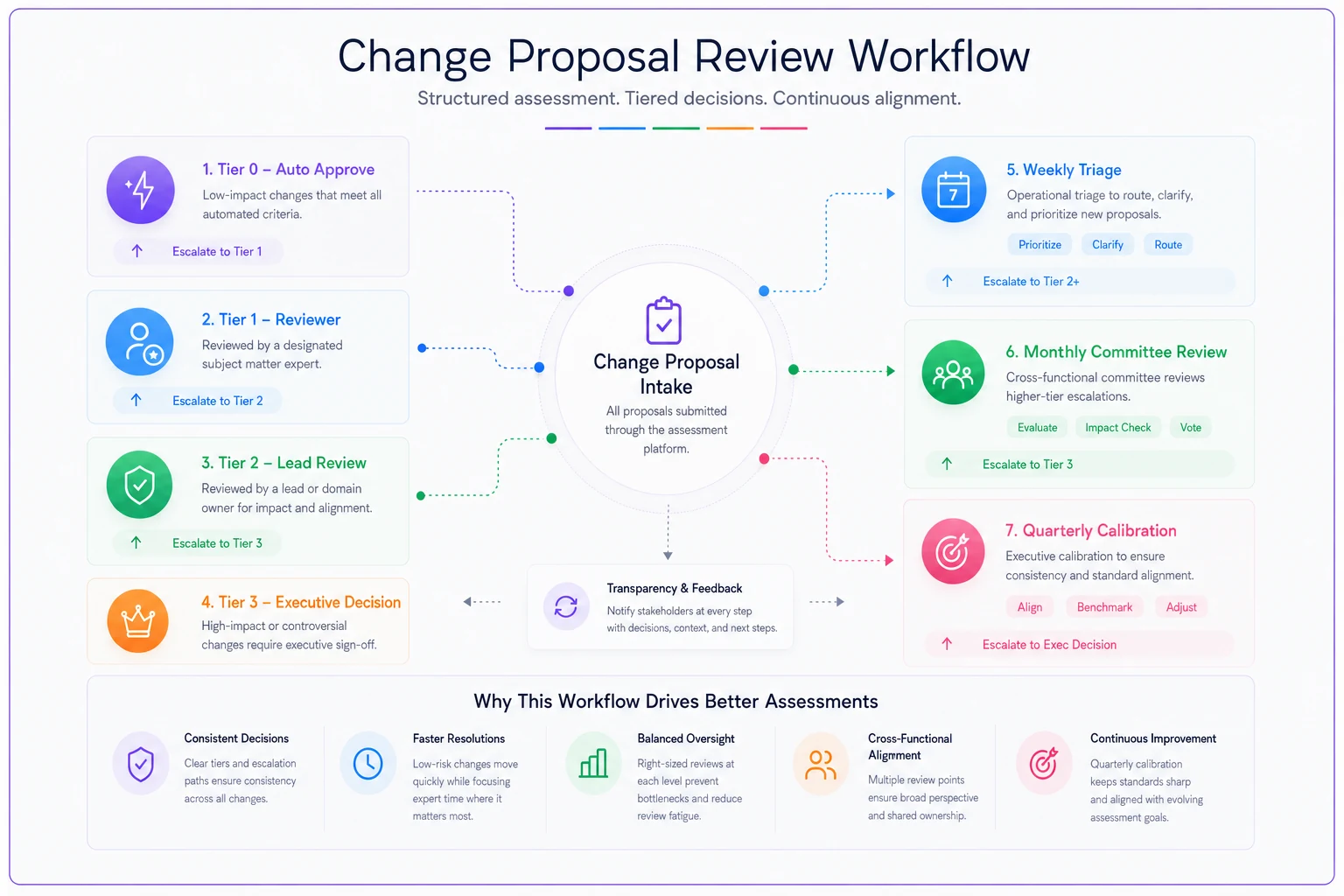
A change gets proposed—say, a revised rubric for a constructed-response item. The owner classifies it. If it's Tier 1, they implement it, log the rationale, and it lands in the next monthly batch review. The committee sees it alongside everything else that month, confirms the classification was right, and either lets it stand or bumps it up a tier if someone spots something the owner missed.
Now say a monthly metrics review surfaces a subgroup pass-rate gap that crosses a defined threshold. That's a Tier 2 trigger automatically—it doesn't wait for someone to "raise a concern." The evidence package gets assembled, the committee reviews it within the SLA window, and the decision—monitor, hold, or pull—gets logged with its frozen evidence snapshot. If the gap looks systemic rather than item-specific, it escalates to Tier 3 and the executive sponsor gets looped in with external input.
-
Continuous — Tier 0 changes logged as they happen, no meeting.
-
Weekly — a triage pass (often just the chair plus one member) to sort incoming items into tiers and catch anything that needs a called meeting.
-
Monthly — the full committee review
batch of Tier 1 changes, any Tier 2 pre-approvals, metrics review against thresholds, action-register follow-up.
-
Quarterly — a calibration session where the committee reviews its own thresholds. Are they catching real problems? Are they generating false alarms? Thresholds set once and never revisited drift out of usefulness fast.
-
As-needed — called meetings for Tier 3 escalations, documented separately.
That weekly triage is the unsung hero. It's what prevents the monthly meeting from becoming a four-hour slog and keeps urgent issues from waiting three weeks for the calendar to come around. Programs that skip triage end up with either marathon meetings or dangerous delays—sometimes both.
A real scenario: mid-size certification program
A professional certification body—around 40 exam forms, roughly 18,000 candidates a year—had a committee that met quarterly and reviewed whatever the psychometrics team brought. It looked fine on paper. In practice, items with elevated appeal rates sat unaddressed for a full quarter because nothing triggered a faster look, and the quarterly meeting ran long enough that the back half of the agenda got rubber-stamped.
The shift wasn't adding more meetings. It was adding thresholds and a triage layer. They defined that any item appearing in more than a small cluster of appeals within a 30-day window triggered a review inside two weeks, independent of the quarterly cycle. Routine rubric tweaks moved to a logged-and-batched path so the quarterly meeting stopped drowning in trivia.
Within about two quarters, the average time from a problem item surfacing to a committee decision dropped from nearly a full quarter to under three weeks. The quarterly meetings got shorter, not longer, because small stuff was handled continuously and the meeting focused on genuinely contested calls. Appeal volume on the previously-flagged items came down noticeably once bad items got pulled on a sane timeline instead of waiting months. No new headcount—just thresholds, a triage pass, and artifacts that made the next decision faster than the last.
When a formal ethics committee makes sense—and when it doesn't
Not every program needs this apparatus. Over-governing a small, low-stakes assessment program is its own failure—you burn goodwill and calendar time on oversight nobody needed.
This structure makes sense when:
-
Assessments carry real consequences—hiring, certification, licensure, promotion.
-
You have demographic subgroups large enough that fairness analysis is meaningful.
-
You're deploying automated or AI-assisted scoring where the logic isn't fully transparent to the people affected.
-
You operate across jurisdictions with differing legal requirements.
This is overkill when:
-
You run a handful of low-stakes formative assessments with no adverse-impact exposure.
-
Your "committee" would be two people who already talk daily—in which case, just document decisions and skip the ceremony.
Who should NOT build this: a team that can't yet produce reliable fairness and item-quality evidence. A committee reviewing unreliable data makes confident decisions on bad information, which is worse than no committee. Build the measurement layer first, then the oversight layer on top of it.
Where AI scoring raises the stakes
One thing has genuinely changed the calculus here: the shift toward AI-assisted scoring and automated item generation. When a human scored an essay, the committee could, in principle, trace the reasoning. When a model does it, "why did this candidate get this score" becomes a much harder question—and it's exactly the question an ethics committee exists to answer.
This is why evidence thresholds and frozen snapshots matter even more with automated scoring in the mix. The committee needs explainability records, monitoring for drift, and red-team results as standing inputs, not occasional curiosities. The operational guardrails for that are worth treating as a companion to this—how to build responsible AI governance for assessments with explainability logs and red-team tests feeds directly into what the ethics committee reviews each cycle.
The connection is straightforward: AI governance produces the evidence, the ethics committee rules on whether that evidence clears the bar, and the charter defines who gets to overrule whom. Three layers, one system.
Keeping agility intact
The fear every operations leader has about ethics committees is legitimate: that oversight becomes drag, that every decision slows down, that the committee becomes a reason nothing ships. That fear is why so many committees get set up toothless—leadership wants to be able to say governance exists without it actually constraining anything.
The way out isn't less oversight. It's tiered oversight. Most decisions never touch the committee—they're logged and batched. A smaller set gets reviewed after the fact. Only the genuinely consequential calls—scoring logic, demographic impact, candidate rights—get pre-approval and full evidence packages. Done right, the committee spends its attention almost entirely on decisions that can hurt people or the organization, and stays out of the way of everything else.
The committees that fail treat every decision as equally important. The ones that work spend their scrutiny where it matters and let the rest flow. Get the tiers, thresholds, and artifacts right, and oversight stops being the thing teams route around—it becomes the thing that lets them move faster, because the boundaries are finally clear.
The committees that fail treat every decision as equally important. The ones that work spend their scrutiny where it matters and let the rest flow. Get the tiers, thresholds, and artifacts right, and oversight stops being the thing teams route around—it becomes the thing that lets them move faster, because the boundaries are finally clear.
Ready to revolutionize your evaluation process?
Join over 2,000 organizations using Evaloly to optimize assessments, improve learner outcomes, and make data-driven decisions.