

Most assessment teams don't have a risk problem. They have a coordination problem that only looks like a risk problem when something breaks.
Your psychometrician knows the test is drifting on difficulty. Your security lead knows two proctoring vendors failed their SOC 2 recertification. Your legal counsel is tracking an adverse-impact complaint in one state. Your procurement team is mid-renewal on the item-banking platform. All four of these people are holding a piece of the same picture, and none of them are looking at the same document. When the complaint escalates, legal asks for the validity evidence, and it takes three weeks to assemble because it lives in four systems and two people's inboxes.
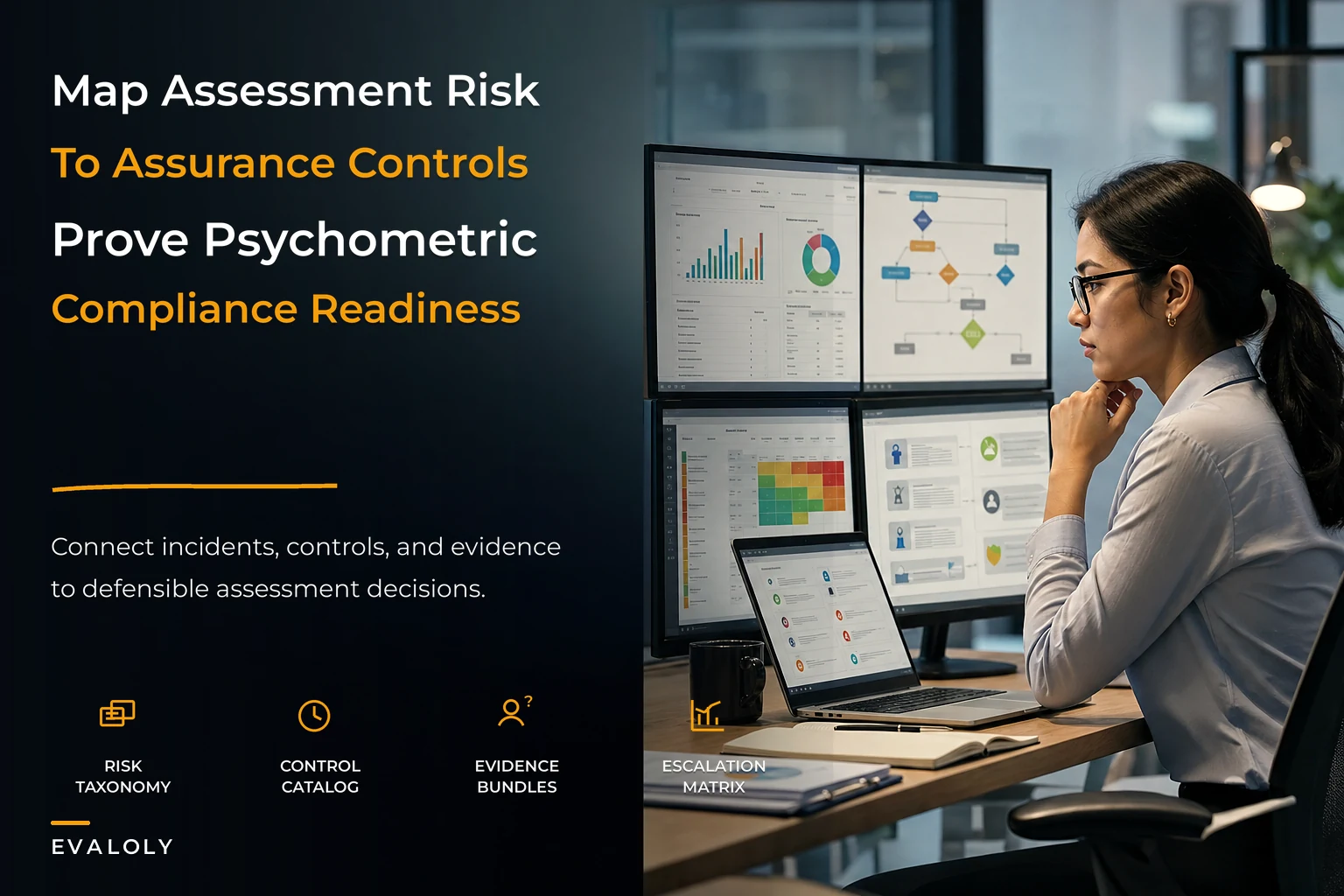
That gap — between the risks you know about and the controls you can prove you ran — is what an assessment risk and assurance framework is supposed to close. Not a binder of policies. A living crosswalk that links a psychometric concern (say, DIF on a scored item) to the control that catches it, the evidence that proves the control ran, and the legal or validity outcome that depends on it.
This article is about building that crosswalk as a system, not a compliance artifact that gets dusted off during an audit.
Why the pieces live in silos (and why that's the actual risk)
The silos aren't an accident. They're the predictable result of how assessment functions grow.
A program usually starts with one or two people who own everything — item writing, scoring, the occasional vendor call. Risk is managed informally because it can be. Then the program scales. You add a security function because remote proctoring created an attack surface. You add legal review because you're now making employment or credentialing decisions that get challenged. You add vendor management because you're running five SaaS tools instead of one spreadsheet.
Each function brings its own language and its own catalog. Security thinks in terms of CIA (confidentiality, integrity, availability) and maps to NIST or ISO controls. Legal thinks in terms of defensibility, documentation, and jurisdiction. Psychometrics thinks in terms of validity, reliability, and fairness. Vendor management thinks in SLAs and data-processing agreements.
The problem is that a single real-world incident touches all four taxonomies at once, and nobody owns the translation layer.
A typical example: an exam item leaks on a forum. Security classifies it as a confidentiality breach. Psychometrics classifies it as an exposure event that compromises the item's statistics and possibly the form's comparability. Legal wants to know whether any pass/fail decision made on the compromised form is still defensible. Vendor management needs to know if the leak originated from a third-party platform and whether that triggers a contractual notification clause.
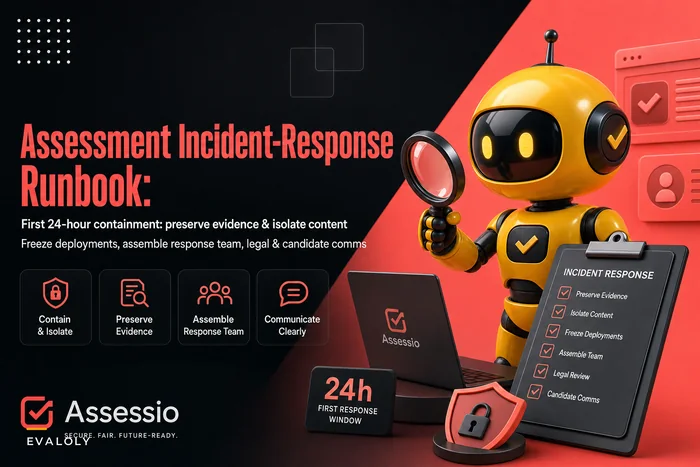
Four classifications. One event. If your taxonomy can't hold all four views of the same thing, your response is going to be slow, inconsistent, and hard to defend later. The mechanics of handling that specific scenario are covered in the exam content leak incident-response runbook — but a runbook only works if the underlying taxonomy already connects those disciplines.
The unified taxonomy: one risk, four lenses
The core idea is deceptively simple. You build a single risk register where every entry is tagged across all four lenses instead of living in a discipline-specific list.
Eliminate assessment bottlenecks.
Evaloly simplifies every step from test design to results analysis, making assessments faster and more reliable.
- Customizable test creation
- Automated grading and analytics
- Secure distribution and proctoring
No credit card required
Think of each risk as a row that has to answer: What psychometric property does this threaten? What security property? What vendor dependency? What legal exposure? Most risks won't score high on all four — but the ones that do are your real priorities, and a siloed catalog will never surface them.
Here's a simplified slice of what the crosswalk looks like once it's populated:
| Risk | Psychometric lens | Security lens | Vendor lens | Legal lens |
|---|---|---|---|---|
| Item overexposure | Degraded item stats, inflated scores | Content confidentiality | Proctoring/delivery vendor exposure logs | Score defensibility, candidate fairness claims |
| Scoring model drift | Reliability/validity decay | Model integrity, access control | AI scoring vendor change logs | Adverse impact, challenge risk |
| Accommodation failure | Construct-irrelevant variance | Access to PII in intake | HRIS/SIS integration gaps | ADA / disability discrimination |
| Form comparability break | Equating failure, cohort invalidity | Version control integrity | Platform versioning bugs | Inconsistent decisions across cohorts |
| Proctoring data breach | — | PII confidentiality | Vendor sub-processor chain | Privacy regulation (state/GDPR) |
The value isn't the table itself. It's that a single person — or a single query — can now see that "scoring model drift" is simultaneously a validity problem, a security problem, a vendor-change problem, and a potential adverse-impact lawsuit. In a siloed world, those four facts never meet until litigation forces them to.
One pattern worth naming: teams tend to over-catalog security risks (because security people are used to formal control frameworks) and under-catalog psychometric risks (because validity threats feel like "measurement issues," not "risks"). A validity threat that invalidates six months of hiring decisions is a far bigger exposure than most firewall gaps, and it almost never appears in the enterprise risk register. That asymmetry is one of the most common and most expensive blind spots in the whole function.
The control catalog: from "we have a policy" to "we can prove it ran"
A risk taxonomy without controls is just a list of things to worry about. The second half of the framework is a control catalog that maps each risk to a specific, testable control — and, critically, to the evidence that control produces.
The distinction that matters: a policy says what should happen. A control is the mechanism that makes it happen. Evidence is the artifact proving the mechanism actually ran. Auditors, and increasingly plaintiffs' attorneys, don't care about your policy document. They care whether the control fired every time it was supposed to and whether you can show it.
A useful way to structure each control entry:
-
Control ID and description — plain-language statement of what the control does
-
Risk(s) it mitigates — linked back to the taxonomy rows
-
Owner — a named role, not a department
-
Frequency — continuous, per-form, quarterly, per-incident
-
Evidence artifact — the specific log, report, sign-off, or export it generates
-
Audit mapping — which external standard or regulation this satisfies (SOC 2, ISO 27001, NIST, EEOC/UGESP, local privacy law)
The evidence column is where most programs quietly fail. They have the control. They run the control. They just can't find the evidence six months later because it was a screenshot in Slack or a verbal confirmation in a meeting. When legal needs to assemble a validity defense package under deadline, "we definitely did that but can't prove it" is functionally the same as not having done it.
Evidence bundles
This is the operational concept that ties everything together, and it's worth slowing down on.
For an adverse-impact challenge on a hiring assessment, the bundle might include: the job analysis linking the test to the role, the validity study, the latest DIF/fairness analysis, the scoring rubric and version history, accommodation records for the affected candidates, and the vendor's model-change log for the relevant period. Define that bundle once, and you've turned a three-week fire drill into a one-day export.
Define evidence bundles once and automate their assembly where possible so you avoid ad-hoc collections when incidents occur.
The teams that handle legal challenges well aren't smarter. They just decided ahead of time what a complete answer looks like.
Audit mappings: don't maintain five frameworks, maintain one
There's a trap mature programs fall into. They get a SOC 2 request, so they build a SOC 2 control set. Then a client wants ISO 27001, so they build a parallel set. Then OFCCP or EEOC guidance enters the picture and someone builds a compliance checklist. Then a European client triggers GDPR obligations. Now you're maintaining five overlapping control inventories that are 70% the same control described five different ways.
The crosswalk solves this by treating external frameworks as mappings onto your controls, not as separate control sets. One control — "all scoring-model changes require documented review and version logging" — maps to SOC 2 change management, ISO 27001 A.12, NIST configuration management, and supports validity defensibility under employment-testing guidance. You run the control once. You map it to four frameworks. When a new regulation arrives, you're adding a mapping, not a workflow.
This matters more every year because the regulatory surface keeps expanding. If you're running assessments across regions, the mapping discipline becomes survival, not elegance. The global assessment compliance framework for multi-jurisdiction programs goes deeper on the jurisdictional layering that sits on top of this. The point here is that your control catalog should be the stable core, and jurisdictional requirements should attach to it as mappings rather than spawning parallel systems that someone has to manually keep in sync.
The incident escalation matrix: linking operational incidents to validity and legal outcomes
This is the part most frameworks skip, and it's the part that separates a real assurance system from a filing cabinet.
Operational incidents happen constantly — a proctoring session glitches, a candidate reports a technical fault, an item gets flagged for unusual response patterns. Most are noise. Some are the early signal of something that will become a validity problem or a legal problem if nobody connects the dots. The escalation matrix is the explicit rulebook for when an operational event becomes a validity or legal event, and who gets pulled in at each tier.
A workable escalation flow looks like this:
-
Detection — an operational event is logged (system alert, candidate report, QA flag, vendor notification).
-
Triage classification — the event is scored against the taxonomy. Does it touch validity? Security? Vendor contract terms? Legal exposure? This is a 10-minute step, not a committee.
-
Tier assignment — based on the lenses triggered and severity, the incident is assigned a tier that dictates response time, who's notified, and what evidence bundle starts assembling.
-
Containment and parallel notification — operational containment runs while the relevant discipline leads are notified in parallel, not sequentially.
-
Validity/legal determination — psychometrics and legal jointly determine whether any decisions made on affected assessments are compromised and what remediation applies (rescore, re-administer, notify candidates).
-
Closure and catalog update — the incident is closed with a post-mortem that feeds back into the taxonomy and controls. New failure mode? New risk row. Control gap exposed? New or revised control.
The tiering logic is the heart of it. A single candidate reporting a slow-loading page is Tier 1 — logged, monitored, no escalation. The same slow-loading page affecting 400 candidates during a timed exam is suddenly a Tier 3 validity event, because timing is a construct-relevant variable and you may have systematically disadvantaged a cohort. Same root event, radically different consequence, and the matrix is what makes that distinction before the complaints arrive rather than after.
Step 6 is the one people drop under pressure, and it's the one that compounds over time. Every closed incident that doesn't update the taxonomy means you'll re-learn the same lesson next quarter. The resilience side of this — continuity, vendor failover, and keeping the system standing during an active incident — is covered in detail at enterprise assessment resilience for security, continuity, and vendor, which is worth reading alongside this if your incident volume has been growing.
A visual flow helps teams internalize the tiering steps.
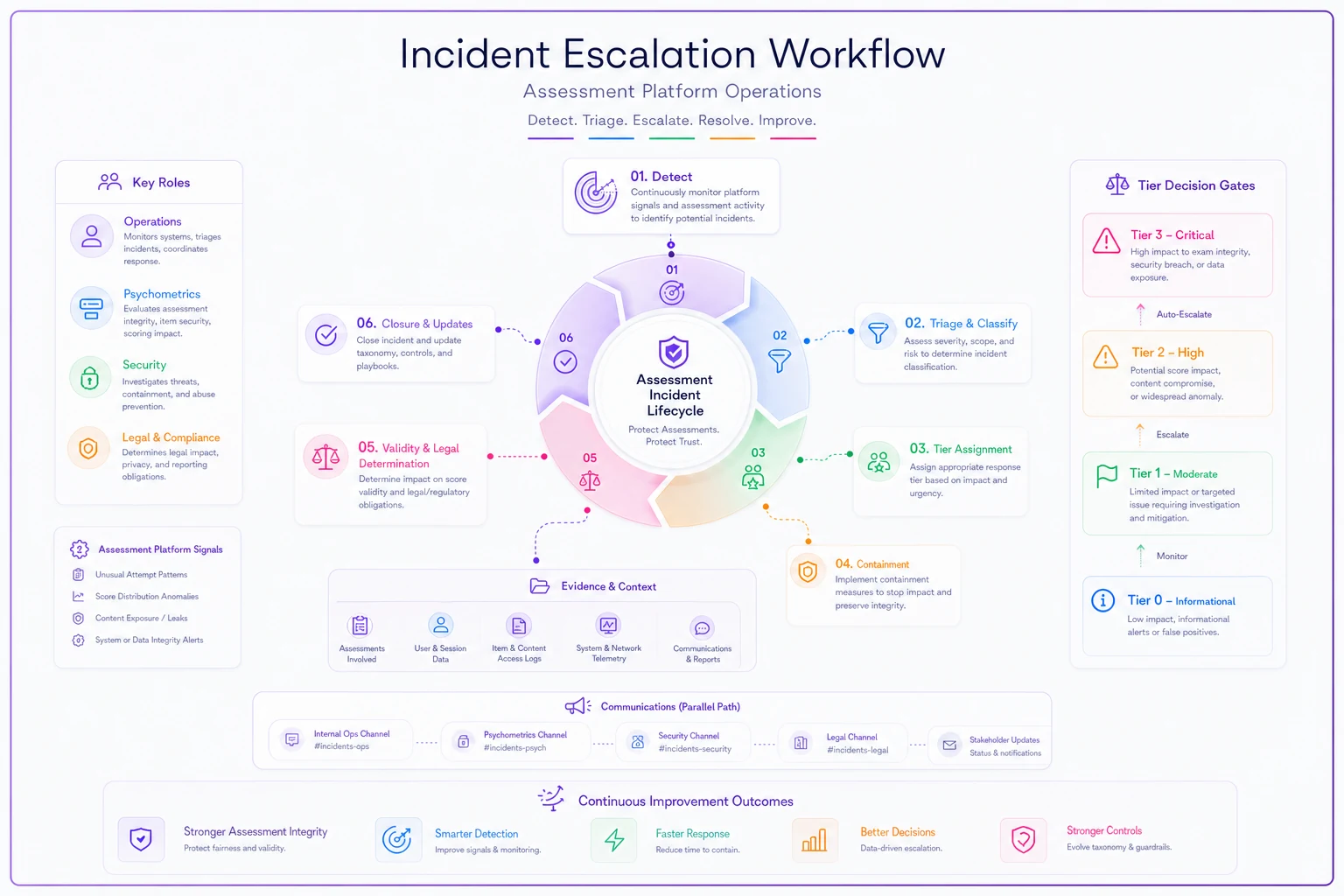
The tiering and notification sequence should emphasize parallel discipline engagement and automatic evidence-bundle kickoffs so containment and defensibility proceed together, not as sequential handoffs.
A real scenario: mid-size certification body
A professional certification program, somewhere around 8,000–10,000 candidates a year, ran a competency exam that gated a licensure-adjacent credential. They had decent individual functions — a psychometrician on contract, a security vendor for proctoring, outside counsel on retainer — but no crosswalk connecting them.
The break came when a scored item started showing anomalous response patterns, consistent with a leak. The psychometrician flagged it. That flag sat in a monthly analytics review for about three weeks before anyone treated it as an incident. By the time security got involved, roughly 600 candidates had tested on the affected form. Legal got looped in only after a candidate who failed filed a challenge arguing the exam was compromised and therefore unfair.
Assembling a defense took close to a month of senior time across three functions. The direct remediation — a partial re-administration and extended psychometric review — ran into the low tens of thousands, and the harder-to-quantify cost was the credibility hit with their accreditation body, who now wanted to see their incident-handling process.
What they built afterward wasn't complicated. A unified risk register with the four lenses. A control catalog where the "item exposure monitoring" control had a defined evidence artifact and a mandatory 48-hour escalation trigger instead of a monthly review cycle. And pre-defined evidence bundles for the two legal claim types they were most exposed to.
The next time an anomaly surfaced — about seven months later — it was triaged within two days, contained before it spread past a small cohort, and the validity determination plus candidate communication went out inside a week. Same category of problem, a fraction of the cost, and almost none of the panic. The difference wasn't talent or tooling budget. It was that the escalation path and the evidence requirements existed before they were needed.
When this framework makes sense — and when it's overkill
This is real work to build and maintain, so it's worth being honest about fit.
When it makes sense:
-
Your assessments drive consequential decisions — hiring, licensure, certification, promotion — where a bad decision is legally challengeable.
-
You run multiple vendors in the delivery and scoring chain.
-
You operate across more than one jurisdiction, or you're subject to employment-testing or privacy regulation.
-
Your incident volume has grown to the point where "we'll figure it out when it happens" has already burned you at least once.
When it's premature:
-
You're running low-stakes formative assessments where no decision hinges on the score.
-
You're a single-person program with one platform and a handful of candidates. The coordination overhead of a crosswalk exceeds the coordination problem it solves. A simple risk list is fine.
Who should NOT start here: teams that haven't yet nailed their measurement fundamentals or their basic data governance. A risk crosswalk assumes you already have controls worth cataloging. If your validity evidence is thin or your item bank metadata is a mess, fix the foundation first — otherwise you're building an assurance framework on top of risks you can't actually measure.
The honest version of this is that most programs fall somewhere in the middle — enough scale to have real coordination gaps, not enough structure to have addressed them. If that's where you are, even a partial crosswalk covering your top five or six risks is worth more than a perfect framework that takes a year to build.
Making it live instead of static
The failure mode for frameworks like this isn't building them. It's letting them calcify. A risk register that was accurate at launch and never updated is more dangerous than no register, because it creates false confidence.
What keeps a crosswalk alive is tying its maintenance to events that already happen: every incident closure updates the taxonomy, every vendor renewal re-checks the vendor-lens mappings, every validity study refreshes the psychometric-lens entries, every regulatory change adds or revises a mapping rather than spawning a parallel framework. Maintenance becomes a byproduct of normal operations instead of a standalone project nobody has time for.
The deeper point is that assessment risk isn't a security problem wearing a psychometrics hat, or a legal problem wearing a vendor hat. It's a genuinely cross-disciplinary problem, and the organizations that handle it well are the ones who stopped forcing it into one department's vocabulary. The crosswalk is just the artifact that lets four specialists see the same risk through their own lens — and respond before an operational hiccup quietly becomes a validity failure you can't defend.
The deeper point is that assessment risk isn't a security problem wearing a psychometrics hat, or a legal problem wearing a vendor hat. It's a genuinely cross-disciplinary problem, and the organizations that handle it well are the ones who stopped forcing it into one department's vocabulary. The crosswalk is just the artifact that lets four specialists see the same risk through their own lens — and respond before an operational hiccup quietly becomes a validity failure you can't defend.
Ready to revolutionize your evaluation process?
Join over 2,000 organizations using Evaloly to optimize assessments, improve learner outcomes, and make data-driven decisions.