

Most assessment programs describe their ethics posture with two documents: a fairness analysis showing no major differential item functioning across groups, and a policy PDF saying the organization "is committed to equitable assessment practices." Both are fine to have. Neither tells you what to do when a wrong score has already reached payroll, a promotion committee has already met, and someone has spent three weeks believing they failed something they actually passed.
That gap is what this playbook covers. An assessment ethics playbook for a high-stakes program has to work at the level of a specific incident and specific people. It has to say what kind of harm happened, how bad it is, what you owe the people affected, what evidence you need before acting, and how the fix gets through every system the original score touched. Group-level fairness checks belong in the picture, but they're a smoke detector, and a smoke detector doesn't put out a fire.
The article reads as a failure analysis. It follows how harm moves through an assessment operation and where it gets stuck, then builds a system around those sticking points. Teams that already run psychometric controls will see some overlap with the assessment risk and assurance framework, but this one starts after the harm has already happened and asks what remediation actually takes.
Where it breaks first: the statistically fair program that still hurts people
Picture a program that passes its fairness review. Pass rates across demographic groups sit within a few points of each other, DIF flags were reviewed and cleared, reliability numbers look solid. Then one of these happens:
-
An answer key on one form has two items swapped, and nobody notices for five weeks.
-
A remote proctoring tool marks a cluster of candidates for "suspicious behavior." The real cause was a building's shared network dropping packets.
-
A cut score gets updated in the assessment platform but not in the HRIS rule that decides eligibility for a pay band.
-
A placement test routes students into a non-credit remedial course because the score import file truncated a column.
None of these show up in a fairness analysis. A key error spread evenly across groups is perfectly "fair" in the statistical sense, since it hurts everyone equally. The proctoring flags might cluster by office location instead of demographic group. The HRIS mismatch isn't a measurement problem at all. It's a data plumbing problem that produces measurement consequences.
The mistake is treating ethics as a property of the test. In high-stakes programs it belongs to the whole decision chain: the item, the scoring, the flagging, the data transfer, the decision rule, the human who acts on it, and the record left behind. Harm can enter at any link, and once it's in, it spreads downstream.
So stop asking "is the test fair?" and ask a different question. If something goes wrong anywhere in the chain, can you see it, size it, and undo it?
The harm taxonomy that actually helps you make decisions
The usual instinct is to sort harms by cause: scoring error, security incident, accessibility failure, AI misclassification. Cause matters for root-cause analysis, but it's the wrong first question for remediation. Two incidents with the same cause can do very different damage, and two different causes can do the same damage.
Eliminate assessment bottlenecks.
Evaloly simplifies every step from test design to results analysis, making assessments faster and more reliable.
- Customizable test creation
- Automated grading and analytics
- Secure distribution and proctoring
No credit card required
Sort by what happened to the person instead. Three categories cover nearly everything in workplace and education assessment.
Economic harm
The person lost money, or lost the chance to earn it. The obvious cases are a missed pay differential, a delayed promotion, retake fees, travel for an in-person retest, and unpaid time spent re-preparing. The less obvious ones: tuition for a remedial course a student didn't need, a contractor losing a site assignment because their safety certification showed as lapsed, and the knock-on effect of a delayed raise on every percentage-based raise after it.
Organizations over-focus on economic harm because it's the easiest to put a number on, and they still under-count it. The direct cost is visible and the compounding cost isn't. A three-month promotion delay isn't just three months of the pay difference. If the annual raise cycle landed in that window, the person can stay behind for years.
Reputational harm
The person's standing changed in someone else's eyes. A misconduct flag in their file, a manager who now sees them as "the one who failed the lead cert," a credential shown as revoked on a public registry, a note in an employer verification response. In education it could be an academic integrity referral that a faculty committee saw before it was cleared.
This one is the hardest to reverse, because you can't recall what other people already saw. You can correct the record, and you can actively tell the people who saw the wrong version. Most programs do the first and skip the second.
Access harm
The person lost an opportunity or a pathway: a role, a program, a retake window, an internal mobility pool, an accommodation. In the moment it often looks small ("they can just retest next quarter"). In practice it's large, because opportunities are time-bound. The internal posting closes, the cohort starts without them, the clinical rotation fills.
It's also the harm people wave off most easily, because the person technically still has options. Technically. A retake in six months doesn't give back a slot that was gone in two weeks, and no one tracks what that person would have done with it.
The dimensions that set severity
-
Reversibility. Can the harm be fully undone, partly undone, or not at all?
-
Duration. How long did it persist before detection, and how long until it's fixed?
-
Breadth. How many people, and do you actually know who they are?
-
Visibility. Who else saw or acted on the wrong outcome?
Visibility is the one teams forget. A wrong score nobody else saw is a records problem. The same wrong score after it has fed a manager dashboard, a promotion slate, and an external verification request is a different incident, even though the underlying error is identical.
Most real incidents also hit more than one category. A false proctoring flag that withholds a certificate is reputational (flag on file), access (can't apply for the role requiring the cert), and economic (lost pay while waiting). Classify all three. The usual mistake is picking the "main" one and building the whole remedy around it.
How harm travels: the workflow nobody draws
Before you think about mitigation, trace the path a single score takes in a mid-sized organization. Almost nobody draws this out, and doing it explains most remediation failures.
Take a typical internal certification path. A candidate finishes the assessment in the testing platform. Raw responses get scored there, by key or rubric, sometimes with AI-assisted scoring for constructed responses. The result goes to the LMS as a completion record. The LMS syncs nightly to the HRIS, where a rule checks whether the certification field is populated and flips eligibility for a pay band or role family. Payroll reads the pay band on the next cycle. Separately, a manager dashboard pulls certification status for team planning. If the credential is externally verifiable, a registry or verification service gets an update too. And somewhere along the way a proctoring or integrity review may have attached a flag that lives in the testing platform, gets mentioned in an email to the candidate's manager, and ends up summarized in a talent review deck.
Here's a simple visual of that flow.
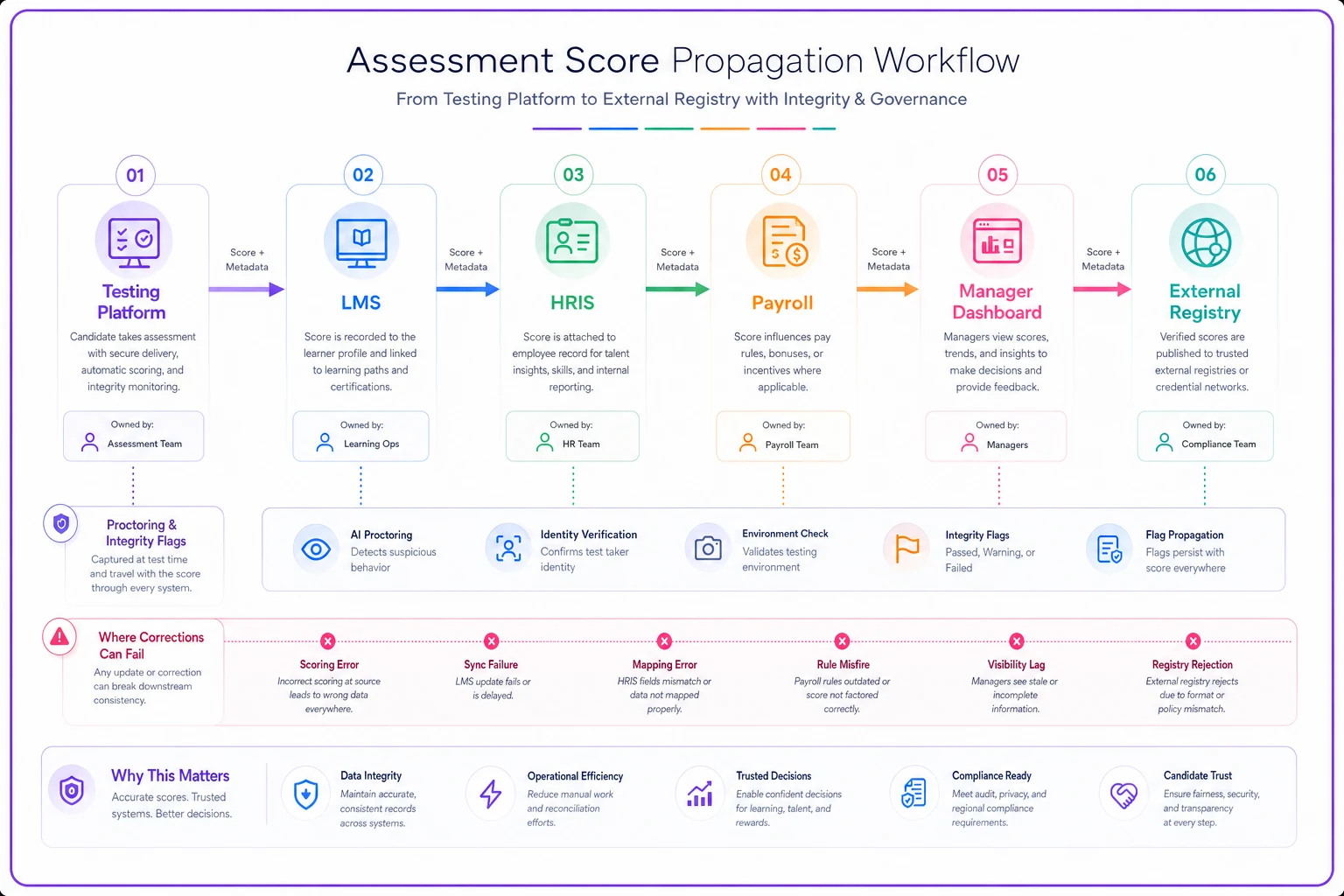
That's six or seven systems and at least five or six different owners: the assessment team, L&D or the LMS admin, HR operations, payroll, the manager, whoever owns the external registry. Nobody owns the whole path.
Now apply a correction. The assessment team re-scores, fixes the result in the testing platform, and considers it done. The LMS may or may not pick up the change, since many integrations only push new completions, not edits. The HRIS rule fires again only if the field changes. Payroll doesn't retro-calculate unless someone files a manual adjustment. The manager dashboard updates, but the talent review deck from two weeks ago doesn't. The integrity-flag email is still sitting in the manager's inbox.
From the candidate's side it sounds like this: "They told me it was fixed, but nothing changed."
The fix was defined as "correct the score" instead of "correct every decision and record that depended on the score." Those are very different scopes of work, and only the second one is remediation.
Mitigation ladders: matching the remedy to the harm
Once you know what kind of harm happened and roughly how bad it is, you need a structured way to decide what you owe. Without one, remediation gets negotiated case by case. The loudest people get the most, the quiet ones get a corrected record and nothing else, and the organization ends up with inconsistent precedents it later has to defend.
| Rung | Remedy | Typical trigger | Evidence needed before acting | Who signs off |
|---|---|---|---|---|
| 1 | Acknowledge and correct the source record | Any confirmed error, even with no downstream effect | Error confirmed in scoring or flag logs; affected records identified | Assessment lead |
| 2 | Propagate the correction to every system that consumed the original result | Result left the testing platform (LMS, HRIS, dashboards, registry) | Downstream consumer list for the affected results; confirmation that each system updated | Assessment lead + system owners |
| 3 | Restore access: reopen windows, priority retest, re-entry to closed pathways | Person lost an opportunity that is still recoverable | Proof the opportunity existed and the error blocked it; current status of that opportunity | Program owner + hiring/admissions owner |
| 4 | Make whole economically: back pay, fee refunds, cost reimbursement, retroactive eligibility dates | Measurable financial loss attributable to the error | Pay/fee records; counterfactual (what would have happened without the error); finance validation | HR/Finance + program owner |
| 5 | Repair reputation actively: notify everyone who saw the wrong outcome, issue a corrected statement, expunge flags | Wrong outcome was visible to managers, committees, or external parties | Access/distribution logs showing who saw it; list of reports or verifications issued | Program owner + Legal/HR |
| 6 | Structural remedy: pause the program, change the decision rule, independent review | Systemic cause, large breadth, or repeat incident | Root-cause analysis; recurrence evidence; breadth estimate | Ethics committee or executive sponsor |
Rung 2 is where most programs fall off. It's unglamorous and crosses multiple owners, so it quietly doesn't happen. If you take one thing from this playbook, take this: a correction that hasn't propagated isn't a correction yet.
Rungs 4 and 5 need a counterfactual. For economic make-whole you have to answer "what would have happened if the score had been right?" Sometimes that's easy: they'd have passed, and the pay band flips on that date. Sometimes it's murky. They'd have been eligible for the promotion, but would they have gotten it? The ladder doesn't remove judgment here. It forces you to write the judgment down, which makes it consistent and reviewable.
Climbing too high costs something too. Pausing a certification program over one isolated key error on one form strands everyone else in the pipeline, and that's an access harm you just created. Proportionate goes both ways.
Evidence requirements: the asymmetry problem
This section is a bit uncomfortable, and it should be.
Almost every remediation process asks the affected person to provide evidence. Fill out the form, describe what happened, attach screenshots. But in nearly every assessment incident, the organization holds the evidence and the candidate doesn't. The candidate can't see the answer key or the proctoring model's confidence scores. They have no access to the sync logs between the LMS and HRIS, and they don't know who viewed their integrity flag.
So the burden of proof lands on the party with the least access to proof. That's backwards, and it's the main reason remediation reaches complainants but not everyone who was affected. People who didn't notice, or didn't feel safe complaining, or didn't know they could, get nothing.
A better rule: the program establishes the facts, and the candidate adds context. For every high-stakes assessment you should be able to produce the following without asking the candidate for anything:
-
The item-level responses and the key or rubric version used to score them
-
Any scoring model version and its output, if AI-assisted scoring was involved
-
Integrity or proctoring flags, with the raw signal behind them and the reviewer's decision
-
Timestamps of when the result was transmitted to each downstream system
-
A record of who viewed or exported the result and when
-
The decision rule (cut score, eligibility logic) in effect at that moment
If you can't produce these, remediation stalls at the evidence step every time. This is where incident response and data governance collide. A common failure is a retention policy that deletes proctoring video or raw response data after 30 or 60 days, which is often shorter than the time it takes for an error to be noticed. The operational privacy and lifecycle playbook for assessment data covers how to set retention windows that respect privacy without leaving you unable to investigate. The short version: keep decision-relevant evidence longer than your realistic detection lag plus the appeal window.
For AI-assisted scoring and flagging the bar is higher. You need to show what the model saw, what it output, which version was running, and whether a human reviewed it. Teams that set up explainability logs ahead of time, as covered in the piece on responsible AI governance for assessments, can answer "why was this person flagged?" in an afternoon. Teams that didn't sometimes can't answer at all, and "we don't know why the system flagged you" is its own reputational harm, to the candidate and to the program.
The incident-to-remediation flow
This is the end-to-end process. It doesn't replace a security incident runbook. It runs next to one and focuses on harm to people rather than containment of a threat.
-
Detect and log. An incident starts from an appeal, an analytics anomaly, a staff report, or a vendor notice. Log it right away with a provisional description, even if you're not sure it's real. Plenty of programs wait until an issue is "confirmed" before logging, which wipes out the timeline you'll need later.
-
Freeze downstream decisions. Before investigating, stop the bleeding. If a suspected key error affects a form, hold new results from that form at the testing platform before they sync. If integrity flags are in question, suspend their visibility to managers. People skip this because it feels premature, and then they end up fixing three times as many records.
-
Classify harm across all three categories. Economic, reputational, access: mark each yes, no, or possible. Then score severity on reversibility, duration, breadth, and visibility. A rough high/medium/low is fine at this stage.
-
Build the affected population from data, not complaints. Query every result that touched the faulty component, whether that's the form, the model version, the proctoring session window, or the sync batch. The person who appealed is a sample of one. The real population is nearly always bigger, often several times bigger.
-
Map downstream consumers. For each affected result, list every system and person that received or acted on it. This becomes your propagation checklist for rung 2 and your notification list for rung 5.
-
Assemble evidence and establish the counterfactual. Pull the records from the evidence list above. For each affected person, answer what the outcome should have been and what changed because of the wrong one.
-
Choose the rung. Apply the ladder, using the same rung for everyone with the same harm profile. Write down the reasoning, especially wherever judgment was involved.
-
Execute across owners. Each remedy action gets an owner and a due date. Assessment corrects the source, HR ops fixes eligibility, payroll processes adjustments, the program owner sends notices.
-
Verify from the affected person's side. Check that the fix is visible from where the person sits, not just from yours. Is the pay band right on their next statement? Does the registry show the corrected status? Is the flag gone from the manager view?
-
Close and feed back. Record root cause, remedies, time to each stage, and cost. Send structural findings to whoever owns program governance. Repeat incidents of the same type should automatically trigger consideration of rung 6.
Step 4 is where the ethics of the whole thing really sit. A program that remediates only the people who complained has turned a measurement error into a test of who feels entitled to push back. That tends to track seniority, confidence, language fluency, and job security, which brings back exactly the fairness problems the statistical checks were supposed to catch.
Step 2 is the one people argue with, usually because holding results feels like creating a delay. It does create one. But a held result can be released in an hour once you know it's right, and a wrong result that has already synced to four systems takes weeks to chase down.
What changes as the program grows
At small scale (one trainer, a couple hundred candidates a year, one decision tied to the result) the whole flow can run in someone's head. The program owner knows who took which form and can walk over to HR and fix the record. The downstream consumer map is one spreadsheet and one manager.
Nobody can name the affected population from memory. You need queryable records that link each result to its form version, scoring version, proctoring session, and sync batch. If your data model doesn't have those links, step 4 becomes manual archaeology.
Owners multiply and handoffs fail. The assessment team fixes its part and assumes HR got the memo. HR assumes payroll was told. Every handoff is a place where remediation dies quietly. At this size you want one incident record that every owner updates, not a chain of emails.
Precedent drift sets in. Without a written ladder, the first incident sets an informal precedent ("we refunded the retake fee"), the next sets a different one ("we refunded the fee and gave a priority slot"), and within a year you've got inconsistent treatment that's hard to defend if anyone compares notes.
Detection lag grows. At small scale someone notices odd results within days. At larger scale an error on one form out of eight can run for weeks before a pattern shows up, and longer detection means more people, more downstream decisions, more expensive rungs.
AI-assisted components add opaque links. Once scoring or flagging uses models, some links in the chain were never looked at by a human in the moment. That's not a reason to avoid them. It's a reason to make sure those links produce logs that support step 6.
This is also where tooling starts to matter. Running the flow by hand across six systems is possible, but slow and error-prone. Operational platforms with AI automation help in fairly unglamorous ways. They keep the lineage between a result and every system it touched, generate the affected-population query when a form or model version is marked faulty, pre-assemble the evidence package for each person, draft notifications for human review, and track remedy actions across owners until each one is verified. None of that replaces the judgment calls on rungs 4 through 6. It removes the clerical work that otherwise gets rungs 2 and 5 skipped.
A real scenario: lead certification at a regional logistics company
Business type: Regional third-party logistics company, roughly 1,100 employees across five warehouses. An internal "Lead Operator" certification gates a pay differential of about $1.35–$1.50 per hour and eligibility for shift lead postings.
The problem: One of three test forms went out with a scoring key error on four items. Two answer options had been swapped during an edit. It ran for about six weeks before a candidate who was sure of their answers filed a review request. Around 140 people had taken that form in the meantime.
The first time around: The assessment coordinator confirmed the key error within a couple of days, re-scored the appellant, and closed the ticket. About two weeks later a supervisor at another site asked a similar question, and only then did anyone re-score the whole form. It turned out 35-odd people had been marked failing who should have passed. The corrected results went into the testing platform, but the LMS integration only synced new completions, so HRIS eligibility never updated for most of them. Payroll adjustments happened only for the five or six people who chased HR directly. Two people were passed over for shift lead postings in the meantime, and nobody looked into that. From first appeal to "closed" took a bit over nine weeks, and by any honest standard most of the affected people were never fully remediated.
What they changed: They wrote down a harm taxonomy and a four-rung version of the ladder (they merged rungs 5 and 6 at their size), added form and key version IDs to every result record, and made "hold syncs from affected form" the first action on any suspected scoring issue. They also set up a single incident record that HR ops and payroll had to update directly.
The next incident: A few months later a proctoring vendor update caused false "tab switching" flags for candidates on one site's older workstations. Around 50 sessions were flagged over roughly ten days. This time the flags were hidden from managers within a day of the first report. The affected population was pulled by session window and site in about three days. Everyone flagged got their result released or a priority retest within two weeks or so. Supervisors at that site got a short written notice saying the flags were a technical error and should be disregarded. Back pay went out on the following payroll cycle for the handful whose eligibility had been delayed.
Outcome: Time to full remediation dropped from about nine weeks to something like two and a half. More importantly, coverage went from "the people who complained" to everyone affected. The HR ops lead said the biggest change wasn't speed. Nobody had to argue about what each person was owed, because the ladder had already settled it.
When this actually makes sense
The full playbook, with taxonomy, ladder, evidence requirements, and the ten-step flow, is worth building when:
-
Results feed a decision that changes pay, employment status, licensure, placement, or progression
-
More than one system consumes the result (LMS plus HRIS is enough)
-
You run multiple forms, versions, or AI-assisted scoring or flagging
-
Results are visible to people other than the candidate, especially external parties
-
You've already had one incident and handled it inconsistently
For educators, that means placement testing, gateway exams for program admission, and any assessment where a result triggers a fee or schedule change. For HR, it means pre-hire assessments that screen people out, certifications tied to pay, and anything used in reductions or role redesign. For corporate trainers, it means compliance certifications where a lapse keeps someone from working a shift or a site.
You don't need all five conditions. Two is usually enough to justify the work, and the last one tends to settle the argument on its own.
When this is a bad idea
For low-stakes formative quizzes, knowledge checks, and practice tests, this level of process is overkill, and it does damage. It slows iteration, makes instructors nervous about trying new items, and burns attention you need for the high-stakes work. A wrong key on a practice quiz deserves a quick fix and a note to learners, not a ten-step flow.
It's also a bad idea to build the ladder and then apply it rigidly to cases it wasn't designed for. Every so often an incident doesn't fit. Someone's harm is unusual, or the counterfactual is honestly unknowable. The ladder should guide judgment, not replace it, and there should be a documented exceptions path that goes to someone senior enough to own the call.
Who should NOT do this yet
If you can't reliably say which form and scoring version produced a given candidate's result, don't start with the ladder. Start with record-keeping. A remediation framework sitting on top of untraceable results is just a nicer-looking way to fail at step 4.
Same if nobody agrees on who owns the decision tied to the assessment. If assessment, HR, and the business unit each assume someone else decides what a failing score means, have that governance conversation first. Otherwise every rung above 2 becomes a turf dispute in the middle of an incident, which is the worst possible time for one.
And a solo trainer running a few cohorts a year probably doesn't need a formal ladder. They need one habit: when something goes wrong, check everyone who took that version, not just whoever noticed.
Readiness checklist before your next incident
Most programs won't build all of this at once, and that's fine. The list below is what's worth having in place before something goes wrong, since setting any of it up mid-incident is miserable.
-
Every high-stakes result links to its form version, key/rubric version, scoring model version (if any), and proctoring session ID
-
A documented list of every system that consumes assessment results, with an owner for each
-
Confirmation of whether each integration propagates edits or only new records (find out now, not during an incident)
-
A way to hold or suspend result syncs and flag visibility without taking the whole platform down
-
Retention for decision-relevant evidence that exceeds your realistic detection lag plus your appeal window
-
A written harm taxonomy (economic, reputational, access) with severity dimensions your team actually understands
-
A mitigation ladder with sign-off authority defined for each rung
-
A named person who can authorize economic make-whole without a three-week approval chain
-
Templates for affected-person notices and for "please disregard" notices to managers or external parties
-
A single incident record format that every owner updates, with remedy actions tracked through to verification
-
A rule that repeat incidents of the same type trigger structural review automatically
If you can only get to a few of these this quarter, start with the version links on every result, the consumer list, and the edit-propagation check. Those three decide whether you can even run steps 4 and 5. The rest of the list makes the response faster and fairer, but without those three you're guessing about who was affected and where the wrong score went.
Closing thoughts
None of this is philosophical. Most of what goes wrong in assessment ethics comes from operations: a sync that doesn't carry edits, a retention policy that deletes evidence too soon, a fix that stops at the testing platform, a process that only serves the people who know how to complain. Statistical fairness checks are still worth running. They catch slow, systematic problems that individual incidents won't reveal. They just don't help on the Tuesday afternoon when a wrong score has already moved through four systems and into someone's paycheck.
If you're starting from scratch, start with tracing. Map where one result goes after it leaves the testing platform, and find out which of those systems would pick up a correction on their own. Most teams that do this exercise find at least one dead end they didn't know about. That dead end is where your next incident will stall, so fix it first, before you write any policy.
Ready to revolutionize your evaluation process?
Join over 2,000 organizations using Evaloly to optimize assessments, improve learner outcomes, and make data-driven decisions.