

Most assessment programs don't fail during a quiet Tuesday. They fail during a hiring surge, a vendor outage mid-exam window, or a security incident that nobody realizes has validity implications until the appeals start rolling in. By then the conversation isn't "how do we fix the system" — it's "can we even defend the decisions we already made?"
That second question is the one most teams aren't ready for. You can have great items, solid equating, and a tidy data model, and still get caught flat-footed because your operational resilience was never built as a system. It was stitched together from a vendor SLA nobody read closely, a monitoring dashboard watching the wrong things, and an incident process that treats a scoring-engine outage as an IT ticket rather than a direct threat to the legitimacy of a candidate's result.
This article is about treating assessment resilience as one connected system — where threats map to controls, controls map to artifacts you can actually produce in an audit, and every security or availability event has a clear line drawn to its effect on validity and decisioning. Not a list of tips. A way of seeing how the whole thing holds together, and where it quietly comes apart as you scale.
The failure most teams don't see coming: resilience built in silos
There's a pattern that shows up repeatedly in enterprise assessment operations. Security lives with IT. Availability lives with the platform vendor. Validity lives with the psychometricians or the assessment team. Decisioning — the actual hire/no-hire, pass/fail, promote/hold — lives with HR or hiring managers.
Each group has its own definition of "working fine." IT considers an incident resolved when the system is back up. The vendor considers their SLA met if uptime hit 99.9% for the month. The assessment team assumes scores are valid because the items were validated. Nobody owns the seam between them.
Real incidents don't respect those boundaries. A partial outage during a timed exam doesn't just reduce availability — it potentially invalidates the scores of everyone who was mid-session. A content leak isn't just a security event — it corrupts the comparability of every form sharing exposed items. A latency spike in the scoring pipeline that delays results by 36 hours isn't just slow — it may blow past a contractual delivery window and force decisions on incomplete data.
This happens because resilience was never designed. It accreted. Someone bought a platform, the platform had an SLA, security got bolted on for a compliance checkbox, and monitoring was whatever came out of the box. There's no single artifact that says: this threat, mapped to this control, produces this evidence, and here's what it means for the scores.
Start with the threat-to-outcome map, not the tooling
Resilient programs do one thing differently at the foundation. Before talking about tools or dashboards, they write down a map connecting four columns: the threat, the control that mitigates it, the operational artifact that proves the control worked, and the decisioning consequence if it fails.
Eliminate assessment bottlenecks.
Evaloly simplifies every step from test design to results analysis, making assessments faster and more reliable.
- Customizable test creation
- Automated grading and analytics
- Secure distribution and proctoring
No credit card required
That last column is what most teams skip, and it's the most important one. It forces you to answer: if this fails, whose decision becomes indefensible, and how far back does the contamination reach?
| Threat | Primary control | Operational artifact (audit evidence) | Validity / decisioning consequence if it fails |
|---|---|---|---|
| Scoring-engine outage mid-window | Redundant scoring path + delayed-scoring runbook | Timestamped job logs, failover event record | Scores delayed past SLA; risk of deciding on partial cohort |
| Item/content exposure | Exposure monitoring + rotation rules | Item-usage logs, leak-detection alerts | Affected forms lose comparability; equating assumptions break |
| Proctoring/identity failure | Multi-signal identity verification | Verification audit trail per candidate | Individual results challengeable on appeal |
| Latency degradation during surge | Load-tested capacity + autoscale thresholds | Load-test reports, p95/p99 latency logs | Timing fairness compromised across sessions |
| Vendor data-handling breach | Contractual responsibility matrix + encryption | DPA, breach-notification SLA, access logs | Privacy exposure; possible invalidation of affected sessions |
| Config drift between forms | Version control + change approval gate | Change log, form-version metadata | Broken cohort comparisons, unexplainable score shifts |
What makes this useful isn't the table itself — it's that it forces every control to earn its place by naming the artifact it produces and the decision it protects. If a control doesn't generate evidence you could hand to an auditor or an appeals reviewer, it's not really a control. It's a hope.
For the deeper architecture that these controls sit on top of, the enterprise assessment architecture blueprint for execs and architects covers how the underlying system should be structured so these resilience layers actually have something solid to attach to.
SLOs and SLAs: stop measuring uptime, start measuring defensibility
The biggest mistake in vendor contracts for assessment platforms is treating a generic uptime SLA as adequate coverage. "99.9% availability" sounds reassuring until you do the math — that's roughly 43 minutes of allowable downtime per month. If those 43 minutes land in the middle of a high-stakes certification window with 800 candidates testing, your SLA was technically met and your program is still on fire.
Assessment programs need assessment-specific service level objectives, not borrowed IT metrics. The distinction matters because the thing you're protecting isn't the server — it's the validity of a decision.
-
Delivery availability during active windows — not monthly average, but availability measured only during scheduled testing windows. A 99.9% monthly number can hide a total outage during your one critical window.
-
Scoring turnaround — maximum time from session completion to validated score, with a hard ceiling tied to your decisioning deadlines. If managers need results in 48 hours, a scoring SLO of "best effort" is useless.
-
Latency bounds (p95/p99) — because a timed assessment where some candidates get a smooth experience and others fight lag is a fairness problem, not just a performance one.
-
Incident acknowledgment and validity-impact assessment time — how fast the vendor tells you and how fast someone determines whether scores are affected.
A certification body running quarterly windows negotiated a contract where availability was measured as 99.95% within defined test windows, scoring turnaround capped at 24 hours with penalties beyond 36, and a requirement that any incident during a live window trigger a validity-impact review within two hours. That last clause is what shifted the vendor relationship from reactive to accountable. When a partial outage hit around 60 candidates one quarter, the two-hour review clause meant they had a documented, defensible decision on re-testing within the window — instead of discovering the problem three weeks later during appeals.
When evaluating platforms that can actually commit to window-specific guarantees, the procurement checklist for evaluating surge-ready assessment platforms is a good companion — surge-readiness and these SLOs are the same conversation from two angles.
Load-testing for the way hiring actually spikes
Seasonal hiring is where capacity assumptions go to die. The problem isn't total volume — most platforms handle your annual candidate count fine spread across twelve months. The problem is concentration. Retail hiring before the holidays, campus recruiting windows, post-fiscal-year promotion cycles — these jam a large fraction of annual load into a narrow window, often with everyone starting simultaneously because the invitation email went out at 9 a.m.
A load-test that confirms "the system handles 10,000 assessments" tells you almost nothing. The approach that actually protects you models the shape of the surge, not just the size.
-
Model the arrival curve, not the total. Pull your worst historical window and look at concurrent session starts in 15-minute buckets. Surges aren't flat — they spike when invitations drop and when deadlines approach. Test the peak bucket, not the average.
-
Test concurrency at session start, specifically. The most expensive moment is often authentication plus item-bank load plus proctoring handshake all firing at once. A thousand people mid-exam is cheaper than a thousand people logging in simultaneously.
-
Include the scoring pipeline in the same test. Delivery and scoring compete for resources. A load test that only hits the delivery side misses the backup that forms when thousands of completed sessions hit scoring at once near the deadline.
-
Measure p95 and p99, not just averages. The average candidate having a fine experience doesn't help the 5% who hit multi-second lag on a timed item. Those are your appeals.
-
Run it against the integrations, not just the platform. The LMS connector, the HRIS sync, the identity provider — these are the quiet failure points. A platform that scales but has a connector that chokes at 400 concurrent syncs still breaks your workflow.
-
Define a go/no-go threshold tied to a validity statement. Not "it felt okay" — a specific bar, like "p99 item-load latency under X at Y concurrent sessions," below which you don't open the window.
When modeling arrival curves, use 15-minute buckets of session starts from your worst historical window to drive realistic peak tests.
Teams that get surprised are almost always the ones who load-tested the platform in isolation and never tested the seams between systems. In real operations, the surge doesn't break the exam engine — it breaks the thing the exam engine depends on.
Minimal observability: enough to defend, not enough to drown in
There's a trap on the other side of under-monitoring: over-monitoring — dashboards full of metrics nobody looks at, generating noise that buries the three signals that actually matter. For a defensible audit, you don't need everything. You need a minimal observability set where every signal maps to a question an auditor or appeals reviewer might ask.
-
Per-session integrity logs — session start/end timestamps, interruptions, and any reconnect events, so you can reconstruct exactly what a specific candidate experienced.
-
Scoring provenance — which engine version, which rubric version, which form scored a given result. If you can't say how a score was produced, you can't defend it.
-
Latency distribution during windows — retained, not just real-time, so you can show timing fairness after the fact.
-
Access and change logs — who touched the item bank, who changed a config, when, and under what approval. This is where version control and audit meet.
-
Incident-to-impact linkage — every logged incident tagged with which sessions or cohorts it potentially touched, so blast radius is answerable in minutes, not weeks.
-
Identity/proctoring verification trail — enough to confirm the right person took the assessment under the right conditions, without hoarding invasive data you'll regret holding.
That last balance — enough evidence to defend decisions without over-collecting sensitive data — is its own discipline. The operational privacy and lifecycle playbook for assessment data governance gets into exactly where that line sits and how to manage retention so your observability doesn't become its own liability.
Most programs log too much of the wrong thing and too little of the right thing. Gigabytes of generic application logs, and no clean way to answer "was candidate #4471's score affected by the 2:15 p.m. latency event?" Minimal observability means optimizing for answerable questions, not log volume.
The vendor responsibility matrix: where "someone will handle it" becomes "nobody did"
The most dangerous phrase in vendor management is the unspoken assumption. You assume the vendor is monitoring for content leaks. The vendor assumes you're reviewing their incident reports. Neither of you is doing the thing, and you both find out during the incident.
A responsibility matrix — a RACI-style grid — kills these assumptions by forcing every resilience function to have a named owner across the boundary. The key is including the functions people forget: not just "who hosts the data" but "who decides whether a score is valid after an incident," and "who notifies candidates."
| Function | Vendor | You (program owner) | Shared / escalation |
|---|---|---|---|
| Platform uptime monitoring | Owns | Reviews reports | — |
| Content-leak detection | Detects technical signals | Owns response decision | Joint forensics |
| Validity-impact determination | Provides data | Owns the call | — |
| Candidate communication | — | Owns | Vendor supplies facts |
| Breach notification | Must notify within SLA | Owns regulatory response | — |
| Score re-run after incident | Executes | Authorizes | Joint sign-off |
| Audit evidence production | Supplies logs | Assembles package | — |
Notice what's bolded. The validity-impact determination — the single most consequential call after any incident — should almost never sit with the vendor. The vendor can tell you what happened technically. Only your team can judge what it means for the defensibility of a decision, because only your team owns the decisioning context. Programs that let the vendor's "no material impact" assessment stand unchallenged are outsourcing the one judgment they can't afford to outsource.
Build this matrix before you sign, because every gap in it becomes a contract red-line. After you sign, every gap becomes an argument during a crisis.
Runbooks that connect incidents to validity — not just recovery
Most incident runbooks stop at recovery. System's back up, incident closed. For assessments, that's only halfway there. The second half — the part that actually protects your decisions — is the bridge from the operational incident to its validity and decisioning consequences.
[Incident Detected] | v [Containment & Recovery Branch] -----> [System Restored] | v (parallel) [Validity Impact Branch] | v [Identify affected sessions via per-session integrity logs] | v [Classify impact: Fully disrupted / Partially disrupted / Unaffected] | +--> Fully disrupted: Flag for re-test + candidate notification (pre-approved templates) | +--> Partially disrupted: Validity review before any decision is finalized | +--> Unaffected: Proceed + log determination (documented proof you checked) | v [Documented, defensible position on every score — before appeals arrive]
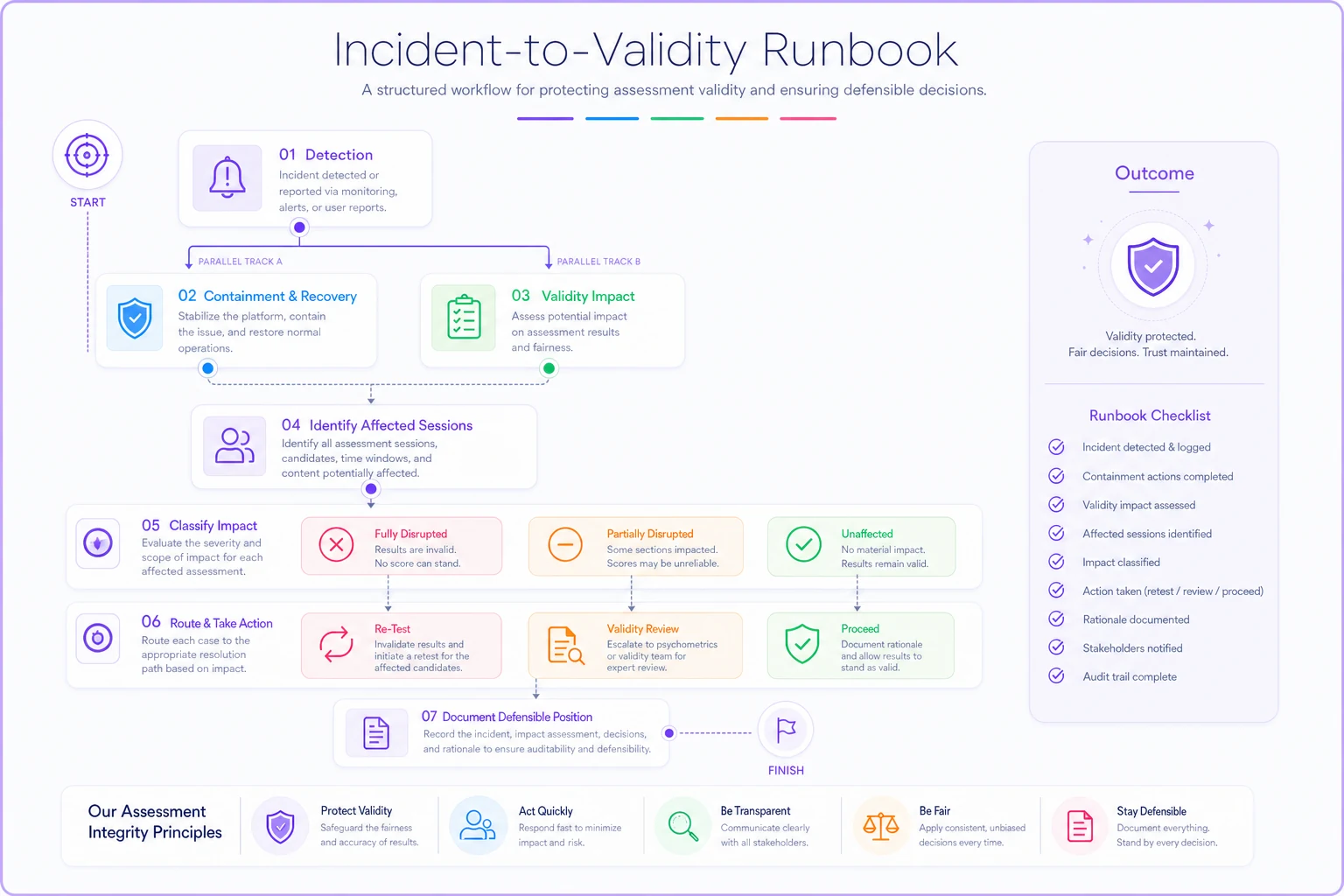
The diagram shows how the validity branch runs in parallel with recovery so you have a documented position on scores by the time the system is back.
In practice, an availability incident fires during a live window. The first branch handles containment and recovery. In parallel, the second branch spins up: identify affected sessions using the per-session integrity logs, classify the impact, and route each class to a predefined decision. By the time recovery is done, you already have a documented, defensible position on every score — rather than scrambling to reconstruct it weeks later when appeals arrive.
The security side has its own depth. When the incident is a content leak specifically, the containment-forensics-communication sequence has enough nuance to deserve its own treatment — the assessment incident-response runbook for when exam content leaks walks through exactly that chain, including how far back the contamination reaches and how to handle affected forms.
A real scenario: the surge that almost invalidated a quarter
A mid-sized financial services firm ran a competency assessment for a seasonal expansion — roughly 1,100 candidates compressed into a two-week window because req approvals all cleared at once. They'd used the platform for two years without issue, so nobody load-tested the surge shape.
On day three, invitations went out to around 400 candidates in a single batch at the start of business. The simultaneous logins — authentication plus proctoring handshake plus item-bank load — pushed p99 latency on the first few items to several seconds for a portion of candidates on a timed section. The platform never went "down." Uptime stayed green. The SLA was met.
Appeals started within days. Candidates reported freezing on timed items. Because there was no per-session latency retention and no incident-to-impact tagging, the team couldn't initially determine which candidates were actually affected versus which were just unhappy with their result. That ambiguity is the dangerous part — without the evidence, you can't defend the clean scores or fairly remediate the affected ones.
They ended up offering re-tests to a broad group out of caution — roughly 150 candidates — because they couldn't precisely scope the real impact. The direct cost was manageable; the hit was a two-week delay in filling roles and a credibility problem with hiring managers who'd been promised fast results.
The fix for the next cycle wasn't a bigger platform. It was the system: a surge-shaped load test keyed to batch-invitation timing, retained latency logs, incident-to-session tagging, and a runbook branch that could scope affected candidates in hours. The following seasonal cycle ran larger — close to 1,400 candidates — with a single minor incident that was scoped and resolved against about 20 identifiable sessions in under a day. Same kind of event, completely different defensibility, because the evidence and the decision pathway existed before it happened.
When this level of rigor makes sense — and when it's overkill
When this actually makes sense: high-stakes decisions ride on the scores (hiring, certification, promotion, licensure), you run concentrated surges, you're in a regulated or litigation-prone environment, or the cost of a single indefensible decision is large. If an appeal can turn into a legal challenge, you need the evidence chain.
When it's a bad fit: formative, low-stakes, or practice assessments where a bad session just means someone retakes it with zero consequence. Building audit-grade observability around a self-paced knowledge check is bureaucracy for its own sake.
Who should hold off: very early-stage programs still figuring out whether their items are even valid. Resilience engineering on top of an unvalidated assessment is polishing the wrong thing first. Get your measurement fundamentals stable, then build the operational resilience around them.
Pulling it together: resilience as one connected system
The through-line in everything above is that assessment resilience isn't a security problem or an availability problem or a validity problem. It's the connective tissue between all three. The threat-to-outcome map, the assessment-specific SLOs, the surge-shaped load tests, the minimal observability set, the vendor responsibility matrix, the validity-linked runbooks — none of them work in isolation. They work because each one hands evidence or authority to the next.
The programs that stay defensible under pressure aren't the ones with the fanciest tooling. They're the ones where someone drew the lines between the pieces before the incident. When something breaks — and at scale, something always breaks — the path from "what happened" to "here's what it means for the decision and here's our evidence" is already built.
Start with the map. Name the artifacts. Assign the owners. Everything else is implementation.
Ready to revolutionize your evaluation process?
Join over 2,000 organizations using Evaloly to optimize assessments, improve learner outcomes, and make data-driven decisions.