

Most assessment programs don't fail because the tests are bad. They fail because nobody drew the line from a score to a decision, and from that decision to a number the CFO actually cares about. You can have beautifully validated instruments sitting in your stack and still watch the whole thing get defunded in a budget cycle, because when someone asked "what did this buy us," the honest answer was a shrug.
This piece is about the connective tissue. Not the psychometrics themselves — you already know validity and reliability matter — but how assessment evidence should move through the talent lifecycle and come out the other end as an investment decision or a mandate. The gap between "we have good data" and "the business acts on it" is where most programs quietly die.
The whole system, before we zoom in
Think of talent assessment as one continuous pipeline, not a collection of events. A candidate takes a screening assessment. That signal should theoretically predict something — early performance, ramp speed, retention at the 12-month mark. Then they get hired, and a different set of assessments kicks in: onboarding checks, skills gap diagnostics, maybe a certification. Later still, performance reviews and development assessments feed promotion and succession decisions.
Almost nobody closes the loop. The hiring assessment generates a prediction. Eighteen months later you have actual performance and retention data sitting in your HRIS. Almost no organization goes back and checks whether the prediction held. So the screening assessment keeps running on faith, year after year, with nobody confirming it still works for the roles you're actually hiring for now.
A simple visual helps make the pipeline obvious and where the feedback loops belong.
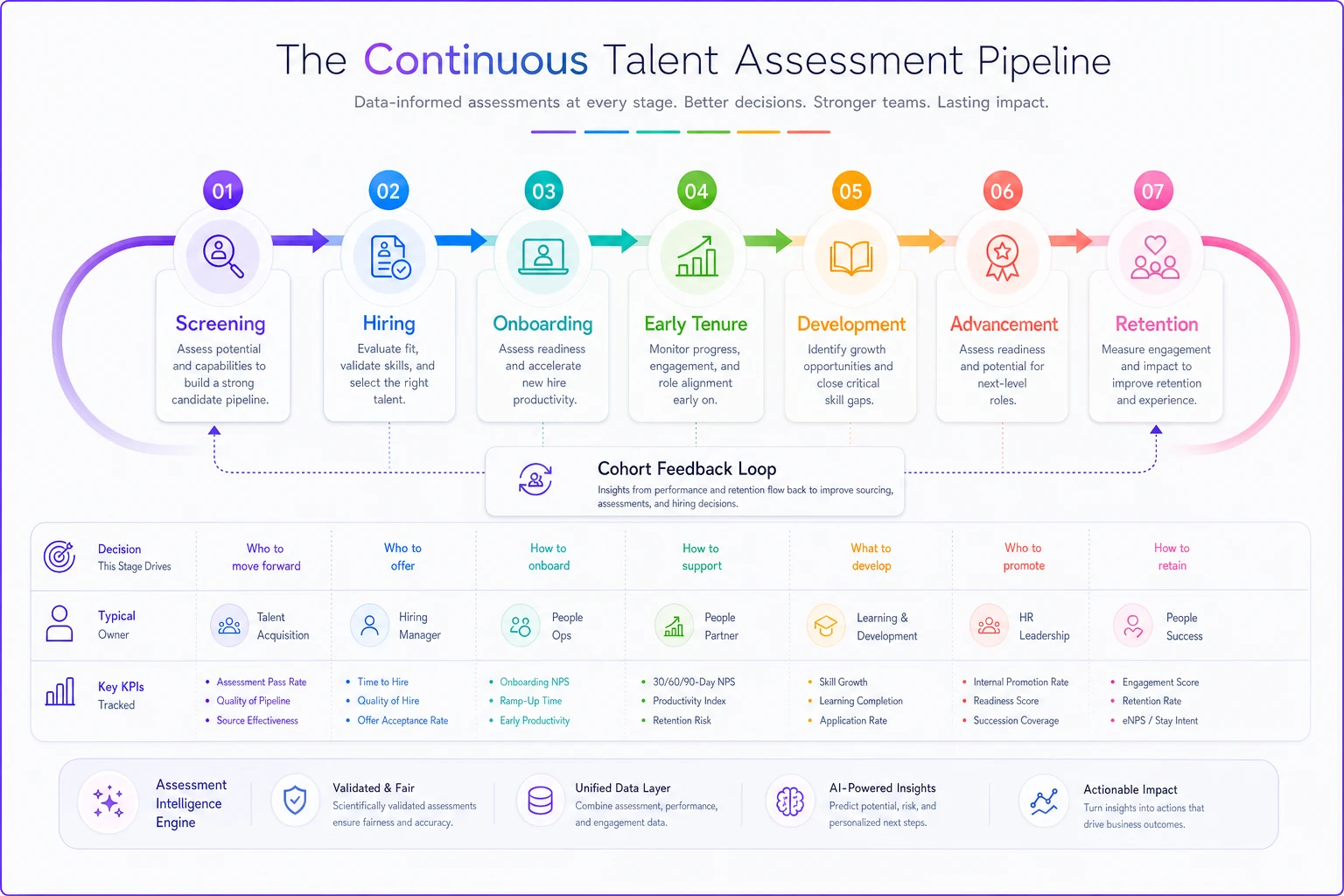
When this system is disconnected — and in most companies it is — each stage optimizes for itself. Recruiting cares about pass rates and time-to-fill. L&D cares about course completion. Managers care about their own headcount being productive. Nobody owns the through-line, so the data never adds up to a story an executive can fund.
Why this breaks across so many organizations
The usual reason is ownership. Assessment touches recruiting, L&D, people analytics, legal, and the business units, and it fully belongs to none of them. So the hiring team buys a cognitive and personality screen, L&D buys a skills platform, and a certification body runs its own thing. Three systems, three data models, three vendors, zero shared keys to join a candidate's screening result to their eventual performance rating.
Eliminate assessment bottlenecks.
Evaloly simplifies every step from test design to results analysis, making assessments faster and more reliable.
- Customizable test creation
- Automated grading and analytics
- Secure distribution and proctoring
No credit card required
The second reason is that the people who buy assessments and the people who make talent decisions aren't the same people, and they don't speak the same language. An I/O psychologist will happily explain incremental validity over base rate. A VP of Sales wants to know if the new screen means fewer bad hires in Q3. Both are reasonable. Nobody translated between them.
There's also a spending imbalance worth naming: most programs over-invest in selection assessment and under-invest in lifecycle assessment. The hiring gate gets all the scrutiny because the risk feels concentrated there. But the bigger dollar leakage is usually downstream — mis-targeted development spend, promotions that don't work out, and attrition in roles where a cheap diagnostic could have flagged the mismatch months earlier.
Mapping assessment types to the decisions they actually serve
Before you can build KPI maps, you have to be honest about what each assessment is for. An instrument that's great for development is often legally and statistically wrong for selection, and vice versa. Mixing those up is probably the most expensive mistake in the whole discipline.
| Lifecycle stage | Assessment type | Decision it should drive | Primary owner |
|---|---|---|---|
| Pre-hire | Cognitive, structured work sample, job-fit | Advance / reject, role matching | Recruiting + I/O |
| Onboarding | Skills baseline, role-readiness | Ramp plan, provisional risk flags | L&D + manager |
| Early tenure (0–12 mo) | Performance signal, 360 lite | Confirm fit, early intervention | Manager + people analytics |
| Development | Competency diagnostic, gap analysis | Where to spend training budget | L&D |
| Advancement | Leadership/readiness, scenario-based | Promotion, succession slate | HR business partner + exec |
| Retention risk | Engagement, stay-interview data | Targeted retention action | Manager + people analytics |
The column that matters most is "decision it should drive." If you can't fill that cell cleanly for an assessment you're running, that assessment is a candidate for the chopping block. There's deeper triage logic in the piece on how to prioritize your assessment portfolio for investment, sunset, and ROI, but the short version is: an assessment with no attached decision is pure cost.
The KPI chain: hiring → performance → retention
This is where the strategy earns its keep. You want a connected measurement chain where each stage's output becomes the next stage's input, and the whole thing rolls up to money.
Start at hiring. The relevant metrics aren't pass rate and time-to-fill — those are process metrics, useful operationally but invisible to a board. The outcome metrics are:
-
Quality-of-hire at 6 and 12 months (performance rating, manager satisfaction, or a composite)
-
Predictive validity holding over time — does a higher assessment score still correlate with higher early performance, this cohort?
-
Adverse impact ratios across protected groups, tracked continuously, not just at validation
Then performance. The assessment-relevant question is whether the people your instruments favored are actually performing. If your screen flags "high potential" candidates and they land in the middle of the performance distribution, your screen isn't doing what you paid for.
Then retention. This is where assessment ROI usually becomes undeniable, because turnover has a dollar figure everyone already accepts. If a job-fit assessment reduces 12-month attrition in a high-churn role from around 38% to the high 20s, and each exit costs roughly half to a full year's salary, the math writes itself. The attribution methods behind that kind of claim are covered in more detail in the work on turning learning goals into measurable ROI.
The failure mode is measuring each stage in isolation. A retention improvement means nothing to an executive if you can't attribute part of it to the assessment versus a dozen other things that changed. You need the cohort design and a credible counterfactual, or your number gets dismissed as correlation.
A real scenario
A regional healthcare system — roughly 4,000 employees, heavy on nursing and allied health roles — was running a legacy personality screen on clinical hires that nobody had revalidated in years. It passed candidates at a high rate and felt rigorous. First-year turnover in their highest-volume role sat around 34%, which in healthcare is painful but not unusual.
When they finally joined the screening data to retention outcomes, the screen had essentially zero relationship with who stayed. It was filtering nobody and predicting nothing. Meanwhile the one signal that did predict retention — a short realistic-job-preview plus a structured situational judgment check — wasn't being used for decisions at all. Just collected and ignored.
They cut the old screen, promoted the situational judgment component to an actual gate, and built a monthly loop checking 90-day and 12-month retention by cohort. Over about four quarters, first-year turnover in that role dropped into the high 20s. Not miraculous, but on a role they were hiring hundreds of people into, the avoided replacement cost ran into the low millions annually. The decisive move wasn't a fancier assessment — it was connecting the data they already had to the decision it should have been informing all along.
Governance: who owns what, and who signs off
Most governance documents are too abstract to be useful. The one that works assigns three things per assessment: a technical owner (accountable for validity, fairness, and maintenance), a decision owner (the leader who acts on the output and lives with the consequences), and an oversight function (legal/compliance and, increasingly, an AI-governance reviewer if there's any automated scoring).
A workable governance cadence:
-
Intake review — any new assessment or significant change goes through a documented review covering purpose, intended decision, validity evidence, and adverse-impact plan.
-
Quarterly data loop — technical owner reports on how predictions are holding and whether impact ratios are drifting.
-
Annual portfolio review — decision owners and finance look at the full inventory and make keep/invest/sunset calls.
-
Incident path — a defined route for appeals, scoring disputes, and fairness flags, so problems surface fast instead of festering.
The thing that wrecks governance is diffusion — everyone's vaguely responsible, so nobody actually runs the quarterly loop, and drift goes unnoticed until legal or a bad headline forces a scramble. Naming a single decision owner per assessment is the unglamorous fix that prevents most of it. Without that, even well-designed programs slide toward chaos as the organization grows.
Incentive models: get the behavior you're paying for
You can design the cleanest KPI chain in the world and still fail if the people in the pipeline are rewarded for the wrong thing. Recruiters paid on time-to-fill and headcount will treat a good assessment as friction and route around it. Managers measured only on current-quarter output will ignore development diagnostics that pay off next year.
Effective programs align incentives with the downstream metric, not the local one. Tie a portion of recruiting's recognition to quality-of-hire at 6 months, not just fill speed. Give managers credit for retention and internal mobility on their teams, so the development data stops looking like extra homework. It doesn't have to be a heavy comp redesign — even making the downstream numbers visible on the same dashboard as the local ones changes behavior, because people optimize what they're watched on.
The moment you start publishing quality-of-hire by hiring manager and by requisition, the conversations about assessment change entirely. It stops being "the test slows me down" and becomes "which sources and screens give me people who stick." That reframing is worth more than most policy memos.
The change-management side nobody budgets for
New assessment strategy fails operationally far more often than it fails technically. The instruments work; the rollout doesn't. Managers don't trust scores they don't understand, recruiters resent new gates, and candidates complain about length. All of that is predictable and all of it is manageable if you treat adoption as its own project rather than an afterthought.
The levers that actually move adoption:
-
Score literacy for decision-makers. A manager who understands what a score does and doesn't mean uses it well. One who doesn't either over-trusts it or ignores it.
-
Short, visible wins early. Pick one role, prove the loop, show the retention or quality number, then expand.
-
Minimal friction at the point of use. If acting on assessment data requires three systems and a spreadsheet, people won't.
There's a full operational treatment in the assessment adoption playbook for HR, L&D, and managers, and it's worth reading before any large rollout, because the sequencing of who you win over first genuinely matters.
Start with one role to prove the loop and show an early, visible win before expanding.
All of that is predictable and all of it is manageable if you treat adoption as its own project rather than an afterthought.
The executive one-pager that gets things funded
Executives don't read validity studies. They read one page, and they read it in under two minutes. The translation layer between psychometric evidence and an investment or mandate decision is a document, and most assessment teams produce the wrong one — too much method, not enough consequence.
A one-pager that works contains, roughly:
-
The decision being asked for — fund, mandate, expand, or sunset — stated in the first line.
-
The business metric at stake — turnover cost, quality-of-hire, time-to-productivity — in dollars or percentages, not jargon.
-
The evidence, compressed — "this screen predicts 12-month retention; cohorts scoring in the top band stay at materially higher rates" — with the detailed stats available on request, not on the page.
-
The fairness posture — adverse-impact status and what's being monitored, because this is the slide that prevents a legal surprise later.
-
The ask and the cost — specific number, specific decision, specific owner.
The common mistake is leading with the instrument and burying the decision. Flip it. Lead with "we want to make the situational judgment screen mandatory for clinical hires because it's associated with lower first-year turnover, here's the cost and the expected saving." The method supports the ask; it isn't the ask. If you want a fuller template for executive-facing reporting, the enterprise assessment scorecard for executive decisions and budgets breaks down the exact fields that survive a budget review.
When this level of strategy makes sense — and when it doesn't
This whole apparatus — connected KPI chains, governance cadence, executive one-pagers — is overkill for a small organization hiring a few dozen people a year. If your volume is low, the statistics won't be stable enough to support confident predictive claims anyway, and you'll spend more on the measurement than you save. For small programs, run clean, defensible assessments and revisit them occasionally. Don't build a governance machine.
Where it absolutely makes sense: high-volume roles, high-turnover roles, regulated hiring, and anywhere the cost of a bad talent decision is large and repeated. A call center hiring hundreds a quarter, a hospital system, a retailer scaling fast — those are the environments where the loop pays for itself many times over.
Who should not do this: anyone treating assessment as a compliance checkbox with no intention of acting on the data. If the organization won't actually make decisions differently based on what the assessments show, building the full strategy just creates documentation nobody uses and risk nobody manages. Better to run a minimal, defensible program and be honest about it.
What changes as you scale
At small scale, one smart person holds the whole picture in their head. At a few hundred hires a year, that stops working — the data model fragments, vendors multiply, and the loop breaks because no single person can track it manually. This is the inflection point where most programs either formalize or collapse.
The scaling failures cluster in predictable places: data that can't be joined across systems, assessments that were never revalidated as roles evolved, adverse-impact drift that goes unnoticed because nobody's watching continuously, and a growing pile of instruments no one can justify. Each is survivable alone. Together, at scale, they produce a program that's expensive, legally exposed, and unable to prove its own worth — which is exactly the program that gets cut in the next downturn.
The organizations that navigate this well do one unglamorous thing consistently: they keep the chain connected. Every assessment has a named decision, a named owner, a downstream metric, and a quarterly check on whether it still works. Everything else — the tooling, the dashboards, the one-pagers — is in service of keeping that loop intact as the numbers get too big to hold in one head. That discipline is genuinely rare, and it's what separates programs that survive budget scrutiny from ones that don't.
Bringing it together
A real assessment strategy for talent outcomes isn't a better test. It's a system where screening predictions get checked against actual performance and retention, where every instrument points at a decision someone owns, where incentives reward the downstream result instead of the local one, and where the evidence gets translated into a one-page ask an executive can fund or mandate.
Get that system connected and the budget conversation changes permanently. Instead of defending assessment as a cost center every cycle, you walk in with a number: this is what better hiring and smarter development saved us, here's the evidence, here's what we want to do next. That's the whole game — turning psychometric work into a sentence a CFO repeats in the next planning meeting.
Get that system connected and the budget conversation changes permanently. Instead of defending assessment as a cost center every cycle, you walk in with a number: this is what better hiring and smarter development saved us, here's the evidence, here's what we want to do next. That's the whole game — turning psychometric work into a sentence a CFO repeats in the next planning meeting.
Ready to revolutionize your evaluation process?
Join over 2,000 organizations using Evaloly to optimize assessments, improve learner outcomes, and make data-driven decisions.