

Most assessment programs don't fail because the measurement science is wrong. They fail because the money moves in one direction while the capability moves in another. A VP approves a six-figure platform contract in Q1, the CoE staffs up in Q2, procurement signs a proctoring vendor in Q3, and by Q4 nobody can explain what the organization can do now that it couldn't do before. The spend happened. The capability didn't follow.
What breaks is the connective tissue. Portfolio prioritization lives in a spreadsheet owned by L&D. Procurement runs its own scoring on a different set of criteria. The CoE has a maturity roadmap that was written before either of those two processes existed. Three functions, three timelines, three definitions of "done." When the budget conversation hits the leadership table, there's no single artifact that says: if we spend this much, we move from here to here, and here's how we'll know.
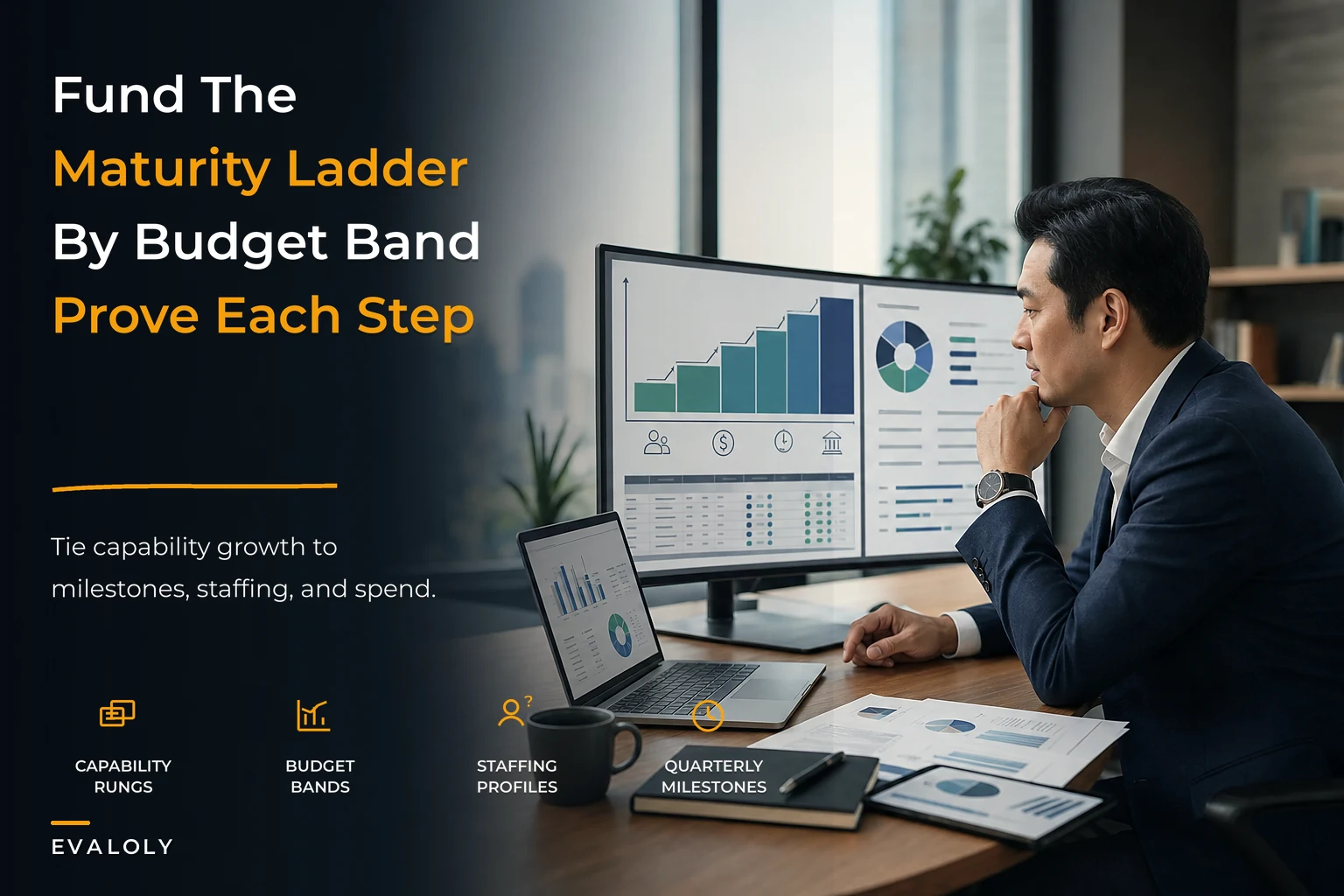
That's what a maturity ladder with budget bands is supposed to fix. Not a generic five-level pyramid you've seen in a hundred decks — an actual ladder where each rung maps to a spend range, a set of milestone KPIs, and a decision matrix that tells you whether to climb, hold, or stop.
Why three functions drift apart
The drift isn't a personality problem. It's structural. Each function optimizes for a different thing, and nobody owns the seam between them.
Portfolio prioritization optimizes for where to put effort. If you've worked through a decision rubric for investment, sunset, and ROI, you know it answers "which assessments deserve more money and which should die." Good question. But it answers it in terms of individual assets, not organizational capability. You can prioritize perfectly and still have no equating function, no analytics observability, no governance layer.
Procurement optimizes for vendor risk and cost. It wants defensible scoring, clean contract terms, and a shortlist. It doesn't naturally ask "does buying this platform move us up a maturity rung, or does it just replace a tool we already had?" Plenty of programs buy a shiny new platform and land exactly where they started, one license fee poorer.
The CoE optimizes for services and staffing. The 12–24 month roadmap most teams build when they stand up an assessment Center of Excellence is usually sound on its own. The problem is it assumes money and tooling will show up when needed. They rarely show up in the right order.
So you get the classic misfire: the CoE roadmap calls for an adaptive-testing capability in month 14, procurement bought a platform in month 3 that can't support it, and the portfolio process never flagged adaptive testing as a priority because no single assessment justified it. Everyone did their job. The system still produced waste.
What a real maturity ladder looks like
Forget the pyramid. Think of it as rungs, where each rung is defined by what the organization can reliably do in production — not what it owns, not what it piloted once.
Eliminate assessment bottlenecks.
Evaloly simplifies every step from test design to results analysis, making assessments faster and more reliable.
- Customizable test creation
- Automated grading and analytics
- Secure distribution and proctoring
No credit card required
A workable ladder for most enterprise programs has four bands. The names matter less than the capability thresholds attached to each.
| Band | Core capability state | Typical annual spend band | What triggers the climb |
|---|---|---|---|
| Foundational | Assessments run, scores report, basic security holds. No shared data model, minimal governance. | ~$40k–$120k | Repeated quality incidents or audit pressure |
| Standardized | Shared item bank, consistent metadata, documented item-writing SOPs, basic analytics. | ~$120k–$350k | Need for cross-cohort comparability |
| Measured | Equating, observability in production, defensible appeals, cohort-level impact tracking. | ~$350k–$800k | Executive demand for outcome attribution |
| Optimized | Adaptive/competency-based delivery, automated quality monitoring, full governance, commercialization-ready. | ~$800k+ | Scale, external certification, or revenue goals |
The spend bands are deliberately wide because they shift with headcount, volume, and whether you build or buy. A 2,000-candidate internal certification program sits lower on cost than a 200,000-candidate public one at the same capability rung. The point isn't the exact dollar figure. The point is that every dollar of incremental spend should be attached to a rung transition, not a line item.
The rule that keeps this honest: you do not fund a capability until you can name the KPI that proves you reached it. If someone asks for budget to "improve analytics" and can't tell you what metric moves from what to what, that request belongs in the Standardized conversation, not the Measured one.
Milestone KPIs that actually prove a rung transition
The weakest part of most roadmaps is the success criteria. "Implement equating" is not a milestone. "Two parallel forms show equated score differences within tolerance across three consecutive cohorts" is a milestone. The first is an activity. The second is a capability you can defend.
A few examples of KPIs tied to each band:
-
Foundational → Standardized percentage of active items carrying complete required metadata (target something like 90%+); number of documented, followed item-writing SOPs; time to locate any item in the bank dropping from hours to minutes.
-
Standardized → Measured forms successfully equated per cycle; appeals resolved within SLA with evidence packages attached; percentage of production assessments under active observability with alerting.
-
Measured → Optimized adaptive routing reducing test length by a meaningful margin without accuracy loss; automated flags catching item drift before it affects a live cohort; cohort impact reports that executives actually cite in staffing decisions.
None of these are vanity metrics. Each one is something a skeptical CFO or auditor could ask you to demonstrate. When the KPI is demonstrable, the spend becomes defensible. This is the same logic behind a good executive assessment scorecard — leadership funds things they can see move.
The decision matrix: climb, hold, or stop
The ladder tells you where you are. The matrix tells you what to do with the next chunk of money. This is where portfolio, procurement, and the CoE finally share one artifact.
For each proposed investment, score it on three axes:
-
Does it enable a rung transition, or does it maintain the current rung? Maintenance spend is fine, but it should be labeled as maintenance, not growth. A lot of budget gets approved as "progress" when it's really keeping the lights on.
-
Is the enabling layer below it already in place? You cannot buy adaptive testing before you have clean metadata. You cannot do cohort attribution before you have consistent data capture. Spend that skips a rung almost always gets written off.
-
Does the KPI for this transition already have an owner and a measurement method? No owner, no funding. This single gate kills more wasted spend than any vendor negotiation.
Here's how it plays out in practice. Suppose procurement wants to sign a premium proctoring vendor at the Foundational band. Run the matrix. Does invasive proctoring enable a rung transition? Usually not — it's a maintenance and risk line. Is the layer below in place? Often the program hasn't even stabilized its item bank. Does a KPI owner exist? Rarely. The matrix says hold. That one disciplined "hold" can save a program a recurring six-figure contract it didn't need yet.
A short process for building the ladder
You can draft the first version in a couple of focused working sessions. The sequence matters more than the polish.
-
Inventory current capability (not tools)
-
Place each capability on a rung
-
Attach existing spend to each rung
-
Define the KPI for each rung transition
-
Assign owners across portfolio / procurement / CoE
-
Set quarterly review cadence
Here's a simple visual of that sequence.
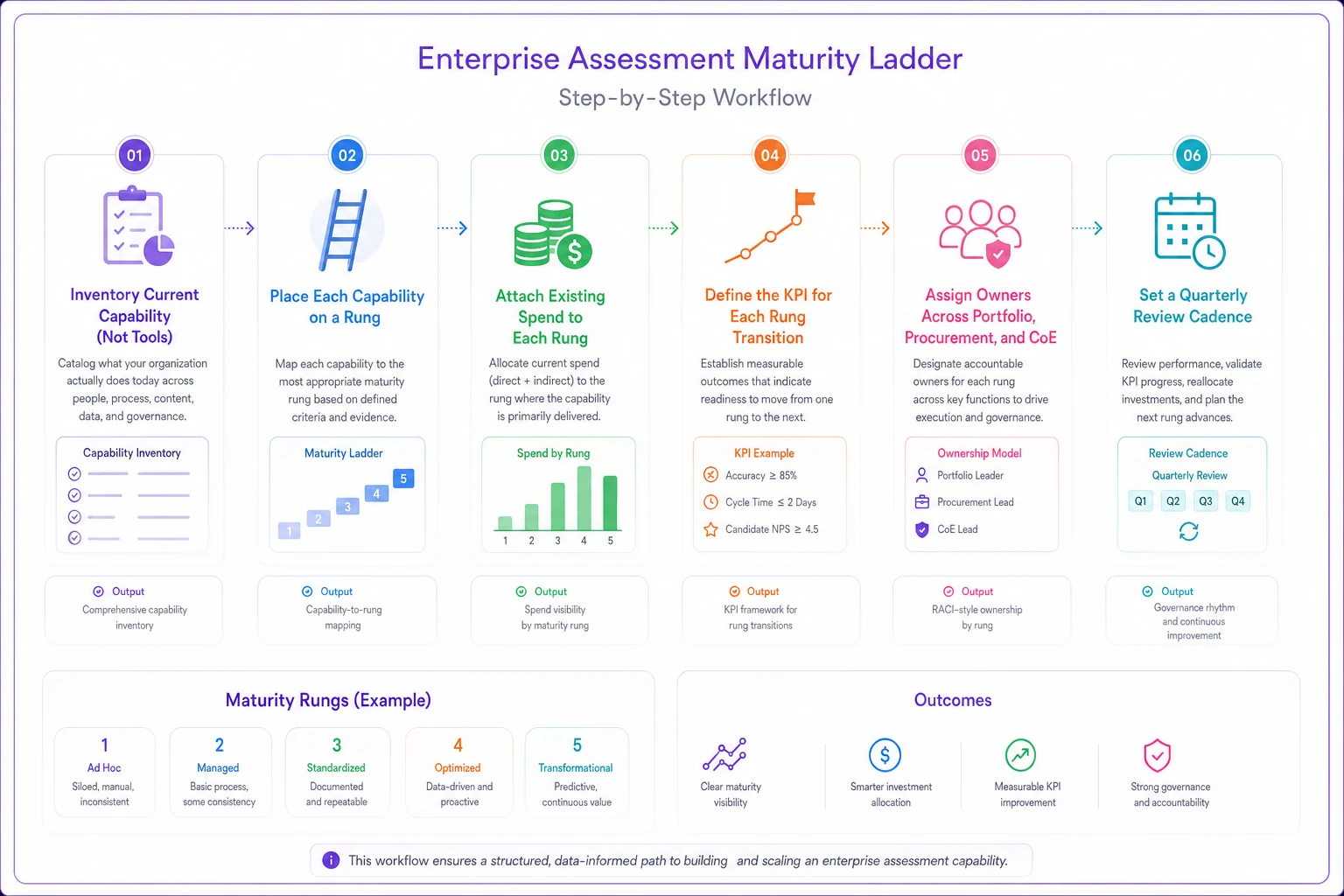
Simple on paper, politically hard in practice — because it forces three functions to agree on one definition of progress.
A realistic scenario
A mid-sized professional-certification body — roughly 18,000 candidates a year across a handful of credentials — had been spending somewhere around $280k–$320k annually on assessment tooling and vendors. On paper they looked like a Measured-band program. When they actually inventoried capability, they were sitting at Standardized with a few isolated Measured features bolted on.
The gap: they'd bought an expensive platform with equating features nobody had configured, while their appeals process still ran on email threads with no evidence packages. Money had gone to the top of the ladder while a lower rung stayed broken.
Running the matrix changed the next year's plan. They paused a planned adaptive-testing initiative — wrong rung, no enabling layer, no KPI owner. That budget went toward finishing the appeals workflow and getting observability live on their two highest-volume exams. Spend stayed roughly flat. But by the following review cycle they could actually demonstrate the Measured-band KPIs: appeals resolved within SLA with evidence attached, production exams under monitoring with drift alerts firing before cohorts were affected.
Same money, real rung transition, defensible story for the board. The quieter win was coordination. For the first time, procurement wasn't signing anything the CoE hadn't mapped to a target rung, and the portfolio team stopped championing initiatives that skipped enabling layers.
When this framework makes sense — and when it doesn't
When it's worth it: multi-function programs where portfolio, procurement, and a CoE (or proto-CoE) all touch the budget. If you have more than one team fighting over the same assessment dollars, the ladder pays for itself in killed redundant spend alone.
When it's overkill: a single team running a handful of assessments with one tool and one budget line. You don't need a four-band ladder to manage one rung. A lightweight portfolio rubric is plenty.
Who should NOT build this yet: programs that haven't stabilized basic production — scores reporting reliably, security holding, items retrievable. If you're still firefighting at the Foundational band, a full maturity ladder becomes a planning distraction. Stabilize first, ladder second.
Where tooling quietly helps
The part that breaks down manually is the measurement. You can define clean KPIs, but if proving "90% metadata completeness" or "forms equated within tolerance across three cohorts" requires someone to hand-build a spreadsheet every quarter, the review cadence dies within two cycles. The matrix only stays honest when the KPIs are observable on demand.
This is where an assessment platform with real observability, consistent metadata enforcement, and built-in analytics earns its place — not because it climbs the ladder for you, but because it makes each rung verifiable without a manual archaeology project every quarter. Automated metadata checks, drift alerts, and appeal evidence trails turn your milestone KPIs from aspirational statements into dashboards. The spend-to-capability link holds because the capability is measured continuously, not reconstructed under deadline.
Pulling it together
The reason assessment budgets feel opaque at the leadership table isn't a lack of spending discipline. It's the absence of a shared artifact that connects money to capability. Portfolio decisions, procurement scoring, and the CoE roadmap are each reasonable in isolation and incoherent together.
A maturity ladder with budget bands, milestone KPIs, and a climb-hold-stop matrix gives all three functions one language. It forces every dollar to answer a single question: what can the organization do after this spend that it couldn't do before, and how will we prove it?
Programs that can answer that question keep their budgets. Programs that can't spend just as much and wonder, two years later, why they're still on the same rung.
Ready to revolutionize your evaluation process?
Join over 2,000 organizations using Evaloly to optimize assessments, improve learner outcomes, and make data-driven decisions.