

Most enterprise assessment programs don't collapse because someone wrote a bad question. They collapse because five different systems each believe they own the "truth" about a candidate, a score, or a form version — and none of them agree.
That's the real problem this blueprint is about. Not psychometrics. Not item quality. The plumbing. The way assessment data flows (or doesn't) between your item authoring tool, your delivery platform, your HRIS or SIS, your analytics warehouse, and whatever spreadsheet a program manager is quietly using to reconcile everything at 11pm before a board report.
If you're an exec funding this or an architect designing it, you're not deciding whether to buy an assessment tool. You're deciding how to stitch together a system of record for assessment that survives reorgs, vendor swaps, compliance audits, and 5x growth in volume. This post lays out how those pieces connect, where they break as you scale, and a phased migration path that doesn't require a two-year big-bang rewrite.
The core issue: everyone owns a fragment, nobody owns the entity
Walk into any mid-to-large assessment operation and ask a simple question: "What's the authoritative record of a candidate's score on Form B of the Compliance exam, and where does it live?"
You'll usually get three answers. The delivery vendor has one. The LMS has a synced copy that's a day stale. Someone in analytics exported a CSV last quarter that's now the "clean" version everyone cites. All three drift apart over time. The root cause is that assessment programs grow by addition, not design. You buy a proctoring tool because you need remote delivery. You add an LMS connector because L&D asked. You bolt on a BI dashboard because an exec wanted a chart. Each addition solves a local problem and quietly creates a new source of truth. Nobody sits down and defines the canonical entities — the small set of objects the whole enterprise actually agrees on.
-
Item — the reusable unit of measurement, with its metadata, statistics, and version history
-
Form — a specific assembled set of items delivered as a coherent test
-
Candidate — the person (or their pseudonymous ID) taking the assessment
-
Event — a specific administration
this candidate, this form, this window, this context
-
Score — the outcome derived from an event, including sub-scores and derived decisions
Everything else — sittings, responses, accommodations, rubric decisions, audit logs — hangs off those five. When an organization can't cleanly name which system owns each of these and how they relate, every downstream report becomes an act of negotiation.
How the entities actually relate (the ER model in plain terms)
Before any migration plan, you need a shared picture of how these objects connect. Here's the relational backbone, described as an architect would sketch it on a whiteboard:
Eliminate assessment bottlenecks.
Evaloly simplifies every step from test design to results analysis, making assessments faster and more reliable.
- Customizable test creation
- Automated grading and analytics
- Secure distribution and proctoring
No credit card required
CANDIDATE ──< EVENT >── FORM ──< FORMITEM >── ITEM │ │ └──< SCORE └──< ITEMVERSION │ │ └── DECISION └── ITEM_STATISTIC
Reading it out:
-
A Candidate has many Events (a person can take multiple assessments over time).
-
Each Event references exactly one Form (the version delivered at that moment).
-
A Form is composed of many Items through a join —
FORM_ITEM— that captures position, weighting, and section. -
Each Item has many Item Versions, and statistics attach to a version, not the abstract item. This is the detail most systems get wrong.
-
Each Event produces one or more Scores, and scores may roll up into a Decision (pass/fail, band, hire recommendation).
The single most common modeling mistake: treating an item as a flat, mutable record. When you edit an item's stem and don't version it, every historical score that depended on the old wording becomes silently uninterpretable. Your cohort comparisons break and you won't know why for months.
The second most common mistake: binding SCORE directly to ITEM instead of to FORM_ITEM within an EVENT. Scores are contextual. The same item can behave differently in a high-stakes certification form versus a low-stakes practice quiz. If your data model can't express "this response, on this item version, in this form, during this event," your analytics team will spend most of its time rebuilding context that should have been captured at write time.
If you haven't already nailed down the vocabulary underneath all this, the naming and relationships get much easier once you've settled on a shared taxonomy first — which is exactly why competency and tagging structure work, like the approach in competency-based question banks for role-based skill mapping, pays off before you start migrating anything.
What breaks at scale (and roughly when)
The interesting thing about assessment architecture is that the failure points are predictable by volume. Different things break at different scale thresholds. Here's the pattern most enterprises follow.
| Scale stage | Approx. annual events | What usually breaks first | Root cause |
|---|---|---|---|
| Early | under ~10k | Nothing obvious; spreadsheets still work | Manual reconciliation is cheap at low volume |
| Growing | ~10k–100k | Score reconciliation, stale LMS sync | Multiple sources of truth diverge faster than humans can patch |
| Scaling | ~100k–500k | Form versioning, item reuse tracking | No canonical item versioning; forms overlap unknowingly |
| Enterprise | 500k+ | Governance, audit, cross-system identity | Candidate identity fragmented across HRIS/SIS/vendor IDs |
At the early stage, honestly, don't over-engineer. A team running under ten thousand events a year and reconciling by hand is fine. Building a canonical warehouse for that volume is a waste of budget.
The pain starts in the growing phase. A typical example: an L&D team scales from three exams to about forty, delivery volume jumps to somewhere north of 40k events a year, and suddenly the quarterly compliance report takes two full weeks to produce because someone has to manually match candidate records across the HRIS and the delivery vendor. The candidates exist in both systems — but with different IDs, different email formats, and no shared key. That identity-resolution gap is the tax you pay for never defining a canonical Candidate.
By the scaling phase, the item bank itself becomes the bottleneck. Without version-aware tracking, item writers unknowingly reuse content across forms, exposure climbs, and equating assumptions quietly fall apart. Nobody notices until pass rates shift and an exec asks why.
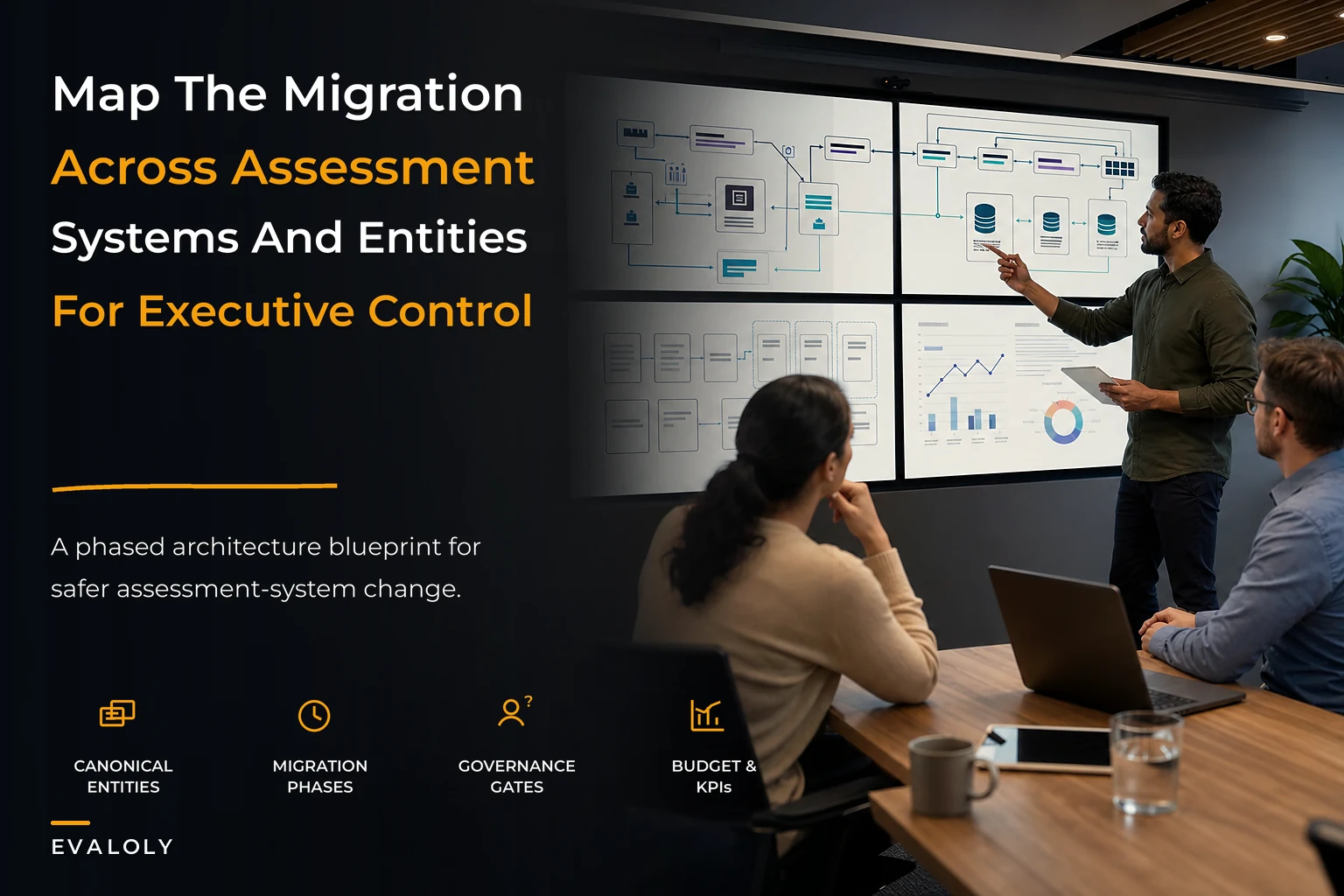
The phased migration plan (no big-bang rewrites)
The instinct at the enterprise level is to fund one large program to "fix assessment data." That almost always overruns and under-delivers, because assessment systems are load-bearing — you can't take them offline for a rebuild. The better pattern is a strangler approach: stand up the canonical layer alongside the existing systems, migrate flows one at a time, and only decommission old sources of truth once the new one is proven.
-
Define the canonical entities and identity strategy. Before touching data, agree on the five entities, their keys, and — critically — how you resolve Candidate identity across systems. This is a governance decision, not a technical one. It usually takes longer than teams expect because it forces HR, L&D, and IT to agree on who a "candidate" even is.
-
Stand up a read-only canonical store. Ingest from existing systems into a warehouse that becomes the single reporting truth. Don't let anything write to it yet. This alone kills the "which CSV is correct" problem and gives you an immediate win: one place executives can trust for numbers.
-
Migrate scoring and reporting off source systems. Point dashboards and compliance reports at the canonical store instead of vendor exports. The reconciliation labor drops sharply, and you've created leverage to justify the rest.
-
Introduce item and form versioning as the system of record. Move authoring and assembly so that every item version and form composition is captured canonically. This is the heaviest lift and where most of the budget goes.
-
Wire integrations through the canonical layer, not point-to-point. Replace the tangle of direct connectors (delivery→LMS, delivery→BI, HRIS→delivery) with a hub model. Every new system integrates once, to the canonical layer, instead of N times to every other system.
-
Decommission redundant sources of truth. Only after each flow is proven do you retire the old spreadsheet, the stale sync, the shadow export. This is the step teams skip — and skipping it means you now maintain both systems forever.
Each phase should ship value on its own. If phase two doesn't reduce reporting effort before phase three starts, stop and figure out why. The whole point of phasing is that you can pause without stranding the organization mid-rewrite.
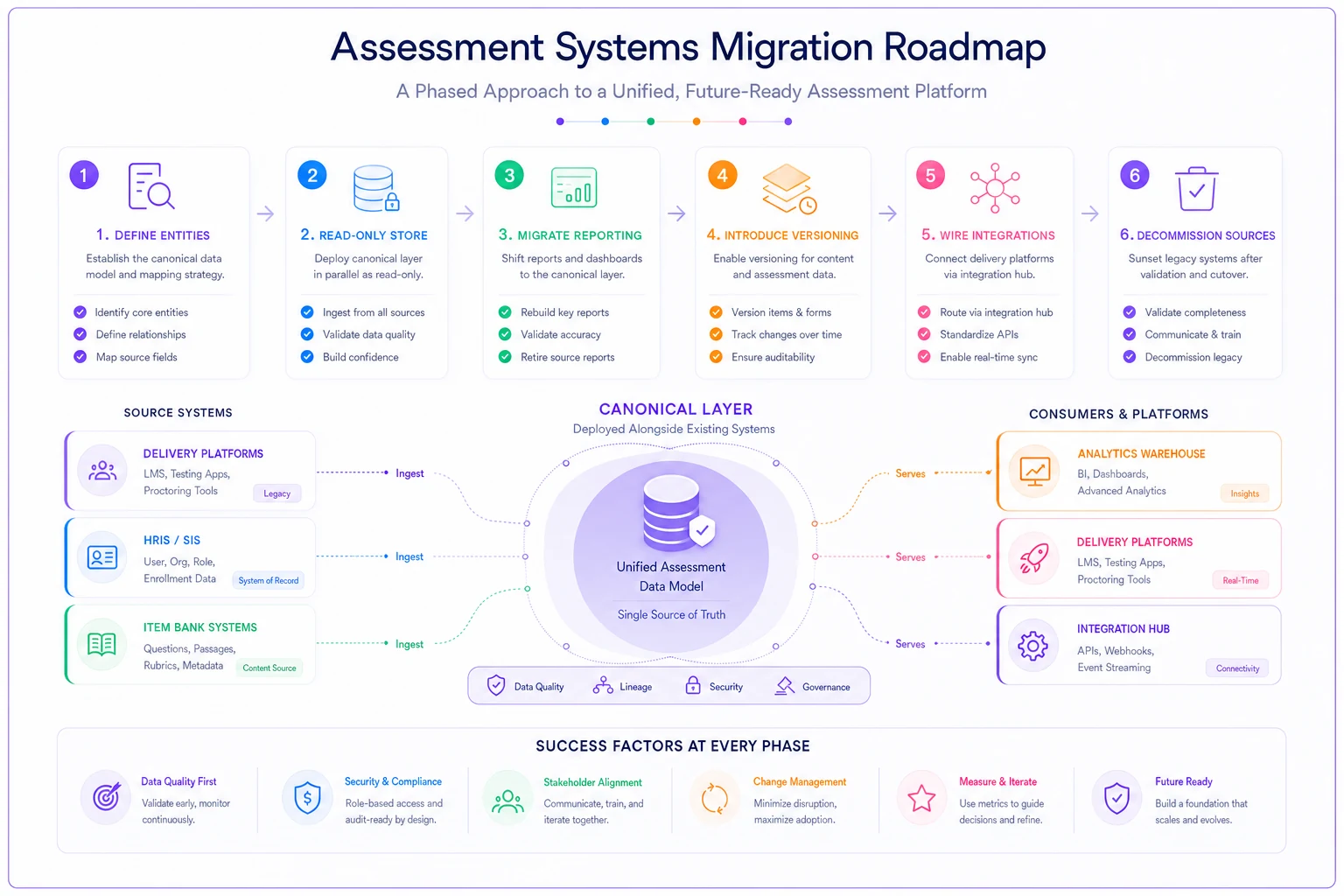
Here’s a simple workflow diagram of the phased migration.
Governance gates: where architects earn their keep
Phased migrations fail quietly when there's no gate between phases — teams just keep moving and the "read-only" store starts getting written to by three teams who each found a workaround. Governance gates are the checkpoints that stop that drift.
A workable set of gates:
-
Gate 1 — Entity definitions signed off. No ingestion begins until HR, L&D, IT, and compliance agree on the canonical entities and identity keys in writing.
-
Gate 2 — Reconciliation parity proven. The canonical store must match source-system numbers within an agreed tolerance for a full reporting cycle before it becomes authoritative.
-
Gate 3 — Versioning integrity check. Before item/form migration, confirm that no historical score loses its item-version context. If you can't trace a past score to the exact item version delivered, you're not ready.
-
Gate 4 — Integration cutover review. Each point-to-point connector retired only after the hub route runs in parallel and matches for a defined period.
-
Gate 5 — Decommission approval. A source of truth is retired only with explicit sign-off that nothing downstream still depends on it.
These gates are also where privacy and lifecycle rules get enforced rather than assumed. Retention windows, access controls, and deletion obligations all live at the entity level, and they're far easier to enforce in a canonical model than scattered across vendors. The operational side of that — who can see what, how long records live, how deletion propagates — is its own discipline worth treating seriously. The assessment data governance and lifecycle playbook covers how those controls actually run day to day.
KPIs that tell you the architecture is working
Executives don't want to hear about ER diagrams. They want to know if the money is buying results. The right KPIs measure the health of the system, not the activity of the teams.
-
Reconciliation effort per reporting cycle — hours spent manually matching records. Should trend toward zero after phase three.
-
Time-to-report — days from period close to a trustworthy compliance or impact report.
-
Identity match rate — percentage of candidates automatically resolved across systems without manual intervention.
-
Item version traceability — percentage of scores that can be traced to the exact item version delivered.
-
Integration surface area — number of point-to-point connectors still live. Fewer is healthier.
-
Data incident rate — how often a report has to be retracted or corrected.
A realistic target: a growing-stage program that once spent close to two weeks per quarter on reconciliation should get that down to a couple of days after phases two and three. If the number isn't moving, the architecture isn't landing — and that's a signal to pause, not to fund the next phase.
A real scenario: certification body, mid-migration
A professional certification organization was running roughly 120k exam events a year across about sixty forms. Delivery was outsourced to a vendor, credentials lived in a separate registry, and analytics ran off quarterly CSV exports.
The visible symptom was the audit. Every year, proving that a given candidate took a specific form version and earned a specific score took the team weeks of manual cross-referencing, because the vendor's item IDs didn't match the internal item bank's IDs, and forms had been edited in place without versioning. In one cycle, they found about a dozen scores they simply couldn't defend with confidence — the item wording had changed and no one could reconstruct what the candidate actually saw.
They ran the phased approach. Phases one and two — defining entities and standing up a read-only canonical store — took roughly a quarter. The immediate payoff was reporting: audit prep dropped from several weeks to a handful of days once every score resolved to a single authoritative record with traceable form composition. Item versioning (phase four) took the better part of a year and was the expensive part, but it eliminated the "we can't reconstruct this score" problem entirely.
The outcome wasn't a flashy revenue number — it rarely is with infrastructure. It was defensibility. When the next audit came, the team could trace any score to its exact item versions in minutes, and the annual scramble simply stopped being a line item on anyone's stress list.
Budget drivers: where the money actually goes
The number that surprises executives is that the platforms are rarely the biggest cost. Licenses are visible and easy to negotiate. The real drivers are less obvious.
-
Identity resolution. Reconciling candidates across systems with no shared key is genuinely hard and often needs custom matching logic. This is frequently the largest hidden line item.
-
Item versioning migration. Backfilling version history onto a legacy item bank is labor-intensive and can't be fully automated because human judgment is needed for ambiguous edits.
-
Integration rework. Moving from point-to-point connectors to a hub model means rebuilding integrations you already "have."
-
Parallel-running costs. During cutover, you pay for both old and new systems simultaneously. Underbudgeting this is the classic mistake — teams plan for the destination but not the transition.
-
Governance overhead. The gates, sign-offs, and cross-functional alignment take real time from senior people.
When you evaluate platforms to sit inside this architecture, the selection criteria change. You're not buying features in isolation — you're buying how well something plays in a hub model, exposes clean APIs, and respects your canonical entities. The evaluation lens in this procurement checklist for surge-ready assessment platforms maps closely to what an architect should be scoring here: connectors, access control, and grading pipelines that don't force you into yet another silo.
When this blueprint makes sense — and when it doesn't
When it makes sense:
-
You're past ~50k events a year and reconciliation is already painful.
-
You have multiple assessment systems that don't agree on candidate or score data.
-
Compliance or audit exposure makes defensibility non-negotiable.
-
You're anticipating a merger, reorg, or vendor swap that will scramble your data anyway.
When it's a bad idea:
-
You're under ~10k events and manual reconciliation still works. Building this now is premature optimization.
-
You're mid-vendor-selection and haven't stabilized which platforms you'll keep. Migrate onto a moving target and you'll do it twice.
-
You don't have executive sponsorship for the governance gates. Without authority to enforce the gates, the canonical layer becomes just another source of truth in the pile.
Who should NOT lead this: a single team acting alone. If L&D builds this without HR and IT, or IT builds it without the assessment experts, you get a technically clean model that doesn't match how assessments actually work — or a psychometrically sound model that no engineer can maintain. The whole premise is cross-functional. That's not a nice-to-have; it's the load-bearing requirement.
Sequencing this against your portfolio decisions
This architecture work shouldn't happen in a vacuum from your portfolio strategy. There's no point building canonical versioning for an assessment you're about to sunset, and there's real urgency to fix the data plumbing for the exams driving your highest-stakes decisions. Deciding which assessments deserve the investment first is its own exercise — and the logic in prioritizing your assessment portfolio pairs naturally with the phased plan here. Migrate your keepers into the canonical model first; let the ones you're retiring stay on the old plumbing until they age out.
The organizations that get this right treat assessment architecture as a system, not a purchase. They name the five entities, agree on who owns them, and migrate flow by flow with a gate between each step. The ones that struggle keep buying tools to patch symptoms and wonder why every report is still an argument. The difference isn't budget or headcount — it's whether someone drew the map before everyone started building on top of it.
The difference isn't budget or headcount — it's whether someone drew the map before everyone started building on top of it.
Ready to revolutionize your evaluation process?
Join over 2,000 organizations using Evaloly to optimize assessments, improve learner outcomes, and make data-driven decisions.